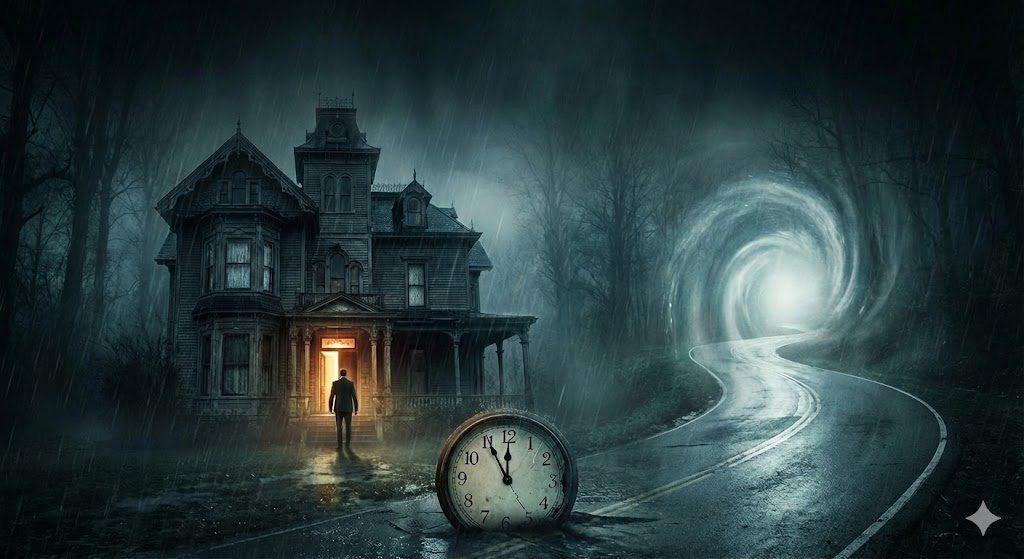
The rain didn’t just fall on the winding backroads of the Oregon coast; it hammered. It was a rhythmic, violent percussion against the roof of Elias Thorne’s Audi A8, a sound that harmonized with the frantic thumping in his chest.
Elias was a man of cold logic, a corporate litigator who had built a career on the strategic dismantling of lives. But tonight, logic had deserted him. Tonight, there was only the memory of the thud.
It had happened near Mile Marker 14. A blur of movement, a splash of yellow against the grey deluge, and then the sickening, wet crunch of bone and plastic meeting at sixty miles per hour. He hadn’t seen a face. He had only seen the reflection of his own headlights in a pair of wide, terrified eyes before the impact. He hadn’t stopped. The whiskey in his system—a celebratory toast to a closed merger—had whispered a single word: Run.
Now, the Audi’s engine groaned, steam billowing from the crumpled hood. The GPS was a frantic swirl of blue, unable to find a signal in this cathedral of ancient pines. He turned onto a gravel path, desperate to hide the car, and that’s when he saw it.
The House on No Map
It sat in a hollow where the mist pooled like milk. It was a massive, sprawling Victorian, its wood stained the color of dried blood. It shouldn’t have been there. Elias knew these roads; he’d scouted them for real estate ventures. This land was supposed to be empty.
Yet, the house breathed. Light, warm and amber, spilled from the floor-to-ceiling windows, beckoning him.
Elias abandoned the car, his expensive loafers sinking into the mud. He ran for the porch, his breath coming in ragged gasps. He didn’t knock. He threw himself against the heavy oak door, and to his surprise, it swung open with a whisper.
The foyer was silent, smelling of beeswax and something underlying—the metallic tang of old pennies. He turned to look back at the storm, but the door didn’t just close; it vanished into the wall. Where the door had been, there was now only seamless, floral wallpaper.
“Hello?” Elias called out. His voice felt thin, swallowed by the high ceilings. “I… I had an accident. My car is stalled.”
No one answered. But at the end of the hall, a door stood slightly ajar. A small, brass plaque was bolted to the wood. It read: THE NURSERY. 1989.
Room One: The Sin of Omission
Elias approached the door with a sense of magnetic dread. He was forty-five years old, but as he pushed the door open, he felt like he was seven.
The room was a perfect recreation of his childhood bedroom in suburban Connecticut. The Star Wars posters, the smell of crayons, the low hum of a humidified. And there, in the center of the rug, was the hamster cage.
Inside, Barnaby, the golden Syrian hamster, was a skeleton wrapped in mangy fur. The animal’s water bottle was bone dry. Elias remembered this week. His parents had gone away, and he’d been left with a sitter who didn’t care. Elias had promised to feed Barnaby. He hadn’t. He had watched the creature grow weak, then frantic, then still. He had felt a strange, dark power in being the god of that small cage—the power to decide when life ended by doing nothing at all.
“It was just a pet,” Elias whispered.
Suddenly, the room began to tilt. The floorboards stretched. The walls rose. Elias looked down and realized his clothes were gone, replaced by a giant, oversized pajama set. He was small. He was tiny.
He looked up and saw a shadow looming over the room. It was himself—the adult Elias—peering into the room with cold, indifferent eyes. The giant Elias reached down, but not to help. He picked up the “room” and began to shake it.
Elias was thrown against the walls. The “giant” took a pitcher of water and poured it, but instead of life-giving water, it was a torrent of dust and dry husks of grain.
“I’m sorry!” Elias screamed, choking on the grain. “I was just a kid! I didn’t know!”
The giant stopped. The room blurred. When Elias blinked, he was back in the hallway. The door behind him was gone.
Room Two: The Price of a Scholarship
The hallway had grown longer, the ceiling higher. The next door appeared, this one marked: THE LIBRARY. 2001.
Elias entered. He was in his university library. The air was thick with the scent of old paper and the frantic energy of finals week. Sitting at a mahogany table was a young man named Leo.
Leo had been Elias’s best friend. He was a brilliant kid from the Bronx, attending on a full-ride scholarship. Elias, the son of a partner at a top firm, had struggled.
On the table sat Leo’s senior thesis—the original manuscript.
“Elias, hey,” the phantom of Leo said, looking up with a tired smile. “I’m going to grab some coffee. Watch my bag?”
Elias watched himself—the younger, hungrier version—nod. As soon as Leo left, the younger Elias took a bottle of ink from his bag and poured it over Leo’s handwritten notes, then threw the backup floppy disks into the trash.
Without that thesis, Leo lost his scholarship. He was expelled for “academic negligence” when he couldn’t reproduce the work. Elias had taken Leo’s research, paraphrased it, and won the Dean’s Award.
“He would have been fine,” Elias told the empty room. “He was smart. He could have started over.”
The library began to groan. The bookshelves started to lean inward. The books didn’t fall; they flew. Thousands of pages whipped through the air like razor blades. Elias tried to shield his face as the paper cut into his skin.
Every page that sliced him bore his own handwriting—the stolen words, the plagiarized thoughts.
“I gave him money later!” Elias yelled, though it was a lie. He had never spoken to Leo again.
The paper storm intensified, spinning into a cyclone that threatened to flay the meat from his bones. Just as he felt his consciousness fading, the room dissolved.
Room Three: The Glass Office
Elias stumbled back into the hallway, his suit tattered, his skin covered in fine, stinging lines. He was weeping now. “Let me out! I’ll go back! I’ll call the police!”
The House did not care for bargains.
The third door was glass. It was etched with the logo of his firm: THORNE & ASSOCIATES. 2018.
He stepped into his corner office. Outside the window, a digital New York City pulsed with light. Sarah, his junior associate, was standing by the window. She was pale, her eyes rimmed with red.
“Elias, the audit found the discrepancies,” she said, her voice trembling. “But I didn’t authorize those transfers. Your digital signature is all over them.”
“I know, Sarah,” the ghost of Elias said, sitting behind the desk. “Which is why it’s so tragic that I have to let you go. And why I’ve already spoken to the Bar Association.”
“You framed me,” she whispered. “You used my credentials.”
“In this world, Sarah, there are hammers and there are nails. You were always a nail.”
The office in the House began to change. The glass walls didn’t shatter; they began to melt. The floor turned into a shimmering, transparent surface. Beneath his feet, Elias saw Sarah. She wasn’t in the office. She was in a cramped, dark apartment, staring at a bottle of pills.
The floor under Elias became incredibly hot. He was standing on the glass ceiling he had forced her under. It began to crack.
“I had to survive!” Elias screamed at the floor. “It was the only way to make partner!”
The glass gave way. Elias plummeted, falling through a void of corporate memos and legal briefs, the sound of Sarah’s weeping filling his ears like a physical weight.
The Final Room: The Loop
He landed hard on cold, wet asphalt.
The smell of rain and ozone returned. He was back on the highway. 11:42 PM.
Elias stood up, his knees shaking. He looked down the road. The headlights of a car were approaching—fast. A charcoal-gray Audi.
He saw the figure in the road. A small child in a yellow raincoat, looking for a lost dog.
This is it, Elias thought. The House is showing me the end. I’m going to watch myself kill him again.
The Audi roared closer. The driver—the version of Elias who had been drinking scotch—wasn’t even looking at the road. He was fumbling with his phone.
Elias looked at the boy. The boy was frozen, blinded by the high beams.
In the previous versions of this “play,” the House had forced Elias to watch as a spectator. But this time, something was different. He wasn’t behind a glass wall. He could feel the wind of the passing car. He could feel the grit of the road under his feet.
“Run!” Elias shouted at the boy.
The boy didn’t move.
The Audi was fifty yards away. Forty. Thirty.
Elias looked at the car. He saw his own face behind the windshield—the face of a man who thought he was untouchable. He hated that face. He hated the man who had let a hamster starve, who had ruined a friend’s life, who had driven a woman to despair.
For the first time in his life, Elias Thorne didn’t think about the consequences. He didn’t think about his career or his reputation.
He ran.
He lunged across the slick asphalt, his fingers catching the rough fabric of the yellow raincoat. He tackled the boy, throwing his own body weight forward, propelling them both toward the muddy ditch.
The Audi screamed past, the side mirror clipping Elias’s shoulder with the force of a sledgehammer. He felt his collarbone shatter. He tumbled into the muck, the boy clutched tightly in his arms.
The Audi didn’t stop. It sped off into the night, its red taillights fading into the mist like the eyes of a retreating predator.
The Alternative Ending: The Breaking of the House
Elias lay in the mud, gasping for air. His shoulder was a white-hot map of pain. He looked down at the child.
The boy was shaking, but he was breathing. He looked up at Elias with wide, blue eyes. “You… you saved me.”
Elias couldn’t speak. He just nodded, tears mingling with the rain on his face.
Suddenly, the highway began to flicker. The trees didn’t look like trees anymore; they looked like the vertical lines of a television screen losing its signal. The asphalt beneath him softened, turning back into the polished wood of the House’s hallway.
He was back in the foyer. But it was different.
The walls were peeling. The amber light was flickering and dying. The House felt… wounded.
A figure stood at the far end of the hall. It was a man, tall and thin, wearing a suit that looked like it was woven from shadows. His face was a smooth, featureless mask of porcelain.
“You broke the script,” the figure said. The voice didn’t come from a mouth; it echoed inside Elias’s skull.
“He’s just a kid,” Elias wheezed, clutching his broken shoulder.
“The House is a mirror,” the figure said, stepping closer. “It reflects the soul until the soul is consumed by its own darkness. No one leaves, Elias Thorne. Because no one ever chooses to be the sacrifice in their own memory. They always try to hide. They always try to justify.”
“I’m not justifying anymore,” Elias said. He stood up, though his vision swam. “I did those things. I killed the pet. I ruined Leo. I destroyed Sarah. And tonight, I ran.”
The figure paused. “And yet, you stayed. You put yourself under the wheels.”
“Do what you’re going to do,” Elias said, closing his eyes. “But let the boy go.”
The figure let out a sound like dry leaves skittering across a grave—a laugh. “The boy was never here, Elias. The boy was you. The part of you that died a long time ago. But tonight… you brought him back.”
The House began to groan, a deep, structural sound of timber snapping. The floor beneath Elias’s feet began to dissolve into white light.
“Where am I going?” Elias asked.
“To the only place the House cannot reach,” the figure said. “The Truth.”
The Awakening
Elias Thorne opened his eyes.
The smell was the first thing he noticed. Not lavender or old paper, but the sharp, sterile scent of bleach and floor wax. The rhythmic sound wasn’t rain; it was the steady beep… beep… beep… of a heart monitor.
He tried to move, but his right arm was heavy, encased in a cast.
“He’s awake!” a voice called out.
A nurse appeared, followed by a man in a police uniform. Elias blinked, the fluorescent lights searing his retinas.
“Mr. Thorne?” the officer asked. “Do you know where you are?”
“The… the highway,” Elias croaked. “The boy.”
The officer sighed, pulling up a chair. “You’re in Mercy General. You’ve been in a coma for three days, Elias. You had a hell of a wreck. You hit a tree near Mile Marker 14.”
Elias shook his head. “No. I hit someone. A boy in a yellow raincoat.”
The officer looked at the nurse, then back at Elias. “Mr. Thorne, there was no boy. We searched the area. There were no tracks, no blood other than yours. But… something strange did happen.”
Elias held his breath.
“About an hour after your crash, a witness called in. They said they saw a man matching your description—or someone who looked like you—standing in the middle of the road, waving his arms to warn people about a washed-out bridge a mile ahead. If that man hadn’t been there, a school bus full of kids would have driven right off the cliff.”
Elias stared at the ceiling.
“The weird thing is,” the officer continued, “the witness said the man looked like he’d been through a war. Covered in cuts, tattered suit. And when they stopped to help him, he just… walked into the woods. Toward an old ruin of a house that burnt down in the twenties.”
Elias looked at his left hand. On his palm, there was a faint, red mark—the shape of a small, golden hamster. And on his forearm, a series of thin, white scars that looked exactly like the edges of paper.
He wasn’t the man he had been. The House had taken that man and stripped him away, layer by layer, until only the core remained.
“Mr. Thorne?” the nurse asked. “Are you okay?”
Elias looked at his reflection in the darkened window of the hospital room. For the first time in twenty years, he didn’t look away.
“I have a lot of phone calls to make,” Elias said quietly. “I have to find a man named Leo. And a woman named Sarah.”
He looked back at the officer. “And then, I’d like to confess to a hit-and-run. Even if you didn’t find the body… I know what I did.”
Outside the hospital, far away in the rain-soaked woods of the coast, a patch of blackened grass sat empty. The House was gone, moved on to a different road, a different sinner. But for the first time in its long, dark history, a room stood empty—the door torn off its hinges, leaving nothing but the light of a new day.