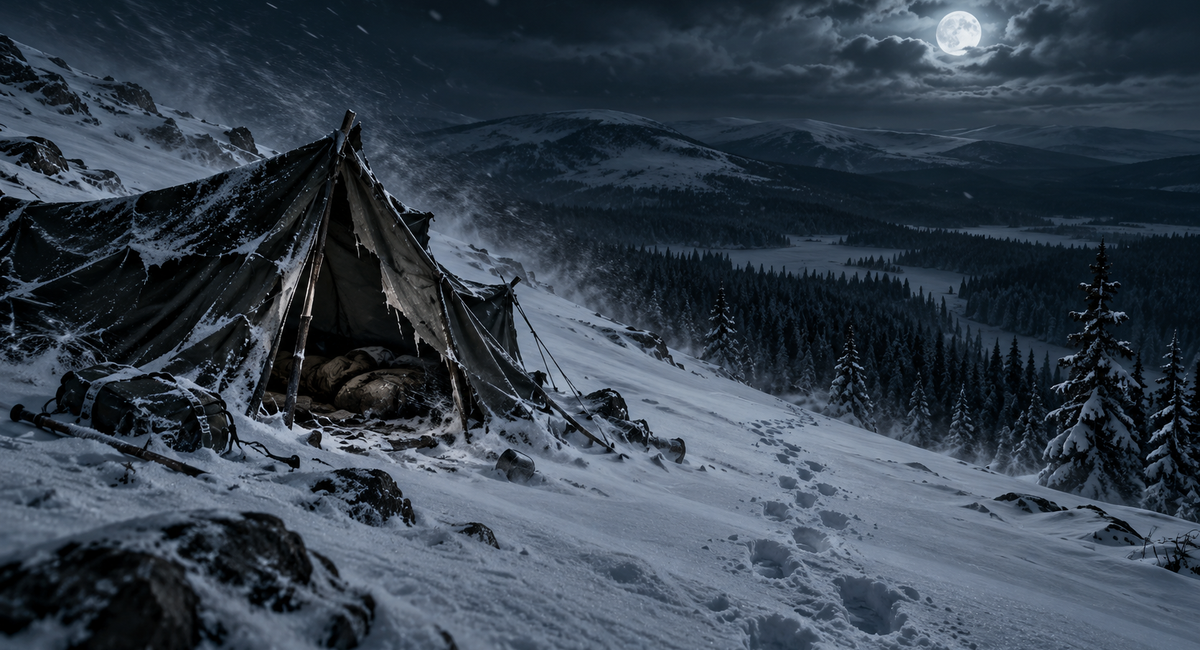
Dyatlov Pass Incident is the focus of this in-depth HorrorStuck guide. We examine the known facts, evidence, leading explanations, and the details that still remain uncertain.
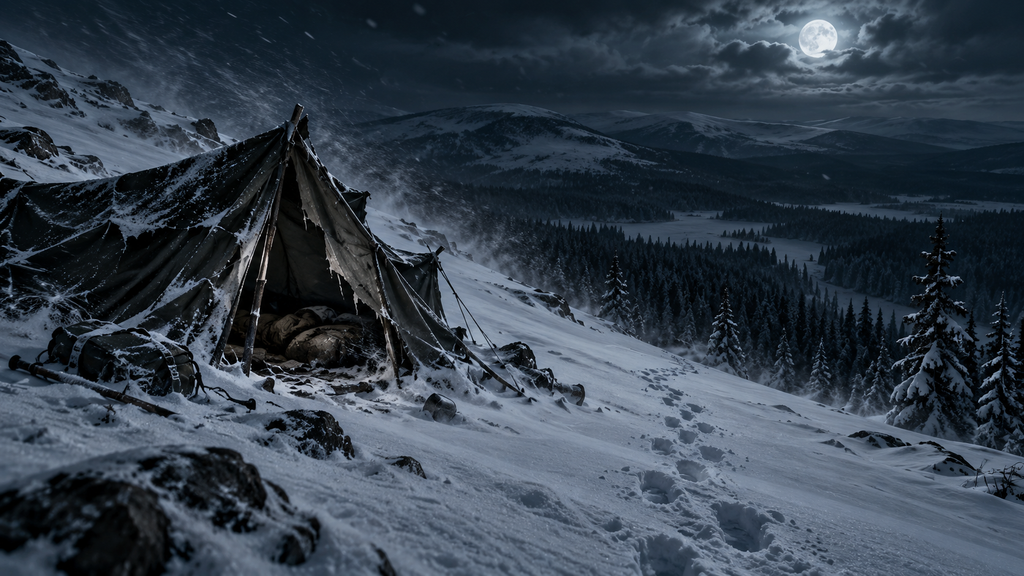
Imagine waking up in the middle of the night on the side of a frozen mountain.
Outside, the temperature is far below freezing.
A violent wind is sweeping across the snow.
You are surrounded by experienced hikers who know exactly how dangerous the wilderness can be.
Then something happens.
Something serious enough that nobody stops to put on proper boots.
Nobody grabs all the warm clothing.
Instead of using the entrance, someone apparently cuts through the side of the tent from the inside.
Nine people abandon their only real protection from the freezing weather and move down the mountain into the darkness.
None of them ever returns.
Weeks later, rescuers find their bodies scattered across the mountainside and forest.
Some died from hypothermia.
Others suffered devastating chest and skull injuries.
One woman was found without her tongue, while soft tissue and eyes were missing from some of the bodies recovered later.
Traces of radioactive contamination were found on pieces of clothing.
And the damaged tent remained on the lonely mountainside, containing much of the equipment the hikers desperately needed to survive.
This was the Dyatlov Pass Incident, one of the most famous real-life mysteries of the 20th century.
For decades, explanations have ranged from avalanches and hurricane-strength winds to secret Soviet weapons, murder, infrasound, unidentified aircraft and even supernatural creatures.
But more than six decades later, science may have brought us surprisingly close to understanding what really happened.
The truth may be less supernatural than the legends.
But it is no less terrifying.
What Was the Dyatlov Pass Incident?
The Dyatlov Pass Incident refers to the deaths of nine members of a Soviet hiking expedition in the northern Ural Mountains during the night of February 1–2, 1959.
The group was led by 23-year-old Igor Dyatlov, an experienced hiker and student at the Ural Polytechnic Institute.
Most members of the expedition were young, physically fit and experienced in demanding winter travel.
This matters.
These were not inexperienced tourists who became frightened by a little snow.
They understood cold weather.
They understood tents.
They understood mountains.
And they would have known that abandoning shelter without adequate clothing in extreme winter conditions could be fatal.
That is one reason the central question has haunted investigators for generations:
What could frighten—or force—nine experienced hikers out of their tent when leaving it meant entering potentially lethal cold?
Who Were the Dyatlov Pass Hikers?
The expedition originally consisted of ten people.
They were Igor Dyatlov, Yuri Doroshenko, Lyudmila Dubinina, Alexander Kolevatov, Zinaida Kolmogorova, Yuri Krivonischenko, Rustem Slobodin, Nikolai Thibeaux-Brignolle, Semyon Zolotaryov and Yuri Yudin.
Yudin became ill early in the journey and turned back.
That decision saved his life.
The other nine continued.
Most were in their early twenties. Zolotaryov, an experienced instructor and war veteran, was considerably older.
Their destination was part of a difficult winter route through the northern Urals.
It was exactly the kind of challenge the group had deliberately chosen.
Nothing about the expedition initially suggested that it would become one of history’s greatest wilderness mysteries.
The Final Journey
The expedition began in January 1959.
After traveling north by train, truck and finally skis, the group entered increasingly isolated terrain.
On January 28, Yuri Yudin turned back because of health problems.
The other nine continued deeper into the wilderness.
Their diaries and photographs provide an extraordinary record of their final days.
The images do not show a terrified group expecting disaster.
They show friends hiking, joking, preparing food and traveling through a difficult but familiar winter environment.
On February 1, worsening weather and navigation difficulties appear to have affected their route.
Instead of descending into a wooded valley where they would have received better protection from the wind, they pitched their tent on the exposed eastern slope of Kholat Syakhl.
The mountain’s Mansi name is often translated as “Dead Mountain.”
That name would later become inseparable from the legend.
At some point that evening, the hikers ate, changed clothes and settled inside the tent.
Then something happened.
Exactly what happened next is the heart of the Dyatlov Pass mystery.
The Group Fails to Return
When the hikers failed to return and no expected message arrived, concern gradually grew.
A search operation was eventually organized.
On February 26, searchers discovered the group’s tent on the slope.
What they found immediately suggested that the hikers had not simply packed their belongings and walked away.
The tent was damaged and partly covered with snow.
Much of the group’s equipment remained inside.
Boots were still there.
Warm clothing had been left behind.
Food and personal possessions remained.
Most importantly, investigators determined that parts of the tent appeared to have been cut open from the inside.
Why would experienced hikers cut their way through their own shelter?
The most logical explanation is urgency.
Whatever happened, at least some members apparently believed that leaving through the normal entrance was too slow or impossible.
Footprints Leading Into the Darkness
Searchers discovered tracks leading downhill from the tent toward the forest.
Some of the footprints indicated people wearing socks, one shoe or no proper footwear at all.
Yet there was no clear evidence that another group had attacked the camp.
No convincing third-party trail led away from the tent.
No obvious signs of a violent struggle were discovered there.
The hikers themselves appeared to have left the shelter and moved toward the forest.
That distinction is important.
They did not necessarily run blindly in every direction.
The evidence instead suggests that the group largely moved downhill together.
About 1.5 kilometers away stood a large cedar tree at the edge of the forest.
That area would become the next important part of the mystery.
The First Bodies
Searchers found Yuri Doroshenko and Yuri Krivonischenko near the cedar tree.
The remains of a small fire were nearby.
Both men were inadequately dressed for the conditions.
This suggests that at least some of the group had deliberately reached the forest, attempted to start a fire and tried to survive.
Broken branches high in the cedar have led to speculation that someone may have climbed the tree.
Perhaps they were trying to see the tent.
Perhaps they were collecting branches.
Perhaps they were watching the slope for danger.
We cannot know.
The bodies of Igor Dyatlov, Zinaida Kolmogorova and later Rustem Slobodin were found between the cedar and the tent.
Their positions have often been interpreted as evidence that they may have been trying to return to the campsite.
If so, their strategy makes chilling sense.
The forest offered temporary protection.
But their boots, clothing, food and equipment were still inside the tent.
Eventually somebody had to go back.
They never made it.
Then Four More Bodies Were Found
Four hikers remained missing through the winter search.
It was not until May, after snow conditions changed, that the remaining bodies were recovered from a ravine near the forest.
They were Lyudmila Dubinina, Semyon Zolotaryov, Nikolai Thibeaux-Brignolle and Alexander Kolevatov.
They were found beneath deep snow.
These bodies transformed a tragic wilderness accident into something far stranger.
Some had suffered severe injuries.
Thibeaux-Brignolle had major skull trauma.
Dubinina and Zolotaryov had extensive chest injuries, including fractured ribs.
The injuries were serious enough to inspire comparisons with the force associated with a vehicle collision or heavy crushing pressure.
And then investigators noticed something even more disturbing.
The Missing Eyes and Tongue
The most sensational detail of the Dyatlov Pass Incident concerns the condition of the bodies recovered from the ravine.
Lyudmila Dubinina had significant facial soft-tissue loss and was missing her tongue.
Eyes or eye tissue were also missing from some of the bodies.
These details have been repeated in documentaries, books and internet discussions as evidence of everything from murder to unknown creatures.
But context matters.
The ravine bodies remained under snow for approximately three months.
They were exposed to moisture, decomposition and potentially scavenging animals.
Soft tissues such as the eyes, lips and tongue deteriorate quickly compared with bones and other protected tissues.
There is no compelling forensic evidence showing that another person deliberately removed these organs while the hikers were alive.
The state in which a body is discovered months after death is not necessarily the state in which the person died.
The missing tissue is disturbing.
It is not, by itself, proof of something paranormal or criminal.
Why Were Some Hikers Barely Dressed?
Another detail frequently presented as mysterious is the condition of the hikers’ clothing.
Why would people leave a tent without shoes or adequate winter gear?
The simplest answer is that they did not expect to be away from the tent for long.
If they believed their shelter was in immediate danger from moving snow, an avalanche or some other threat, escaping quickly would take priority over dressing properly.
They may have believed they could return within minutes.
But once outside, the situation could have changed rapidly.
The cold would progressively damage coordination and judgment.
There is also evidence that clothing was redistributed among survivors.
Taking clothes from those who had already died would have been a rational survival decision.
Hypothermia can additionally produce confused behavior in its later stages, although it is not necessary to invoke extreme psychological effects to explain the initial evacuation.
The central mystery is not why freezing people behaved strangely after prolonged exposure.
It is why they left the tent in the first place.
The Strange Radioactivity
The Dyatlov case became even more mysterious when radioactive contamination was detected on some pieces of clothing.
This fact helped create theories involving secret Soviet weapons, nuclear experiments and military testing.
Radioactivity was indeed detected.
But that fact should not automatically be turned into evidence of a nuclear explosion.
At least one member of the group had previously worked at the Mayak nuclear facility, associated with the 1957 Kyshtym nuclear disaster. Some of the contaminated clothing could potentially have been connected to earlier occupational exposure or contamination rather than something that happened on the mountain.
Most importantly, no convincing evidence shows that radiation caused the hikers’ deaths.
Radioactive clothing is an unusual clue.
It is not proof of a secret weapon.
What Did the Original Investigation Conclude?
The 1959 Soviet investigation failed to identify a conventional criminal explanation.
There was no convincing evidence of robbery.
Valuables remained.
There was no clear evidence of an outside attacker.
The investigation ultimately attributed the deaths to what has commonly been translated as an “overwhelming” or “compelling natural force.”
The vague wording did little to reassure the public.
Instead, it created the perfect environment for conspiracy theories.
If the government knew exactly what happened, why did it not explain it?
Was something being hidden?
Or did investigators simply lack enough evidence and scientific understanding to reconstruct an unusual mountain accident?
For decades, almost every imaginable explanation would be proposed.
Theory 1: The Hikers Were Murdered
One early possibility involved an attack by local people or another unknown group.
But the evidence for murder has always been weak.
There were no convincing tracks belonging to attackers around the tent.
Important belongings remained.
The group apparently left the tent together.
Some of the hikers then attempted to make a fire and possibly return to the campsite.
That sequence looks more like people responding to an environmental emergency than people escaping armed attackers.
The local Mansi people were also unfairly drawn into early speculation despite the lack of convincing evidence connecting them to the deaths.
Murder cannot be mathematically disproved six decades later.
But the known evidence does not make it the strongest explanation.
Theory 2: Secret Soviet Weapons
Cold War secrecy made a military explanation irresistible.
Witnesses in the broader region reportedly described strange lights in the sky around that period.
Radioactive contamination was found on clothing.
The Soviet investigation was opaque.
Perhaps, the theory goes, the hikers accidentally entered an area where classified weapons were being tested.
Versions of this idea involve rockets, parachute mines, explosives or radiation.
The problem is evidence.
There is no established physical evidence showing that a bomb, missile or experimental weapon struck the campsite.
An explosion powerful enough to create the hikers’ injuries would normally be expected to leave other traces.
And a secret weapon does not neatly explain why footprints apparently led away from the tent in an organized direction toward the forest.
The Soviet Union certainly conducted secret military activities.
That does not mean one occurred at Dyatlov Pass.
Theory 3: Infrasound Caused Panic
One particularly interesting theory proposes that unusual wind conditions around Kholat Syakhl generated low-frequency sound known as infrasound.
Humans may not consciously hear very low frequencies, but certain frequencies and vibrations have been associated with discomfort, anxiety or unusual sensations.
Could powerful winds have generated infrasound that caused the hikers to panic?
It is an intriguing idea because the weather was severe.
But it requires several assumptions.
Even if the hikers experienced fear or disorientation, why would all nine abandon critical equipment?
And why would experienced mountaineers continue downhill rather than quickly realize that no visible threat existed?
There is currently no direct evidence that infrasound drove the evacuation.
Theory 4: Katabatic Winds
Another natural explanation involves powerful katabatic winds—cold, dense air rapidly flowing downhill.
Such winds can become extremely strong.
A severe wind event could potentially damage a tent, make remaining on an exposed slope dangerous and encourage the hikers to seek shelter among trees.
This theory has advantages.
It fits the weather.
It requires no attacker or unknown technology.
A 2019 Swedish-Russian expedition argued that intense wind conditions deserved serious consideration.
But wind alone does not completely explain every element of the incident, particularly the severe traumatic injuries.
That brings us to the explanation now considered especially important.
Theory 5: A Slab Avalanche
For years, many people rejected an avalanche explanation.
Searchers did not report the enormous field of avalanche debris one might expect.
The visible slope seemed too gentle.
The tent had not been swept hundreds of meters downhill.
And if the hikers cut into the slope while pitching the tent hours earlier, why would the snow suddenly fail much later?
Then researchers looked at the problem differently.
What if this was not a giant roaring avalanche?
What if it was a small slab avalanche directly above the tent?
In 2021, researchers Johan Gaume and Alexander Puzrin published a peer-reviewed study in Communications Earth & Environment modeling how such an event could have occurred.
Their proposed mechanism involved several factors working together.
The hikers cut into the snow slope to create a flat platform for their tent.
A weak snow layer may have existed beneath a harder slab.
Strong winds continued depositing additional snow above the campsite.
Local terrain around the tent could have been steeper than broad measurements of the mountainside suggested.
Eventually, enough additional load accumulated for a slab of compacted snow to break loose.
Importantly, the model showed that failure could occur hours after the hikers originally cut into the slope.
The calculated delay could fall within the approximate timeframe of the disaster.
Suddenly, one of the biggest objections to the avalanche theory became less convincing.
But Would a Small Avalanche Cause Those Injuries?
This was another problem.
Some of the hikers suffered crushing chest or skull trauma without the kind of extensive surface injuries people might expect from tumbling down a mountain.
The researchers modeled the effect of a dense snow slab striking people lying on a relatively firm surface inside the tent.
Their simulations suggested that even a comparatively small slab could potentially cause serious thoracic or skull injuries without producing the dramatic scene associated with a massive avalanche.
It does not prove that this happened.
But it demonstrates something important:
The injuries do not automatically rule out a snow-slab event.
Another possibility is that some serious injuries occurred later in or near the ravine, potentially from a fall or snow collapse.
The exact injury sequence remains one of the uncertain parts of the case.
Why Was There No Avalanche Evidence?
Searchers reached the tent roughly three weeks after the deaths.
Snow conditions can change dramatically in that amount of time, particularly on an exposed, windswept mountain.
A relatively small slab could be buried, redistributed or obscured.
It would not necessarily resemble the aftermath of a huge avalanche seen in disaster footage.
Even more importantly, later fieldwork strengthened the argument that the area is capable of producing avalanches.
In 2022, the researchers behind the slab-avalanche study reported follow-up expeditions showing that avalanches do occur around Dyatlov Pass and that slopes above the campsite can be steep enough for avalanche release.
That does not close the case.
But it weakens one of the long-standing objections to the avalanche hypothesis.
A Possible Reconstruction of the Final Night
No one survived to describe what happened.
So any reconstruction contains uncertainty.
But based on the evidence, one plausible sequence looks like this.
The group cuts into the mountainside and sets up the tent.
Wind moves snow across the exposed slope for several hours.
Additional snow accumulates above a weak layer.
Sometime during the night, part of the slab fails.
Snow presses into or partly collapses the tent.
Some hikers may be injured.
The group fears that a larger avalanche could follow.
Getting everyone out quickly becomes the priority.
The normal entrance is blocked, difficult to reach or simply too slow.
The tent is cut open from inside.
The hikers escape.
They leave boots and clothing behind because they expect the evacuation to be temporary.
They move downhill toward the forest, where trees offer protection from wind and avalanche danger.
A fire is started beneath the cedar.
But the temperature is brutally low.
The group now faces a terrible decision.
Remaining near the fire means slowly freezing.
Returning to the tent means crossing an exposed mountainside toward whatever danger drove them away.
Some hikers apparently try to return.
They collapse from cold before reaching it.
Others construct or seek better shelter near a ravine.
At some point, members of this group suffer serious crushing injuries—possibly during the initial snow event, a later fall, snow-shelter collapse or some combination of these events.
The survivors redistribute clothing.
But without proper equipment, shelter and medical help, their situation is hopeless.
One by one, the mountain wins.
So, What Really Happened at Dyatlov Pass?
The completely honest answer is:
We still cannot know every detail.
There were no survivors.
The campsite was not discovered for weeks.
Several bodies remained buried for months.
Weather altered the scene.
The original investigation took place under a secretive Soviet system.
And decades of legends have mixed genuine evidence with exaggeration.
But the mystery is not as scientifically inexplicable as it once appeared.
A small delayed slab avalanche—or another serious snow instability—provides a plausible trigger for the emergency evacuation.
The hikers then appear to have attempted organized survival measures in the forest.
Hypothermia explains the deaths of several members.
Snow-related trauma, a ravine accident or collapsing snow could help account for the severe injuries suffered by others.
Post-mortem decomposition provides a far more conventional explanation for the missing soft tissue than deliberate mutilation.
The radioactive clothing remains interesting but has never been demonstrated to be connected to the cause of death.
In other words, there may never have been one bizarre event that explains everything.
The Dyatlov Pass Incident may instead have been a chain of disasters.
Snow.
Wind.
Injury.
Darkness.
Confusion.
Extreme cold.
And a series of survival decisions made by people who suddenly discovered that every available choice was dangerous.
Why the Dyatlov Pass Incident Still Feels So Terrifying
Perhaps that explanation makes the story more frightening, not less.
A monster can be avoided.
A murderer can be fought.
A supernatural force can be dismissed as fiction.
But nature does not need motives.
Imagine standing beneath that cedar tree.
Your fire is dying.
Your hands are becoming numb.
Some of your friends are injured.
Your tent—and everything you need to survive—is visible somewhere uphill through the darkness and blowing snow.
You know you probably cannot remain where you are.
You also know that something dangerous happened at the campsite.
Do you stay?
Do you climb back?
Do you search for shelter?
Every decision could kill you.
That may be the real horror of Dyatlov Pass.
The hikers did not necessarily make irrational decisions.
They may simply have reached a point where there were no good decisions left.
Is the Dyatlov Pass Mystery Finally Solved?
Not completely.
The slab-avalanche theory is currently one of the strongest scientifically supported explanations for the initial emergency, particularly after the 2021 modeling study and subsequent observations showing avalanche activity in the area.
But a scientific model demonstrates plausibility—not historical certainty.
We still cannot prove exactly what struck the tent.
We cannot know the hikers’ conversations.
We cannot reconstruct every movement after they reached the forest.
And there remains debate over exactly how and when the severe injuries occurred.
What modern research has done is make the incident less impossible.
Many supposedly supernatural details can be explained without aliens, monsters or secret death rays.
Yet the final hours of the nine hikers remain hidden beneath the snow of February 1959.
And that small gap between what we can explain and what we can never know is what keeps the Dyatlov Pass Incident alive.
More than six decades later, nine hikers still walk through the darkness in our imagination—away from a warm tent, down a frozen mountainside and toward a forest from which none of them would return.
Frequently Asked Questions About the Dyatlov Pass Incident
What is the Dyatlov Pass Incident?
The Dyatlov Pass Incident was the unexplained death of nine Soviet hikers in the northern Ural Mountains during the night of February 1–2, 1959. Their abandoned tent, unusual injuries and mysterious evacuation created one of history’s most famous wilderness mysteries.
How many people died at Dyatlov Pass?
Nine hikers died. The expedition originally included ten people, but Yuri Yudin became ill and turned back early, making him the only member of the original group to survive.
Why did the Dyatlov hikers cut their tent open?
Investigators concluded that sections of the tent were cut from inside. The exact reason is unknown. One plausible explanation is that a snow slab or perceived avalanche threat made an immediate evacuation necessary and cutting through the tent provided the quickest exit.
Did an avalanche kill the Dyatlov hikers?
An avalanche-related event is one of the leading scientific explanations, but it cannot be considered definitively proven. A 2021 peer-reviewed study showed that a delayed slab avalanche at the campsite was physically plausible. Later expeditions also documented avalanche conditions in the area.
Why were the Dyatlov hikers without shoes?
Many boots and items of warm clothing remained inside the tent. This suggests the group evacuated suddenly and probably expected to return. Once separated from their equipment in extreme cold, hypothermia became a major threat.
Why was Lyudmila Dubinina missing her tongue?
Dubinina’s body remained under deep snow in a wet ravine environment for months. Decomposition, water exposure and scavenging provide plausible natural explanations for the loss of soft tissue. There is no established evidence that her tongue was deliberately removed before death.
Why was there radiation on some Dyatlov Pass clothing?
Testing detected radioactive contamination on some clothing. However, some group members had histories connected with Soviet nuclear-related work, and no evidence has demonstrated that radiation caused the incident or the hikers’ deaths.
Were aliens involved in the Dyatlov Pass Incident?
There is no credible physical evidence demonstrating alien involvement. Reports of unusual lights contributed to UFO theories, but they do not establish a connection to the hikers’ deaths.
Was the Soviet military responsible?
Secret-weapons theories remain popular, partly because of Cold War-era Soviet secrecy. However, no conclusive evidence has established that a military experiment caused the disaster.
What is the most likely explanation for the Dyatlov Pass Incident?
Based on current evidence, a plausible reconstruction involves a snow-slab or avalanche-related emergency forcing the hikers from their tent, followed by attempts to survive in the forest, severe cold, hypothermia and traumatic injuries. The precise sequence of events remains uncertain.
Final Thoughts
The Dyatlov Pass Incident has survived for more than sixty years because it contains everything a mystery needs: an isolated mountain, an abandoned tent, footprints disappearing into snow, unexplained injuries and nine people who could never tell investigators what they saw.
But the most compelling explanation may not require anything supernatural.
It may require only a mountain, unstable snow, brutal weather and one emergency that triggered a cascade of increasingly deadly problems.
And perhaps that is why Dyatlov Pass remains so frightening.
Because nothing about it needs to be impossible.
It only needs to have happened.