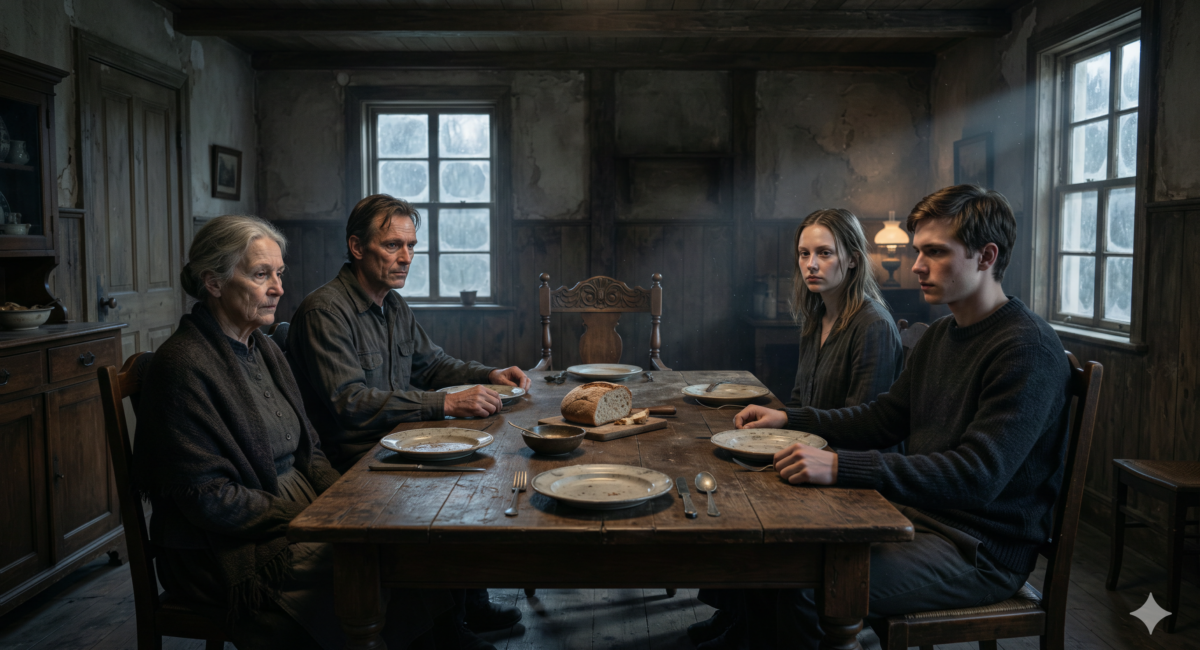
Empty Chair at 2 AM is the focus of this in-depth HorrorStuck guide. We examine the known facts, evidence, leading explanations, and the details that still remain uncertain.
Empty Chair at 2 AM: Key Facts and Context
Every night at exactly 2:00 AM, my entire family walks downstairs in pitch darkness and sits around the oak dining table, staring silently at an empty chair. When I first returned home after fifteen years away, I assumed this empty chair horror story playing out in my own hallway was just an isolated case of collective sleepwalking. None of them ever remembered leaving their beds the next morning, and none of them could explain why the house smelled of wet river clay every dawn.
- Why I Came Back After Fifteen Years
- What Happens at 2 AM in the Dining Room
- The Clues That Did Not Belong to Me
- The Night I Took the Empty Chair
- Frequently Asked Questions
Why I Came Back After Fifteen Years
I had not set foot in Oakhaven since the autumn I turned eighteen. Back then, getting out felt like escaping a cellar before the hatch froze shut. Our village sat tucked inside a damp valley ringed by spruce ridges, three hours from the nearest highway and forty minutes from a grocery store that stocked anything fresher than tinned peaches.
When my father’s heart finally gave out enough to warrant a pacemaker, my older sister Clara called me in Chicago. She did not beg, which somehow made it worse. She simply said my mother was struggling to haul firewood up the cellar steps and that someone needed to help winterize the farmhouse before November locked the roads.
I packed two suitcases, took a three-week leave from my drafting firm, and drove north until the asphalt turned to gravel. The moment I stepped onto the front porch, a strange familiarity washed over me, though every memory felt slightly blurred at the edges, like a photograph left too long in direct sunlight.
My mother met me at the door with a grip so tight her knuckles turned white against my coat sleeves. She smelled of lavender soap and woodsmoke, just as I remembered, though her hair had gone entirely silver. Behind her stood my father, leaning on an ash cane, and Clara, looking thinner than she had in any of the holiday cards she sent.
“You look thinner, Julian,” my mother said, her thumb brushing just below my left cheekbone where a childhood scar from a bicycle fall still sat pale against my skin. “Still, you have your grandfather’s eyes. Come inside before the chill gets into your joints.”
Dinner that first evening was warm, loud, and almost aggressively normal. My father complained about the county road crew, Clara teased me about my city accent, and my mother heaped roast potatoes onto my plate until the porcelain groaned. For the first time in a decade, I wondered why I had stayed away so long.
There were six chairs around the heavy oak dining table. Five of us ate. The sixth chair, carved with high spindles at the far head of the table, remained pushed neatly beneath the linen runner.
What Happens at 2 AM in the Dining Room
What happens at 2 AM in the dining room is an unnerving nightly ritual where the entire family gathers in absolute darkness, sits completely motionless around the oak table, and stares at the unoccupied head chair for forty-five minutes before returning to bed with zero memory of the event.
I discovered it on my third night back. Jet lag had given way to the deep, suffocating quiet of the countryside, where the absence of traffic hum leaves your ears ringing. At 1:58 AM, I woke up parched, my throat dry from the radiator heat.
I slipped out of my childhood bedroom and padded down the hallway in thick wool socks. As I reached the top of the staircase, the floorboards beneath my left foot gave a faint, familiar groan. Below me, the foyer was submerged in shadow, save for a thin blade of silver moonlight cutting through the frosted glass beside the front door.
Then I heard the soft, rhythmic scuff of bare feet on hardwood.
I froze on the landing, pressing my back against the cold plaster wall. Below me, my father emerged from the downstairs hall, moving without his cane. His posture was unnaturally straight, his arms hanging slack at his sides. Behind him came my mother, still in her flannel nightgown, followed closely by Clara.
None of them carried a flashlight. None of them reached for the brass wall switches.
I crept halfway down the stairs, squinting into the gloom as they filed into the dining room. Four chairs scraped softly against the floorboards—wait. Four? I counted the silhouettes in the pale moonlight spilling through the bay window. My father, my mother, Clara, and my younger brother Leo, who lived two towns over and had not been at dinner.
My pulse hammered against my ribs. I had not heard Leo’s truck pull into the gravel drive.
All four of them sat with their hands folded flat on the tabletop. Their chins were level, their backs rigid against the wooden slats. Not one of them blinked. Not one of them shifted weight.
And every single pair of eyes was locked onto the empty spindle-back chair at the head of the table.
The air in the stairwell dropped ten degrees. A faint scent drifted up from the dining room—cold, mineral-heavy river mud mixed with wet wool and stale pine needles. It was the exact smell of the creek bed behind the orchard after a spring thaw, something you encounter in stories about haunted northern woods where the land refuses to stay quiet.
I stood paralyzed on the sixth step for nearly twenty minutes, watching their chests barely rise or fall. Around 2:45 AM, as if responding to a silent bell, all four rose in unison, tucked their chairs in without a sound, and walked back into the dark. When I checked the front porch a minute later, the gravel driveway was empty. No truck. No tire tracks in the frost.
The Clues That Did Not Belong to Me
The next morning, I came down at seven to find my mother frying eggs and humming along to a local radio station. My father was nursing his coffee, rubbing his stiff knee with a wince. Clara sat scrolling on her phone, a mug of black tea steaming beside her elbow.
“Did Leo drop by late last night?” I asked casually, pouring myself coffee.
Clara frowned without looking up. “Leo? No, he’s in Duluth until Friday for a lumber auction. Why?”
“Thought I heard footsteps downstairs around two,” I said, watching my mother’s back stiffen almost imperceptibly at the stove. “And the front door latch clicking.”
My father chuckled, rattling his newspaper. “Probably the wind off the ridge, son. Old timber settles when the frost hits hard. You’ve forgotten how noisy this house gets.”
I did not push it. Instead, I spent the afternoon inspecting the dining room in full daylight. The oak table showed no marks, though when I ran my fingers along the underside of the empty chair’s armrests, my fingertips came away gritty with dried gray silt. River clay.
Over the next four nights, I set an alarm on my phone to vibrate silently at 1:50 AM. Every single night, the exact same sequence unfolded. At 1:59 AM, the bedroom doors eased open. At 2:00 AM sharp, my mother, father, Clara, and the phantom version of Leo took their seats in total darkness. Even when I intentionally left the kitchen hall light switched on before going to bed, my father calmly flicked it off on his way past without breaking stride.
People often wonder if strange nocturnal episodes are just sleep paralysis or genuine paranormal encounters, yet nothing about this felt like a waking dream. I was wide awake, pinching the skin of my wrist until it bruised, recording the timestamps in my notebook.
By day six, small inconsistencies around the house began to grate against my nerves like sand in a gear.
First, I noticed the family photographs lining the hallway wall. Every picture from my childhood stopped abruptly around my fourteenth birthday. There were graduation photos of Clara, wedding photos of Leo, even snapshots of my parents at a state fair three summers ago—but not a single frame showed me as an adult, or even as an older teenager.
When I asked Clara about it while we stacked split birch logs behind the shed, she paused with an armload of wood, looking genuinely confused.
“Julian, what are you talking about? Mom packed all your old albums into the cedar chest after you moved away. She said looking at them made the house feel too quiet.”
Second, there was the matter of my own reflection and habits. On Tuesday, I reached automatically into the upper-left kitchen cabinet for the blue ceramic mugs, only to find spice jars. My mother blinked at me from the sink. “We moved the dishes to the island drawers twenty years ago, sweetheart. Before you were even in high school.”
I laughed it off, blaming my terrible memory, though my stomach felt heavy as lead. Why did I remember blue mugs in the upper-left cabinet? Why did the smell of river clay make the back of my teeth ache with a sudden, blinding migraine every time I walked past the orchard?
That night, I checked the locked cedar chest in the attic. The brass padlock was rusted shut, yet the lid sat unlatched by half an inch. Inside lay neatly folded wool sweaters, a tarnished silver watch, and a stack of yellowing newspaper clippings from the Oakhaven Sentinel dated October 2011—fifteen years ago.
Before I could unfold the top clipping, footsteps sounded on the attic ladder below. I dropped the lid and slipped back toward the stairs just as Clara’s head appeared through the hatch, her face pale in the single bulb’s glare.
“Mom wants to know if you’re coming down for supper,” she whispered, her eyes darting nervously toward the cedar chest. “She made pot roast.”
The Night I Took the Empty Chair
By Friday, my hands had developed a constant, fine tremor. Sleep was out of the question. Whatever held my family in that nocturnal trance had begun to feel less like an illness and more like an unfinished sentence waiting for a final word.
I decided that if they were waiting for someone to sit in that empty chair at 2:00 AM, I would give them an answer.
At 1:30 AM, long before the floorboards began to creak upstairs, I crept down into the unlit dining room. The cold radiating off the windowpanes felt solid enough to touch. I pulled out the spindle-back chair at the head of the table, sat down, and rested my forearms on the dark oak.
The wood beneath my palms was freezing, damp with that familiar smell of river silt and rotting spruce needles. As I adjusted my posture, my left knee brushed against the underside of the table—and struck a deep, jagged gouge carved into the oak apron. My fingers traced the rough splinters instinctively. A strange, suffocating pressure built behind my eyes, as if water were filling my sinuses.
At 1:58 AM, the upstairs hinges sighed.
I held my breath, keeping my back straight and my eyes fixed straight ahead toward the dark archway of the foyer. One by one, they drifted into the room like figures underwater. My father took his chair to my right. My mother sat directly to my left. Clara and Leo—real or not, his wet wool coat smelling sharply of creek water—took the far ends.
For ten full seconds, nobody moved. Their eyes remained fixed slightly above my shoulder, staring at the space where the empty chair usually sat.
Then, slowly, my mother’s head turned.
Her neck made a dry, faint clicking sound in the dead silence. Her eyes, wide and milky in the silver moonlight, dropped until they met mine. Across the table, my father’s chin rotated toward me with terrifying, mechanical precision. Clara and Leo turned in unison, four pairs of unblinking eyes locking onto my face.
The temperature in the room plummeted so fast my breath plumed white in the dark. The smell of wet river clay became overwhelming, choking the air out of my lungs.
My mother leaned forward an inch, her trembling fingers barely grazing the edge of the oak table.
“Finally,” my mother whispered, her voice thick with fifteen years of unshed tears, “the person wearing our son’s face has sat down.”
The words hit me like ice water straight to the chest. I tried to speak, tried to tell her it was me—Julian—that I had driven up from Chicago, that I had a drafting job and a scar beneath my left cheekbone.
Except as I raised my hand to touch my face, my fingers felt cold, slick, and weirdly pliable, like wet river clay molded over hollow bone. Memories that were not mine suddenly fractured and slid apart in my skull. There was no drafting firm in Chicago. There was no gravel highway drive.
In October 2011, eighteen-year-old Julian had slipped on the slick rocks above Oakhaven Creek during an autumn flood and drowned beneath the root tangle of a fallen spruce. They had found his body three days later, pale and swollen with gray river silt, and buried him beside the church.
And for fifteen years, something from the cold mud beneath the orchard had crawled up to the house every autumn, piecing together his voice, his bicycle scar, and half-remembered fragments of old kitchen cabinets, trying to step into the life he left behind.
As the dawn gray began to bleed through the frosted windows, my family did not scream or run. My mother simply reached out, closed her warm, living hand over my freezing fingers, and wept softly while the thing wearing her son’s face sat trapped in the chair at last.
Frequently Asked Questions
What does the empty chair symbolize in this horror story?
In supernatural fiction, an empty chair at a family dining table symbolizes unresolved grief, an unspoken absence, and an invitation for lingering entities to occupy a space left behind by someone who died prematurely.
Why couldn’t the family remember sitting at the dining table at 2 AM?
Their nightly gathering functioned as a grief-induced dissociative trance triggered by the house’s lingering spiritual imprint. Consciously, they accepted Julian’s death, while subconsciously their mourning drew them downstairs to confront the entity impersonating him.
What clues hinted at the twist before the ending?
Several subtle clues foreshadowed the ending: the pervasive smell of wet river clay, the absence of family photos after age fourteen, Julian remembering cabinets moved twenty years earlier, and the 2011 newspaper clippings hidden inside the attic cedar chest.
Is this empty chair ghost story based on a true event?
No, this narrative is an original work of supernatural fiction created for Horror Stuck. However, it draws inspiration from classic folklore surrounding doppelgängers, changelings, and shared nocturnal sleepwalking phenomena reported in isolated rural households.
Why is 2:00 AM significant in paranormal stories?
The hours between 2:00 AM and 3:30 AM are traditionally known in folklore as the witching hour or dead time, when ambient human activity reaches its lowest point and sensory perceptions become heightened in quiet, darkened environments.
Author’s Note: This story is a work of fiction. Any resemblance to actual persons, living or dead, or real events is purely coincidental.
What is your theory about how long the narrator had actually been living in the house before realizing the truth? Share your thoughts or your own unexplained nighttime experience in the comments below, and explore more chilling tales on Horror Stuck.
Further Reading & External Resources
Ultimately, Empty Chair at 2 AM remains compelling because the documented evidence answers some questions while leaving others open to careful investigation.