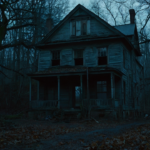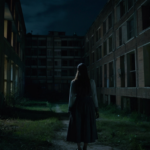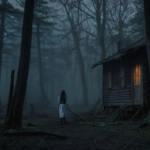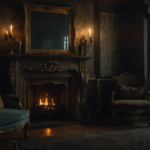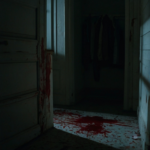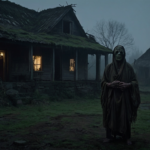
The old Victorian house on Blackwood Lane was not haunted, Arthur had often told himself, it was simply exhausted. It was a structure built in the late eighteen-hundreds, settling deep into the damp earth of the Pacific Northwest, its bones creaking in the perpetual autumn wind. Arthur had bought it cheap after the divorce, seeking isolation, a place where the echoing silence of his failed marriage could be swallowed by the groans of settling timber and the relentless drumming of rain against single-pane glass.
His only companion in this sprawling, drafty exile was Barnaby.
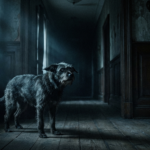
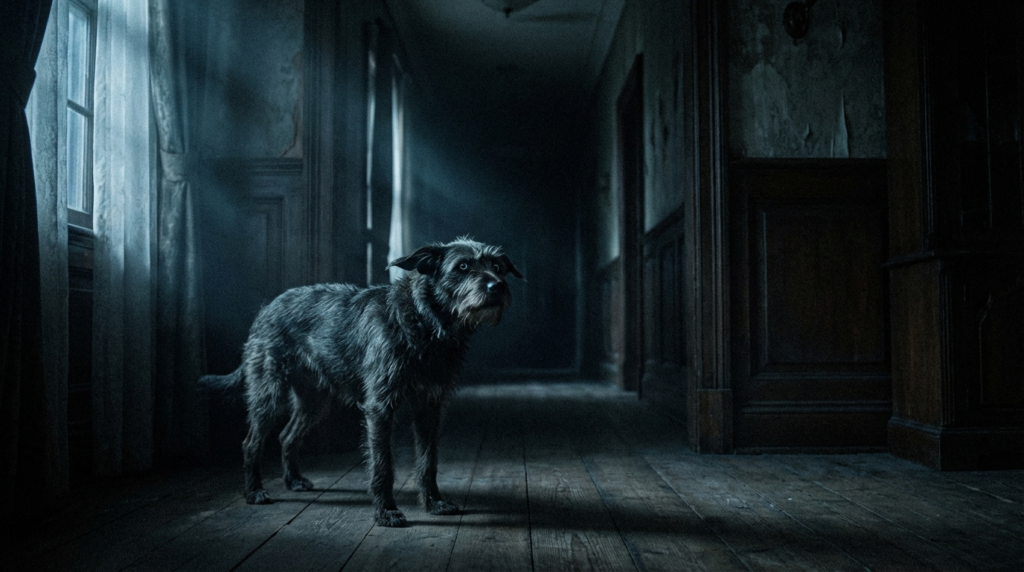
Barnaby was a mutt of indeterminate origin—a patchwork of Airedale terrier rough-coat, the soulful, heavy-lidded eyes of a hound, and the lanky, awkward legs of a deer. Barnaby was not a particularly brave dog. He was terrified of the vacuum cleaner, suspicious of the toaster, and refused to go into the basement under any circumstances. But to Arthur, Barnaby was an anchor to reality. In a house that constantly whispered with drafts and shifting floorboards, Barnaby’s rhythmic panting, the heavy thump-thump of his tail against the rug, and the clicking of his claws on the hardwood floors were the sounds of life.
Living alone, isolated from the hum of the city, Arthur had developed the inevitable habit of the solitary: he spoke to the dog incessantly. He narrated his day, asked for Barnaby’s opinions on dinner, and complained about the rising cost of coffee.
“What do you think, Barnaby?” Arthur would ask, holding up two different cans of soup in the sterile, fluorescent glare of the kitchen. “Chicken noodle or minestrone?”
Barnaby would usually respond with a sharp head tilt, a soft, high-pitched huff of air through his nose, or a short, guttural whine if he thought the cans contained wet food. Arthur had learned to translate these micro-vocalizations. He knew the exact pitch of Barnaby’s “I need to go outside” whine, the urgent, staccato bark of “There is a squirrel on the porch,” and the low, rumbling groan of “I am comfortable on this couch and will not be moving.”
It was a Tuesday in late November when the isolation finally curdled into something else.
The sun had set at four-thirty in the afternoon, plunging the surrounding woods into a deep, impenetrable purple bruise. A storm was rolling in from the coast, not with a violent crash of thunder, but with a steady, suffocating pressure. The air inside the house felt thick, heavy with the scent of ozone and the damp, earthy smell of wet pine needles.
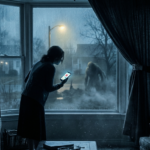
Arthur was in the midst of his evening chores, a ritual designed to keep his mind occupied and his hands busy. He had just finished a load of laundry. The warm, cotton-scented pile of clothes sat in a plastic basket on the living room floor. He was systematically folding them, matching socks, smoothing out the wrinkles in his flannel shirts. The television was off. The only sounds were the wind pressing against the windowpanes and the distant, metallic hum of the old refrigerator in the kitchen.
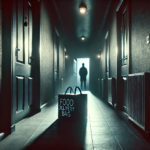
Barnaby had been sleeping on the rug near the front door, his legs twitching in some dog-dream, but a few minutes ago, Arthur had heard him get up. The familiar click-clack-click of his nails had wandered down the long, L-shaped hallway that connected the living room to the bedrooms and the bathroom. The hallway was the darkest part of the house. The bulb in the overhead fixture had burned out three days prior, and Arthur, gripped by a lethargy he couldn’t quite explain, hadn’t bothered to fetch the stepladder to change it. It was a pitch-black corridor, a gaping maw leading into the private quarters of the house.
Arthur finished folding a grey sweater and placed it neatly on the stack. He stretched his back, vertebrae popping in the quiet room. He rubbed his eyes, feeling the gritty exhaustion of the day behind his eyelids. He looked at the old grandfather clock in the corner. Seven-fifteen.
His stomach gave a hollow rumble. It was time for dinner.
He stood up, his joints protesting the damp cold that seemed to seep through the floorboards. He walked toward the kitchen, pausing at the threshold of the living room, looking toward the gaping, lightless void of the hallway. He couldn’t see anything past the first three feet of hardwood. The darkness was absolute, thick like ink.
“Hey, Barnaby,” Arthur called out, his voice sounding flat and dead in the quiet house. He turned his body toward the kitchen, reaching for the light switch. “I’m making dinner. You hungry, buddy?”
He expected the familiar sounds in response: the frantic scrabbling of claws on wood as Barnaby lost his footing trying to turn around too fast, the heavy panting, the jingling of the brass tags on his collar.
Instead, the house held its breath.
Then, from the absolute, pitch-black depths of the hallway, a voice answered.
“Starving.”
Arthur stopped breathing. His hand froze inches from the kitchen light switch.
The word was not spoken by a human. That was the first, most paralyzing realization. It was an auditory impossibility that shattered the foundation of Arthur’s reality. The voice had no human timbre, no vocal cords vibrating with air.
It was Barnaby’s voice.
It was the exact, distinct pitch of Barnaby’s high-pitched, needy whine—the sound the dog made when he wanted a treat—but it had been stretched, distorted, and violently contorted around the consonants and vowels of an English word. It was a canine noise shaped into human speech, carrying a raspy, wet vibration, as if a dog’s throat was attempting to mimic a man. It sounded agonizing. It sounded hungry.
A wave of pure, primal adrenaline washed over Arthur. It didn’t feel like energy; it felt like a cold, metallic poison flooding his veins. The taste of copper bloomed sharply on the back of his tongue. His heart, which had been beating at a steady, resting pace, suddenly slammed against his ribs with the violence of a trapped bird. Every hair on his arms and the back of his neck stood rigid, a prehistoric defense mechanism screaming at him that he was in the presence of a predator.
He didn’t move. He couldn’t. His body was locked in absolute paralysis, his brain desperately scrambling to process the sensory input and finding only terrifying, impossible conclusions.
I imagined it, the rational part of his brain pleaded, desperate for purchase in the slipping reality. The wind. A floorboard. A trick of the acoustics. Auditory pareidolia. I’m tired. I’m alone. I’m losing my mind.
“Barnaby?” Arthur whispered. The word barely scraped past his lips, his throat tight and dry as dust.
Silence. The heavy, suffocating silence of the house pressed in on him. Even the wind outside seemed to have paused, listening.
Arthur slowly lowered his hand from the kitchen light switch. He didn’t want to turn the light on. Turning the light on would illuminate the kitchen, making him a beacon, a spotlighted target, while the hallway remained drowned in darkness.
He turned his head, millimeter by millimeter, back toward the hallway.
The darkness was a solid wall. Staring into it, his eyes began to play tricks on him. The static of his vision swirled in the blackness, forming shapes that weren’t there, shifting geometries of shadow. But there was no sound. No jingling tags. No breathing.
He had to get a weapon. He had to defend himself. But against what? A burglar? A burglar wouldn’t—couldn’t—make a sound like that.
Beside the armchair in the living room, about ten feet to his left, was a heavy, cast-iron fireplace poker. It was an antique, heavy enough to shatter bone. Arthur mapped the route in his head. Four steps. Grab the poker. Turn back.
He took the first step. The old hardwood floor, usually just a minor nuisance, shrieked beneath his weight. The sound was deafening in the stillness.
Arthur froze again, his eyes locked on the black maw of the hallway. Nothing moved.
He took another step. Then another. He reached the armchair, his fingers wrapping around the cold, textured iron of the poker. The heavy weight of it in his hand offered a meager, pathetic comfort. He held it up like a baseball bat, his knuckles turning white.
“Who’s there?” Arthur demanded. His voice was louder this time, harsher, fueled by the rising tide of panic. He wanted to sound commanding, but it trembled, betraying his terror. “I have a weapon. I’ve called the police.” A lie, but a necessary one.
From the dark hallway, a sound emerged.
It wasn’t a word this time. It was the clicking of nails on hardwood.
Click… clack… click… clack…
The rhythm was wrong. Barnaby’s trot was a chaotic, four-legged scurry. This sound was slow. Deliberate. Methodical. It was the sound of something dragging sharp points across the floorboards, one at a time, spacing them out perfectly. And it was heavy. Far heavier than a fifty-pound mutt. The floorboards groaned in protest under each calculated impact.
Click… clack… It was coming closer. Moving from the far end of the hallway, past the bathroom, approaching the threshold of the living room.
Arthur backed away, bumping into the coffee table. He didn’t take his eyes off the darkness. He felt blindly behind him with his free hand, finding the edge of the couch.
Then, something brushed against his calf.
Arthur nearly screamed, violently swinging the iron poker downward before his brain could catch up with his reflexes. He stopped the swing inches from the floor.
Huddled beneath the slight overhang of the couch, pressed so tightly against the upholstery that he seemed to be trying to merge with it, was Barnaby.
The dog was curled into a tight, trembling ball. His tail was tucked so far between his legs it touched his stomach. Barnaby’s head was pressed flat against the floor, his ears pinned back against his skull. The whites of his eyes were showing, wide and rolling with abject, mindless terror. He wasn’t panting. He was taking short, shallow, silent breaths, his entire body vibrating like a plucked string.
Arthur stared down at his dog, his mind fracturing.
If Barnaby was here. Hiding. Terrified.
What was walking down the hallway?
Arthur looked back up. The clicking had stopped.
The entity was standing just beyond the veil of darkness at the end of the hall. Arthur couldn’t see it clearly, but he could sense its mass. The blackness there was denser, thicker, blocking out the ambient grey light that filtered in from the living room windows. It was tall. Impossibly tall. The top of the shadow seemed to brush the eight-foot ceiling, hunched over, its geometry all wrong. It didn’t look like a man in a suit or a masked intruder. It looked like a cluster of sharp angles wrapped in a shroud of the void.
A smell drifted into the living room. It was the sickly-sweet scent of copper, rotting meat, and wet earth. The smell of a slaughterhouse left to bake in the sun. Arthur gagged, bile rising in the back of his throat.
From the shadow, a new sound emerged. A wet, tearing noise, like raw meat being pulled apart.
Then, it spoke again.
This time, it didn’t use Barnaby’s voice. It used Arthur’s.
“What do you think, Barnaby?” the thing in the hallway asked.
The mimicry was flawless, yet entirely devoid of humanity. It possessed Arthur’s exact cadence, the slight rasp in his throat from smoking in his twenties, the exact inflection he had used three hours ago in the kitchen. But it was delivered completely flat, a recording played out of a damaged, biological speaker.
“Chicken noodle or minestrone?”
Arthur’s sanity snapped. The sheer, incomprehensible wrongness of the situation bypassed his logic centers and triggered a blind, hysterical panic.
He didn’t scream. He didn’t speak. He reached down, grabbed Barnaby by the scruff of his neck, and hauled the heavy dog into his arms. Barnaby didn’t resist; he went completely limp, paralyzed by fear.
Arthur turned and sprinted for the front door.
He threw his shoulder against the heavy oak wood, his free hand fumbling frantically for the deadbolt. His fingers were slick with cold sweat. He twisted the brass knob, yanking the door toward him.
It didn’t budge.
Arthur dropped the poker. It clattered loudly on the floor. He used both hands, wrestling with the lock, turning the deadbolt back and forth. The mechanism clicked cleanly, the bolt sliding in and out of the strike plate. But the door wouldn’t open. It felt as if it had been sealed shut from the outside, mortared into the frame.
Behind him, in the living room, a heavy, wet thump shook the floor. The entity had stepped out of the hallway.
Arthur spun around, his back pressed tight against the unyielding front door, clutching his trembling dog to his chest.
The ambient light from the storm outside offered only a pale, grayish illumination, but it was enough. The thing standing in the center of Arthur’s living room was not meant for this world.
It was a staggering caricature of human anatomy, stretched and broken. Its limbs were too long, possessing too many joints that bent at agonizing, inverted angles. It was draped in something that looked like pale, translucent flesh, pulled so taut over a jagged skeletal frame that Arthur could see dark, sluggish fluids pumping beneath the surface. It had no hands; its arms ended in long, tapering bone-spikes that scraped against the hardwood.
But its face. God, its face.
It was a smooth, featureless canvas of pale skin, devoid of eyes, nose, or ears. The only feature was a mouth. A massive, gaping vertical slit that stretched from where a chin should be up to the crown of its head. As Arthur watched, paralyzed by absolute, mind-shattering horror, the vertical slit peeled open. Inside, there were no teeth, only rows upon rows of wet, pink, vibrating vocal cords, pulsing like sea anemones.
The cords spasmed, releasing a cacophony of sound.
It wasn’t just Arthur’s voice now. It was a chorus. It was Arthur asking about soup. It was Barnaby’s distorted, human-like whine. It was the sound of the washing machine tumbling. It was the squeak of the floorboards. It was every sound the house had made that day, played back simultaneously in a deafening, discordant symphony of stolen noise.
The creature took a step forward, its inverted knees buckling and snapping back into place with a sickening crack. Its bone-spikes gouged deep grooves into the floorboards.
Arthur’s survival instinct, buried under mountains of shock, finally flared. The front door was sealed. The living room was occupied. His only chance was the stairs leading to the second floor, positioned just to his left.
He moved. He didn’t think, he just moved. He scrambled up the wooden staircase, slipping on his socks, bruising his shins against the risers, hauling Barnaby’s dead weight upward. He heard the creature lunge behind him, a massive gust of putrid air washing over his ankles, followed by the terrifying crash of the coffee table shattering as the entity collided with it.
Arthur reached the top of the stairs, sprinted down the short second-floor landing, and threw himself into the master bedroom. He kicked the door shut behind him, the sound like a gunshot in the house. He reached up and slammed the slide-bolt into place, then frantically turned the knob lock.
He dropped Barnaby, who immediately scrambled under the king-sized bed, whimpering pitifully.
Arthur didn’t stop. He threw his weight against the heavy oak dresser sitting against the wall and shoved. His muscles screamed, his boots slipping on the rug, but he managed to push the heavy piece of furniture across the floor until it slammed against the bedroom door, barricading it.
Then, he collapsed against the side of the bed, his lungs burning, his throat raw. He sat in the dark, his knees pulled to his chest, shaking uncontrollably. The storm outside raged on, rain lashing against the bedroom window, but inside, the house had fallen dead silent again.
Ten minutes passed. Then twenty.
Arthur sat in the dark, the smell of his own sweat and terror sharp in his nose. The logic slowly seeped back into his brain, bringing no comfort, only the horrifying reality of his situation. He was trapped on the second floor of a remote house in a rainstorm. No cell service. A landline downstairs. And a monster that stole voices waiting below.
He reached under the bed, his fingers brushing against Barnaby’s soft fur. The dog licked his hand, a rough, warm, comforting sensation that brought hot tears to Arthur’s eyes.
“We’re going to be okay,” Arthur whispered into the dark, not believing a word of it. “When the sun comes up, we’ll break the window. We’ll climb down the trellis. We’ll get out.”
An hour passed. The silence remained unbroken. Arthur’s heart rate began to slow, the exhaustion of the adrenaline crash pulling at his eyelids. Maybe it had left. Maybe it couldn’t climb the stairs. Maybe it was a hallucination, a stress-induced psychotic break. Yes. That was it. He was having a breakdown.
He leaned his head back against the mattress, closing his eyes, focusing on the sound of Barnaby’s breathing under the bed. In. Out. In. Out.
Then, a sound right outside the bedroom door.
Arthur’s eyes snapped open.
Scratch. It was a soft sound. A single, tentative scrape of a bone-spike against the bottom of the wooden door.
Arthur held his breath, his hand gripping the bedframe so hard his fingers ached.
Scratch. Scratch. It was right there. Standing in the hallway, inches away, separated only by an inch of wood and a heavy dresser.
Then, the voice came through the wood. It was soft. Intimate. It was not Arthur’s voice. It was not Barnaby’s voice.
It was a voice Arthur hadn’t heard in five years.
“Artie?” Arthur’s blood ran colder than ice. It was Sarah. His ex-wife. Her voice was perfectly recreated, carrying the soft, sleepy inflection she used to have when she woke up in the middle of the night.
“Artie, let me in. It’s so cold out here.” Arthur pressed his hands over his ears, squeezing his eyes shut, shaking his head violently. “No. No. You’re not real. You’re not real.”
The entity outside the door paused. Then, the voice changed.
It was Arthur’s mother. She had died when he was sixteen.
“Arthur, sweetheart. Open the door. Mommy’s home. Open the door, Arthur.” He bit his lip so hard he tasted blood, hot tears streaming down his face. The psychological torture was worse than the physical threat. It was rummaging through his memories, pulling out the voices of the people he loved, wearing them like grotesque auditory masks to lure him out.
“Artie? Chicken noodle or minestrone?” “Starving.”
“Let me in, Artie.”
The voices began to overlap, a choir of the dead and the distant, layered over the distorted, agonizing whines of a frightened dog. The voices begged, they commanded, they wept.
Arthur scrambled backward away from the door, pressing his back against the furthest wall, his hands still clamped tightly over his ears, sobbing into the darkness. He looked out the window. The sky was still pitch black. Dawn was hours away.
Underneath the bed, Barnaby let out a long, shuddering sigh.
Arthur took a deep, ragged breath, trying to center himself. He had to stay strong. He had to protect Barnaby. He lowered his hands from his ears, preparing to endure the auditory assault until the sun came up.
But the voices outside the door had stopped.
The house was silent again.
Arthur sat there, pinned against the wall, listening. Had it given up? Had the silence finally won?
He heard a sound. It didn’t come from the hallway.
It came from underneath the bed.
It was a voice. Raspy, wet, and distorted, vibrating from the throat of the creature that was currently pressed against Arthur’s legs in the dark.
“Starving,” Barnaby whispered.