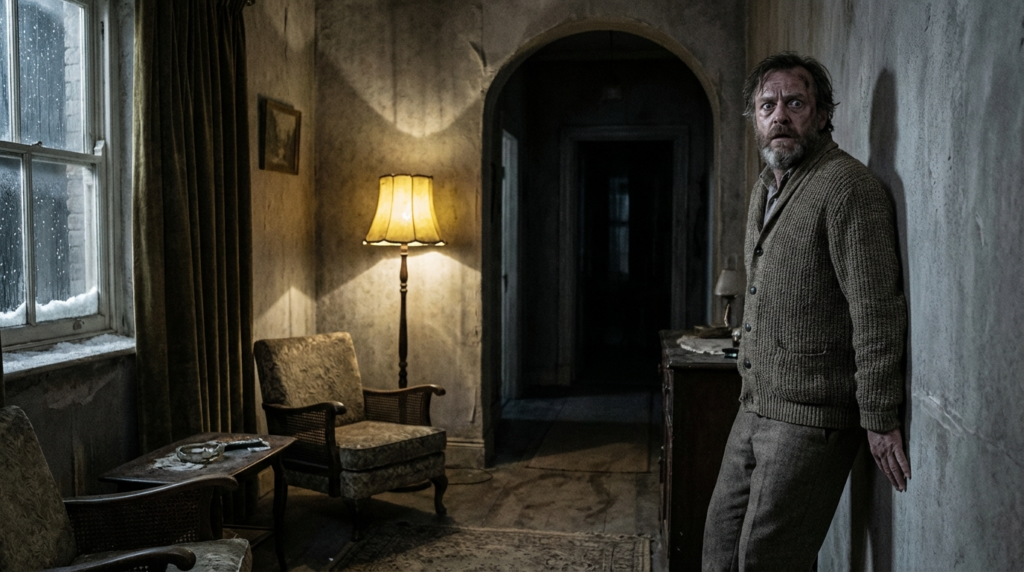
The silence in Elias Thorne’s apartment was not an absence of noise, but a physical presence. It was a dense, heavy thing that settled over the furniture like dust and pooled in the corners of the rooms. Elias, a man whose life was defined by the quiet cataloging of archaic texts at the city library, had lived in this third-floor unit for eleven years. He had grown accustomed to the silence, learned its textures, and, ultimately, found a way to fracture it.
He talked to himself.
It wasn’t the disjointed muttering of the unwell, but a deliberate, conversational narration of his solitary existence. It was a coping mechanism, a way to verify his own presence in a world that largely ignored him.
“Keys on the hook, shoes by the door,” he would announce to the empty foyer upon returning home, the brass hook chiming softly in agreement.
“Let’s see what we have for dinner,” he would say to the humming refrigerator, his voice a low, pleasant baritone that warmed the sterile white kitchen. “Ah, the leftover risotto. A fine choice, Elias. A fine choice indeed.”
It kept the crushing weight of his isolation at bay. It made the apartment feel inhabited, shared, even if the roommate was merely the echo of his own voice bouncing off the faded wallpaper.
It was a Tuesday evening in late November. The world outside the window was a smudged canvas of charcoal gray, sleet tapping a chaotic rhythm against the glass. Inside, the apartment was warm, smelling faintly of old paper, chamomile tea, and the sharp tang of the floor wax he had used over the weekend.
Elias stood by the stove, watching the blue ring of gas heat the copper kettle. The library had been particularly draining that day. A patron had berated him over a misplaced volume of 18th-century tax records, and Elias, as always, had absorbed the vitriol with a bowed head and a polite apology. Now, in the sanctuary of his kitchen, the delayed frustration was beginning to simmer alongside the water.
“Why do I do it?” Elias asked the peeling paint above the stove, his voice tight with lingering humiliation. “Why do I just stand there and let them strip me down to nothing? I should have told him the index was clearly marked.”
He sighed, rubbing the bridge of his nose where his reading glasses usually rested. The skin there felt bruised. The kettle began to sing, a low whistle that steadily climbed in pitch.
“It’s just weakness,” he muttered, reaching out to turn off the burner. The blue flame snapped out of existence. The sudden quiet of the kitchen rushed back in, broken only by the fading hiss of the hot copper. “I am profoundly, pathetically weak. When will I ever learn to stand up for myself?”
It was a rhetorical question, cast out into the empty space of the apartment to dissipate and die.
From the dark, windowless hallway that connected the living room to his bedroom, a voice answered.
“I’ve been wondering the same thing.”
Elias froze. His hand, still hovering over the stove knob, seized with a sudden, violent cramp.
The air in the kitchen seemed to instantly crystallize, dropping ten degrees in a fraction of a second. The hairs on his forearms stood rigidly at attention. It wasn’t the muffled, distorted sound of a neighbor’s television bleeding through the plaster. It wasn’t the ambient noise of the street warped by the wind.
It was clear. It was close. And it was his exact voice.
The cadence, the slight rasp of fatigue, the low baritone pitch—it was a perfect, flawless mirror of the voice he had just used.
Elias didn’t breathe. His lungs burned, straining against his ribs, but he dared not make a sound. He listened, straining his ears so hard that a high-pitched ringing began to manifest in his head. The apartment was dead silent. The sleet tapped against the window. The refrigerator kicked into its cooling cycle with a mechanical shudder.
Nothing else.
A hallucination, his mind scrambled to rationalize, the thought feeling frantic and slippery. Auditory pareidolia. You’re exhausted. Stressed. The brain seeks patterns where there are none. It was a pipe settling. A floorboard groaning.
He forced himself to inhale. The air tasted stale, metallic, like the smell of pennies.
“Hello?” he called out. His voice was an embarrassing croak, stripped of its usual resonance.
Silence.
He swallowed hard, the dry click of his throat sounding deafening in his ears. He needed to move. He needed to prove to his panicking nervous system that he was alone. Slowly, deliberately, Elias turned away from the stove.
The kitchen opened up into the living room, illuminated only by a single floor lamp that cast long, distorted shadows across the faded rug. Beyond the living room was the hallway—a narrow throat of darkness leading to the bathroom and his bedroom. He had never bothered to fix the switch for the overhead light in there; he usually just navigated it by memory.
Tonight, the darkness in that hallway looked impenetrable. It looked solid, like a wall of black water waiting to rush out and drown the living room.
Elias walked to the edge of the living room, his stockinged feet sliding silently over the hardwood. He stopped at the threshold of the hallway. He could smell the familiar scents—the lavender sachets from his dresser, the faint mildew of the bathroom—but beneath them lay something else. A smell like ozone, like the air right before a severe thunderstorm strikes.
“Is someone there?” he asked, louder this time. He tried to inject authority into his tone, but it quavered at the edges.
He waited. He counted to ten in his head.
One. Two. Three…
The silence held.
The tight knot of terror in his chest loosened a fraction of an inch. A nervous, breathy chuckle escaped his lips. “You’re losing your mind, Elias,” he whispered to himself, wiping a cold sheen of sweat from his forehead. “Talking to yourself so much you’re starting to answer back.”
He turned away from the hallway, moving toward his worn leather armchair. He needed to sit down. He needed to drink his tea and read something mundane until his heart stopped hammering against his sternum like a trapped bird.
He sank into the leather, the familiar squeak of the cushions offering a strange comfort. He reached for the remote control on the side table.
“Now,” he murmured, actively trying to normalize the situation by resuming his habit, “where did I put the television guide?”
“Under the stack of mail.”
The voice didn’t come from the hallway this time. It came from directly behind the armchair.
Elias screamed—a raw, visceral sound of pure animal terror that tore at his throat. He vaulted out of the chair, his knees connecting painfully with the coffee table, sending a stack of books crashing to the floor. He scrambled backward, pressing his spine flush against the wall near the window, his chest heaving as he stared at the empty space behind the leather chair.
There was nothing there. Just the blank expanse of beige wallpaper and the dust motes dancing in the lamplight.
But the voice. It had been right in his ear. He could still feel the phantom displacement of air against his neck. He could still smell the ozone.
“Who are you?!” Elias shrieked, his hands gripping the windowsill behind him so tightly his knuckles turned bone-white. “Show yourself! I’m calling the police!”
“Who am I?” the voice asked.
It was drifting now. The source seemed to be shifting around the room. First it came from the corner by the bookshelf, then from the ceiling above the dining table.
“I am the echoes, Elias,” his own voice replied, carrying a tone of deep, sorrowful pity. “I am everything you’ve poured into these empty rooms for eleven years. You fed me every day. Did you think all those words just disappeared?”
Elias’s legs gave out. He slid down the wall, his hands covering his ears, pulling his knees to his chest. He squeezed his eyes shut, trying to block out the impossible reality of the room.
I am asleep. I am asleep in my bed and this is a nightmare. I fell asleep reading.
“You’re not asleep,” the voice said, entirely conversational, originating from the center of the room now. “And you know it. You can feel the cold draft from the window. You can feel the bruise forming on your knee where you hit the table. Nightmares don’t have bruises, Elias.”
It was right. The dull, throbbing pain in his knee was absolute. The cold glass of the windowpane against his back was undeniable.
“What do you want?” Elias sobbed, keeping his hands clamped over his ears, though it did nothing to muffle the sound. The voice wasn’t just entering through his ears; it felt like it was vibrating directly into his jawbone, resonating within his skull.
“I want what you want,” his own voice answered. The sound of footsteps—soft, stockinged feet sliding on hardwood, exactly like his own—began to circle him. Swish. Pause. Swish. Pause. “You asked why you are so weak. You asked why you let people walk all over you.”
“Stop,” Elias begged, tears hot and fast tracking down his cheeks.
“You’ve spent your entire life apologizing for existing,” the voice continued, the footsteps stopping just a few feet in front of him. “You hide in this apartment, talking to the walls because you are terrified of the world. But the walls are full now, Elias. They can’t hold anymore of your pathetic, lonely noise.”
Elias opened his eyes. The living room was empty. The floor lamp continued to cast its yellow glow. The books lay scattered on the rug. But the air directly in front of him shimmered, like heat rising off asphalt in the summer.
“Please,” Elias whispered, staring at the empty space. “Please leave me alone.”
“I can’t,” the voice said, dropping to a low, intimate whisper that seemed to brush against his cheek. “I am you. Just the parts you threw away. The anger you swallowed. The resentment you hid. The confidence you lacked. I’ve been growing in the dark, Elias. Listening to you talk. Learning how to be you.”
The single floor lamp at the edge of the room flickered. Once. Twice. Then the bulb popped with a sharp crack, plunging the room into absolute darkness.
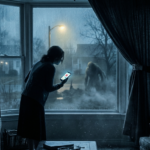
Elias gasped, his hands scrabbling blindly against the floor. The only light came from the pale, sickly glow of the streetlamp filtering through the sleet-streaked window behind him, casting long, skeletal shadows across the floor.
“You’re so quiet now,” the voice mocked from the black maw of the hallway. “Where did all your words go?”
Elias couldn’t speak. His throat was paralyzed. He was hyperventilating, his breaths coming in short, ragged wheezes. The sheer psychological weight of the entity in the room was crushing him. It was a predator born of his own loneliness, and it was starving.
“Let me show you,” the voice said from the darkness.
Suddenly, the apartment erupted with sound.
It was a cacophony of a thousand voices, overlapping, echoing, screaming, whispering, crying. And every single one of them belonged to Elias.
“Keys on the hook.” “I’m so sorry, sir.” “Just a leftover night.” “Why do I do it?” “It’s fine, really.” “I’ll just stay in tonight.” “Pathetic.” “Weak.” “Lonely.”
It was a playback of a decade of isolation, cranked to a deafening volume. It battered against Elias physically. He clamped his hands over his ears and screamed into his knees, but his own scream was instantly swallowed by the maelstrom of his copied voice. The sound pushed at his eardrums, feeling like physical pressure, like descending too fast in deep water. He felt a hot, wet trickle of blood slide from his left nostril.
The voices swirled around him like a cyclone in the dark, tearing at his sanity, shredding his sense of self. They were berating him, laughing at him, weeping for him. He was drowning in an ocean of his own verbal refuse.
He couldn’t take it. His mind began to fracture, the edges of his consciousness curling inward to escape the sensory assault.
“Stop!” Elias finally managed to roar, throwing his head back against the wall. It was the loudest, most aggressive sound he had ever made in his life.
The cacophony stopped instantly.
The silence that slammed back into the room was heavier than before. It felt final.
Elias sat trembling, gasping for air, the metallic taste of blood thick on his tongue. He waited in the dark, his heart hammering a frantic, dying rhythm. Minutes bled into hours. The sleet stopped. The deep, oppressive black of the night slowly began to thin, replaced by the bruised purple of pre-dawn light creeping through the window.
Elias hadn’t moved. His body was locked in a state of rigid catatonia. His mind felt hollowed out, scraped clean.
As the first gray rays of morning illuminated the living room, he realized he was alone. The pressure in the air was gone. The smell of ozone had faded, replaced by the mundane scent of dust and cold tea.
He was alive. He had survived the night.
Slowly, agonizingly, Elias uncurled his stiff limbs. His joints popped, his muscles screaming in protest. He dragged himself up the wall, using the windowsill for support. He stood swaying, looking at his wrecked living room.
The fear was receding, leaving behind a profound, terrifying emptiness.
Suddenly, a sharp, repetitive sound shattered the morning quiet.
Knock. Knock. Knock.
It was his front door.
Elias flinched. He stared at the entryway. Who would be knocking at 6:30 in the morning?
Knock. Knock. Knock.
“Elias?” a muffled voice called through the heavy wood. It was Mrs. Gable, his elderly neighbor from across the hall. “Elias, dear, are you alright? I heard a terrible shout last night. Is everything okay in there?”
Elias felt a surge of desperate relief. A real person. Contact. The nightmare was over. He took a step toward the door. He needed to tell her he was fine. He needed to ask her to call a doctor.
He opened his mouth, taking a deep breath to call out to her.
He pushed the air over his vocal cords.
Nothing happened.
There was no sound. Not a croak, not a whisper, not even the rush of air. His throat moved, his mouth formed the words, but he was entirely, utterly mute. Panic, sharp and icy, spiked through his veins. He grabbed his throat with both hands, his eyes widening in horror as he tried again.
Complete silence.
From the dark, windowless hallway behind him, the sound of soft, stockinged feet sliding against the hardwood began to approach. Swish. Pause. Swish. Pause. Elias froze, a silent scream tearing at his paralyzed vocal cords.
The footsteps stopped right behind him. He could feel the cold radiating from the space at his back.
Then, clear and resonant, carrying the perfect, polite baritone of Elias Thorne, a voice called out to the closed front door.
“I’m perfectly fine, Mrs. Gable! Just had a bit of a nightmare, that’s all. So sorry to have worried you.”
“Oh, alright dear,” the muffled voice of his neighbor replied, sounding relieved. “As long as you’re safe. Have a good day at work.”
“Thank you,” his voice replied from the empty space behind his shoulder. “I’m looking forward to it. It’s a brand new day.”
Elias stood rooted to the floor, staring at the front door. He couldn’t speak. He couldn’t scream. He could only listen as the footsteps behind him turned away, walking purposefully toward the bedroom to get dressed for his life.