Tapping in the Dark – Horror Story is the focus of this in-depth HorrorStuck guide. We examine the known facts, evidence, leading explanations, and the details that still remain uncertain.
Tapping in the Dark – Horror Story: Key Facts and Context
The ocean does not hate you. Hate requires intent, a conscious focus of malice. The ocean is far more terrifying than that. It is completely, boundlessly indifferent. It is a crushing, lightless void that existed long before the first lungs drew breath, and it will remain long after the last.
Elias Thorne knew this better than most. He was a saturation diver, a mechanic who commuted to an office located four hundred feet below the rolling gray surface of the North Sea. Down here, at twelve atmospheres of pressure, the human body was an unwelcome trespasser.
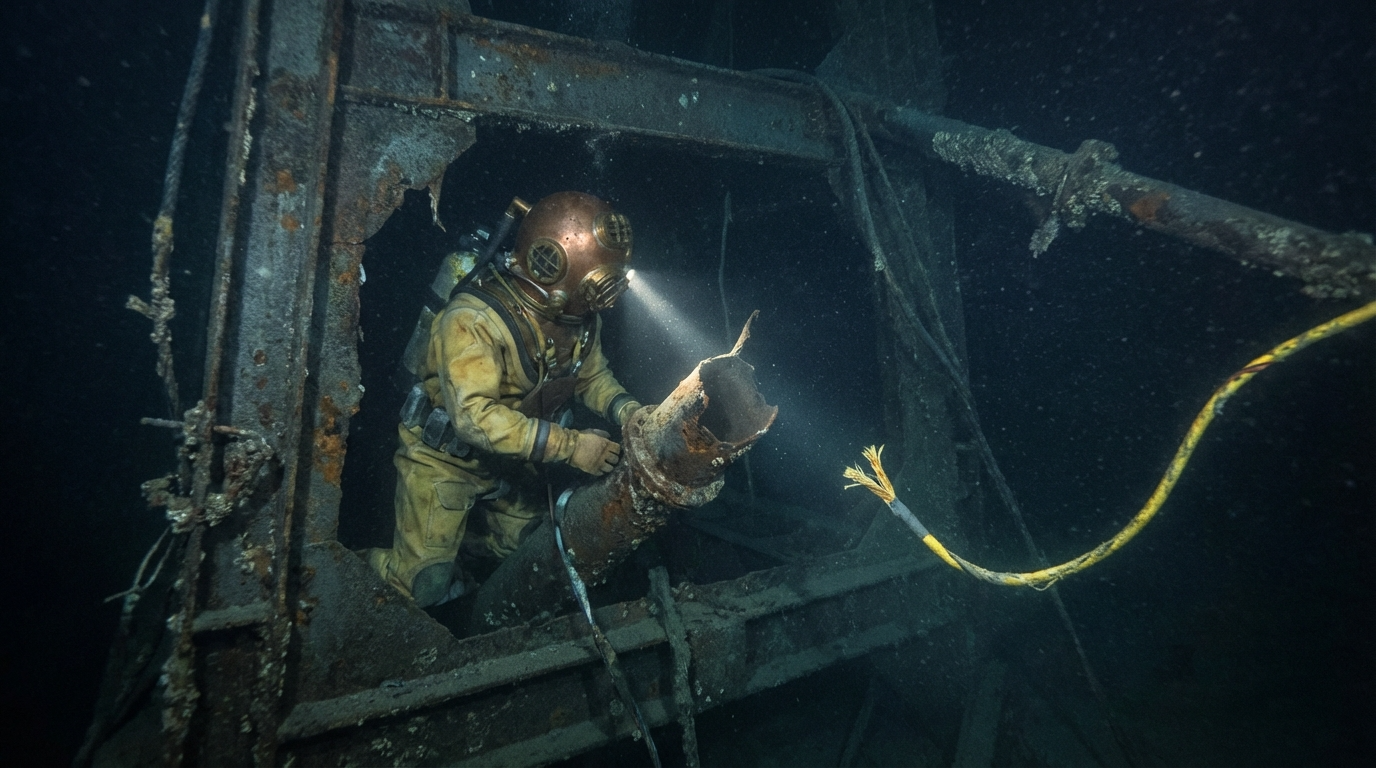
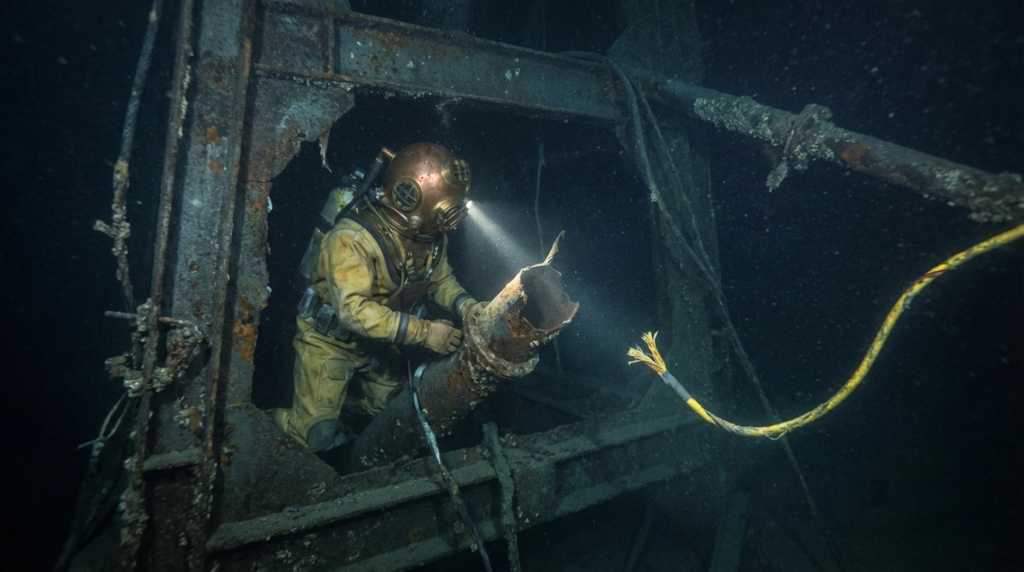
Elias hung suspended in the absolute, ink-black water, the beam of his helmet lamp cutting a weak, dusty cone through the floating particulates. He sounded like Darth Vader in his own ears, each breath a loud, mechanical rasp through the reclaimed gas of his rebreather. The mixture of helium and oxygen he was breathing made his throat dry and pitched his voice into a comical squeak, a stark contrast to the grim reality of his environment.
His suit, a heavy, armored shell of neoprene, brass, and composite plastics, was the only thing keeping the crushing weight of millions of gallons of saltwater from collapsing his ribcage into splinters. Extending from the back of his helmet, disappearing up into the blackness above, was the umbilical—a thick lifeline containing his breathing gas, communication wire, and the hot water that circulated through his suit to keep him from freezing to death in the two-degree Celsius water.
“Control, this is Diver One. Approaching the breach on the port side of the hull. Visibility is less than three meters.”
“Copy that, Diver One,” the voice of topside control crackled in his earpiece, distorted and tinny. “Take it slow, Elias. The telemetry shows the rig is unstable on that shelf.”
The objective was the Prometheus, a massive offshore drilling platform that had suffered a catastrophic structural failure during a localized seismic event three weeks prior. The rig hadn’t collapsed entirely, but a massive lower section of the pontoon had flooded, sinking the platform dangerously low. Elias’s job was to assess the tear in the lower ballast tanks and weld a temporary patch so the salvage crews could pump it out.
Elias reached out a thick, gloved hand, his fingers brushing against the cold, barnacle-encrusted steel of the Prometheus. The metal felt dead, humming only with the distant, unnatural vibration of the ocean currents tearing against it.
He moved hand over hand along the hull, pulling his umbilical behind him like a tethered astronaut. He hated these wreck jobs. There was a claustrophobia to them that open-water diving lacked. Wrecks were mazes of jagged metal, trailing wires, and dark, gaping holes waiting to snag a lifeline.
He rounded the massive curve of the pontoon and found the breach. It was a jagged tear, ten feet high and four feet wide, looking like a wound ripped into the belly of an iron whale. Inside the tear was a maintenance compartment, plunged into absolute darkness.
“I’m at the breach, Control,” Elias reported, his breath fogging the inside of his visor slightly before the defogger cleared it. “Looks like the primary bulkhead doors inside the compartment are sealed, but the outer hull is torn wide open. I’m going to enter the compartment to assess the structural ribbing.”
“Copy, Diver One. Do not proceed past the first compartment. Keep your umbilical clear of the jagged edges.”
Elias pulled himself into the gaping wound of the ship.
The moment he crossed the threshold, the ambient noise of the open ocean—the distant clicks of shrimp, the low hum of currents—was instantly muted, replaced by the suffocating, dead silence of the steel tomb. His helmet beam bounced off the gray walls of the compartment. It was a pump room. Massive, cylindrical pipes ran along the ceiling, and large, dormant machinery sat bolted to the grating on the floor.
He kicked his fins gently, drifting deeper into the room, spooling his umbilical carefully with one hand to keep it taut. He approached the far wall, inspecting the heavy steel ribbing that had buckled inward.
Then, the ocean decided it was done waiting.
It didn’t happen with a roar. It happened with a groan—a deep, resonant shudder that vibrated through the water and straight into the marrow of Elias’s bones. The Prometheus was shifting on the underwater shelf.
“Control, we have movement,” Elias barked, his heart rate spiking, the monitors topside surely flashing yellow.
“Diver One, abort! The rig is sliding! Get out of there, Elias, now!”
Elias didn’t need to be told twice. He turned, grabbing his umbilical to follow it back out to the breach.
Above him, the ceiling of the pump room screamed. The structural integrity of the damaged section finally gave way. A massive, overhead pipe, thicker than an oak tree and weighing several tons, sheared off its mountings.
Elias looked up just as the iron behemoth plummeted through the water.
It didn’t hit him, but it crashed down directly across the path of his exit, slamming into the grating floor and pinning his umbilical against the jagged edge of the hull tear. The sheer force of the impact yanked Elias backward violently. The safety tether on his harness snapped taut, whipping his head back inside his helmet.
And then, a sound that every commercial diver dreads more than anything else in the world.
A sharp, violent hiss, followed by a stream of chaotic bubbles erupting into his vision.
The pipe hadn’t just pinned his umbilical. It had sheared it clean in half against the torn hull.
The communications instantly died. The steady, comforting flow of warm water circulating through his suit stopped. And worst of all, the primary flow of his breathing gas ceased.
Panic, cold and sharp, ignited in his chest. His training kicked in automatically. His right hand shot down to his side, grabbing the valve for his bailout bottle—an emergency tank of gas strapped to his back. He twisted the valve open.
The harsh, metallic bite of the emergency gas flooded his helmet.
He was breathing. But he was trapped.
He swam to the fallen pipe, desperately pulling at the severed, fraying end of his umbilical trapped beneath it. It was completely useless. Topside couldn’t hear him. They couldn’t pull him up.
He checked his wrist computer. The bailout bottle was small. It held exactly twelve minutes of breathing gas at this depth.
Twelve minutes.
He looked around frantically. The water inside the compartment was churning with silt and rust disturbed by the collapse. The way out was completely blocked by the massive pipe and the collapsed ceiling grating. He was sealed inside a steel box, four hundred feet underwater.
He aimed his helmet light upward.
The pump room had a vaulted ceiling, sloping upwards toward an access hatch. And there, trapped against the roof of the compartment, shimmering like a mirror in the beam of his light, was a pocket of air.
When a ship sinks, water doesn’t fill every void immediately. Air gets trapped in the upper cavities, compressed by the pressure of the ocean into a dense, breathable pocket.
Elias didn’t hesitate. He kicked his legs, swimming upwards, fighting the heavy drag of his suit. He broke the surface of the trapped water, his helmet emerging into the air pocket.
He grabbed onto a cluster of overhead cables to secure himself. The water level was at his chest.
He checked his bailout bottle again. Ten minutes. If he stayed on the bottle, he would die in ten minutes. If he took his helmet off and breathed the trapped air, he might have hours. The air would be incredibly dense, pressurized to twelve atmospheres, and likely foul with diesel fumes and rust, but it was oxygen.
He reached up, unlatching the heavy brass locks on his helmet collar. He twisted the helmet and pulled it off, letting it hang by its tether, resting against his chest plate.
He took a breath.
The air tasted like pennies, motor oil, and ancient dust. It was thick, heavy in his lungs, requiring conscious effort to pull in and push out. But it kept him conscious.
He turned off his helmet light to conserve the battery.
Absolute, crushing darkness swallowed him.
It was a darkness so complete that his brain immediately began to try and fill the void, creating swirling, static phantoms in his vision. He closed his eyes; it made no difference.
He was hanging by his arms from the cables, his lower body submerged in the freezing water. The hot water circulation had died with the umbilical. The ocean was already beginning to steal his body heat. Within an hour, hypothermia would set in. Within three, he would fall asleep and slip under the surface.
“Okay,” Elias whispered to the dark. His voice sounded flat and dead, absorbed instantly by the dense air and wet steel. “They know you’re here. They saw the umbilical snap. They will send the bell back down. They will send a rescue diver.”
He just had to wait.
Time loses all meaning in sensory deprivation. Ten minutes felt like an hour. An hour felt like a second. Elias hung there in the pitch black, his teeth beginning to chatter uncontrollably as the cold gnawed at his flesh. He tried to think of his ex-wife, of his daughter’s laugh, trying to anchor his mind to the surface world. But the memories felt thin, paper-fragile against the massive, physical reality of the ocean pressing against the hull all around him.
He was an ant trapped in a tin can, buried under a mountain of water.
The silence was the worst part. He could hear the heavy, wet thud of his own heart, the rasp of his breathing, and the occasional drip… drip of condensation falling from the ceiling into the water around his chest.
Then, the silence broke.
Clack.
It was a sharp, metallic sound. It reverberated through the steel hull of the compartment, echoing in the dense air of the pocket.
Elias stiffened, his breath catching in his throat.
Clack.
It came from the wall to his left. The outer hull of the Prometheus. The side facing the open, lightless expanse of the deep ocean.
Rescue, his brain screamed immediately. They sent an ROV. A remote sub.
“Hey!” Elias shouted, his voice cracking, tearing his throat. “I’m in here! In the air pocket!”
He reached down, unclipped a heavy steel wrench from his tool belt, and slammed it against the wall nearest to him.
CLANG. CLANG. CLANG.
He paused, holding his breath, listening so hard his eardrums ached.
Silence. The water lapped gently against his chest.
Then, an answer.
Tap. Tap. Tap.
It was much softer this time. Not the heavy, mechanical clang of a rescue sub’s manipulator arm. It sounded like a stone hitting glass. Or a bone hitting steel.
Elias frowned in the dark. “Who’s there?” he whispered, though he knew sound couldn’t travel through the hull to the water outside.
Tap. Tap. Tap-tap-tap. Tap. Tap.
Elias’s blood ran cold. The rhythm. It wasn’t random debris striking the rig in the current. It was deliberate. Spaced.
It was Morse code.
Every commercial diver knew Morse code. It was the absolute last line of communication if all electronics failed. You could tap it on a pipe, on a hull, on a helmet.
Elias closed his eyes, focusing entirely on the sounds, translating the rhythmic strikes into letters in his mind.
Dot-dash-dot-dot. (L) Dot. (E) Dash. (T)
Tap-tap-tap. Pause. Tap. Pause. Tap-tap.
Dot-dot-dash. (U) Dot-dot-dot. (S)
Tap. Pause. Dash-dot. (I) Dash-dot. (N)
L-E-T-U-S-I-N.
Elias’s grip on the overhead cables slipped slightly. A violent shiver wracked his body that had nothing to do with the freezing water.
Let us in.
“Nitrogen narcosis,” Elias said aloud, his voice trembling violently. “Carbon dioxide buildup. I’m hallucinating. The air is bad.”
It was the only logical explanation. At this depth, breathing pressurized air, the nitrogen saturating his tissues could act like an anesthetic, causing extreme paranoia, auditory hallucinations, and a loss of rational thought. It was the rapture of the deep. He was losing his mind.
He gripped the wrench tighter and struck the wall again, desperately trying to re-establish control over his failing reality.
CLANG. CLANG. (NO).
He waited.
The response came from a different part of the hull. Directly below him, beneath the surface of the trapped water, near the jagged tear where he had entered.
Tap… tap… tap…
Dot-dot. (I) Dash. (T) Dot-dot-dot. (S)
Pause.
Dash-dot-dash-dot. (C) Dash-dash-dash. (O) Dot-dash-dot-dot. (L) Dash-dot-dot. (D)
I-T-S-C-O-L-D.
Elias squeezed his eyes shut, hot tears mixing with the cold salt water on his face. “Stop it,” he whimpered. “Stop it, you’re not real. It’s just the gas.”
Then, the tapping multiplied.
It didn’t come from just one spot. It started on the left wall. Then the right wall. Then from the ceiling directly above the air pocket.
Tap-tap-tap. Clack-clack. Tap-tap-tap.
Dozens of them. Hundreds of them. A chaotic, overwhelming cacophony of rhythmic striking surrounding his steel tomb. It sounded like a torrential downpour of hail hitting a tin roof, but every single drop was violently hammering out the same, continuous message from every angle.
L-E-T-U-S-I-N L-E-T-U-S-I-N L-E-T-U-S-I-N
The noise was deafening in the confined space. Elias let go of the cables with one hand and pressed it against his ear, screaming in terror. The sound wasn’t just in the room; it felt like it was inside his skull, vibrating through his teeth.
Then, he felt something that made the panic crystallize into pure, absolute horror.
The water level against his chest rose. Just an inch.
The air pocket was shrinking.
He reached down into the black water, fumbling blindly for his helmet. He grabbed it by the brass collar and hauled it up. His hands were shaking so badly he could barely grip the metal. He found the switch for the helmet lamp mounted on the side and clicked it on.
The sudden beam of stark white light blinded him for a second. When his eyes adjusted, he pointed the beam directly down into the dark, churning water beneath him.
The water was crystal clear now. The silt had settled.
The beam of light penetrated the blackness, illuminating the sunken pump room below.
He saw the grating on the floor. He saw the massive pipe that had crushed his umbilical.
And he saw them.
Gathered around the edges of the room, clinging to the walls, the ceiling, and the jagged edges of the hull tear, were figures.
They were humanoid, but they were deeply, fundamentally wrong. They possessed no diving suits, no tanks, no masks. Their skin was the color of drowned pearls, translucent and bloated, glowing with a faint, sickly bioluminescence in the darkness of the deep. Their limbs were impossibly elongated, ending in hands with too many joints, their fingers tipped with hardened, blackened cartilage that they were using to strike the steel.
They were perfectly adapted to the crushing pressure of the abyss.
Elias stared down at them, his mind finally, irrevocably snapping under the weight of the impossible.
As the beam of his helmet light swept over them, the tapping abruptly stopped. Total silence crashed back into the room.
Every single one of the pale figures slowly turned their heads upward, looking directly into the beam of light. They had no eyes. Just smooth, pale hollows beneath heavy brow ridges. But their mouths were massive—gaping, black maws filled with rows of needle-thin, translucent teeth.
The figure closest to Elias, hovering just a few feet below the surface of the water, raised a long, spindly arm. It reached up, its pale, multi-jointed fingers breaking the surface of the water, reaching into the air pocket.
The creature’s mouth stretched open impossibly wide, revealing the dark void of its throat.
It didn’t speak. It didn’t make a sound.
It simply raised its blackened fingernail, looked directly at Elias with its empty, eyeless sockets, and tapped the air, mimicking a telegraph key.
Dot-dash-dot-dot. Dot. Dash.
L-E-T.
Elias dropped the helmet. It splashed into the water, the beam of light spinning wildly as it sank into the dark, illuminating flashes of pale skin and reaching hands before hitting the grating below and shorting out entirely.
Absolute darkness returned.
Elias hung in the pitch black, his heart failing, his breath hitching as the icy water rose another inch, swallowing his collarbone.
From the darkness directly beside his ear, less than an inch from his face, he heard the softest, wettest sound of cartilage gently tapping against his shoulder plate.
Dash-dot. Dash-dot.
I-N.
Further Reading & External Resources
Ultimately, Tapping in the Dark – Horror Story remains compelling because the documented evidence answers some questions while leaving others open to careful investigation.