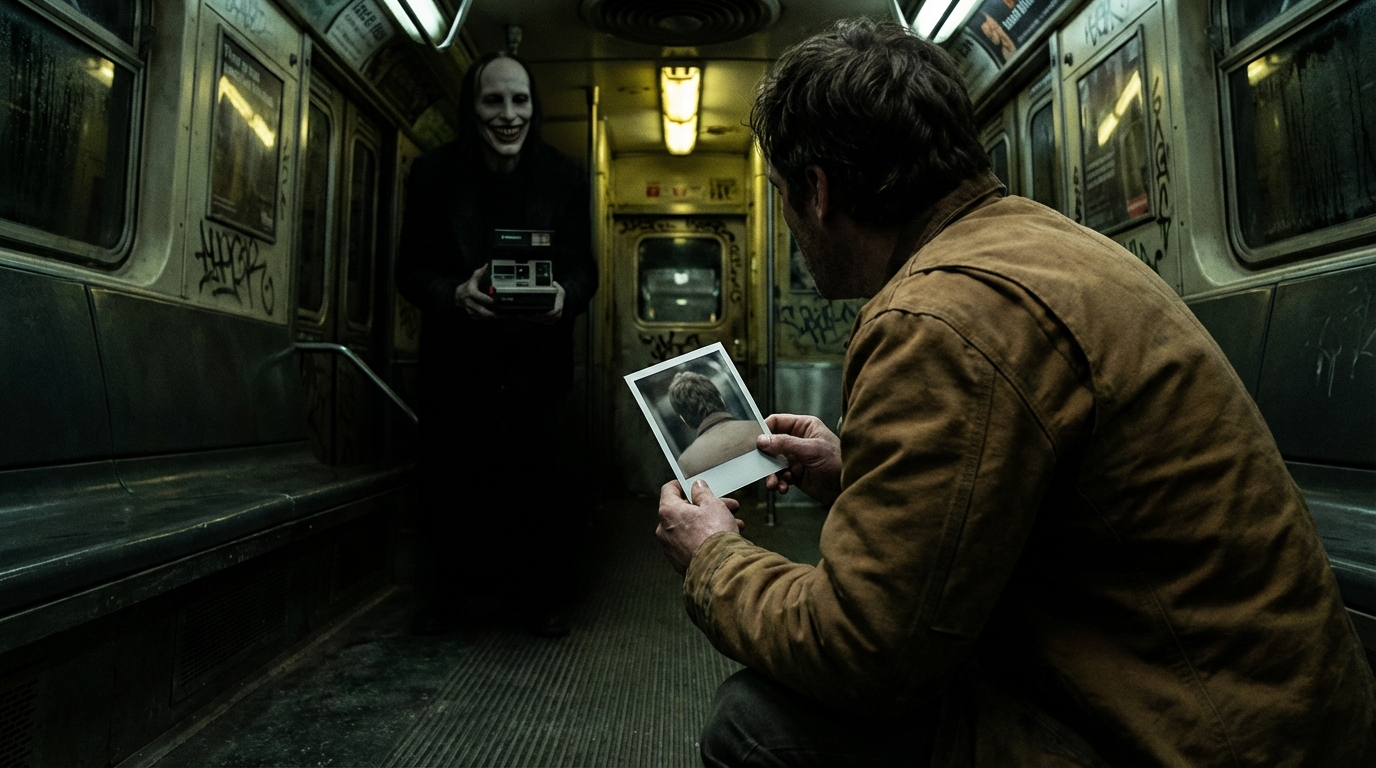
Polaroids – Horror Story is the focus of this in-depth HorrorStuck guide. We examine the known facts, evidence, leading explanations, and the details that still remain uncertain.
Polaroids – Horror Story: Key Facts and Context
The air at the end of the line always tasted like metal. It was a sharp, coppery tang of ozone, pulverized brake dust, and the stale, lingering humidity of a million exhaling commuters who had come and gone hours ago.
Marcus wiped a bead of sweat from his forehead with the back of a gloved hand. He leaned against the heavy yellow handle of his mop bucket, the squeaky rubber wheels protesting the shift in weight. It was 3:17 AM. He was three hundred feet below the sleeping city, deep in the maintenance turnaround of the Broad Street Line. The terminal was a cavernous cylinder of ribbed concrete, illuminated by flickering sodium lights that painted everything in a jaundiced, sickly yellow.
On the tracks beside him sat Train 409. It was a massive, six-car metal centipede, entirely devoid of life. Its doors were locked open, waiting for Marcus to sanitize its hollow gut before the morning rush.
He was a man who appreciated the graveyard shift. Marcus didn’t like people. People were messy. They spilled coffee, they dropped half-eaten food, they left behind the sticky, unidentifiable residue of their chaotic lives. Down here, in the graveyard hours, Marcus was the sole authority. He was the eraser. He brought order to the subterranean world.
He unhooked his heavy keyring from his belt, the metallic jingle echoing loudly off the curved concrete walls, and stepped through the open doors into Car Number Four.
The fluorescent tubes overhead buzzed with a low, angry hum, a frequency that vibrated right at the base of his skull. The car smelled of industrial bleach and old vinyl. It was relatively clean. A few discarded newspapers, a crushed soda can rolling lazily across the ribbed rubber floor as the train settled on its suspension.
Marcus started his routine. He pushed the rolling trash barrel ahead of him, moving methodically from seat to seat, his eyes scanning for debris.
Halfway down the car, tucked neatly onto a bright orange plastic seat, was a small white square.
Marcus paused. It wasn’t crumpled. It wasn’t tossed casually. It was placed deliberately in the absolute center of the seat cushion. He pushed the cart forward and reached out with his thick, yellow rubber glove.
It was a photograph. A Polaroid.
The thick, glossy paper felt rigid between his thick rubber fingers. The iconic white border framed a square image that was slightly underexposed, bathed in the grainy, low-light aesthetic typical of instant film.
Marcus lifted it closer to his face, squinting in the harsh fluorescent light.
It was a picture of a bedroom. A small, cramped room with peeling paint near the baseboards. A cheap floor lamp cast a dim, amber glow across a twin bed pushed flush against the wall. A man was asleep in the bed, lying on his side, his face half-buried in a flat pillow. The perspective of the shot suggested the photographer was standing right in the doorway of the room.
Marcus felt a strange, cold flutter in his stomach.
He stared at the peeling paint in the photograph. He stared at the dark blue comforter covering the sleeping man. He recognized the specific, jagged tear in the fabric near the corner of the blanket.
He recognized the man’s face.
It was him.
The breath caught in his throat, refusing to move past his vocal cords. His heart, previously beating a slow, steady rhythm, gave a sudden, violent lurch against his ribs.
“What the hell,” Marcus whispered. His voice was swallowed instantly by the vast, empty acoustics of the train car.
He pulled the photo inches from his eyes. He scrutinized the details. The digital alarm clock on the nightstand in the picture read 11:45 AM. That was yesterday morning. He had been asleep, exhausted from his previous shift.
Someone was in my apartment.
The thought hit him with the force of a physical blow. His mind raced, scrambling for a rational explanation. A prank. It has to be a prank. One of the guys from the day shift. Miller or Jackson. They got ahold of my keys. They sneaked in while I was sleeping to mess with me.
But Marcus didn’t hang out with the day shift guys. He barely spoke to them. He was notoriously private, bordering on paranoid. He had three deadbolts on his apartment door. He checked them obsessively. How could anyone have gotten in? And to leave it here, exactly on the train he was scheduled to clean?
His hands began to shake, the thick rubber gloves squeaking slightly against the glossy surface of the Polaroid.
He shoved the photograph into the front pocket of his heavy canvas work jacket. Suddenly, the empty train car didn’t feel like a sanctuary. The fluorescent lights seemed too bright, casting stark, aggressive shadows beneath the seats. The hum of the electrical systems sounded like a swarm of angry wasps.
Marcus reached up to the radio clipped to his shoulder harness. He pressed the transmit button.
“Dispatch, this is Maintenance Two. Come in.”
A burst of loud, hissing static erupted from the speaker, followed by silence.
“Dispatch, this is Marcus. You reading me?”
More static. Down in the turnaround tunnels, radio reception was notoriously spotty, relying on repeater boxes bolted to the concrete walls. Sometimes they worked perfectly. Tonight, all he got was the white noise of dead air.
He let go of the button. He needed to finish the train, get back to the platform, and use the hardline phone in the supervisor’s booth to call the police. He wasn’t going back to his apartment until the cops cleared it.
He abandoned his trash cart in Car Four. He didn’t care about the empty soda cans anymore. He grabbed his heavy, heavy-duty Maglite flashlight from his belt. The solid weight of the machined aluminum offered a meager comfort.
He walked to the end of the car and stepped through the heavy sliding door into Car Number Five.
The transition between cars was always loud. The metal grating of the coupling plates shifted under his boots. He pushed through the second door and stepped into the next car.
The air in Car Five was noticeably colder. The lights flickered sporadically, the aging ballasts struggling to maintain a steady current.
Marcus stood perfectly still just inside the door, his eyes scanning the length of the car. He half-expected to see Miller or Jackson sitting there, laughing at him.
The car was empty.
But halfway down the aisle, resting precisely on the floor in the center of the walkway, was another white square.
Marcus’s stomach plummeted. The metallic taste of fear flooded his mouth, thick and bitter. He didn’t want to walk toward it. His instincts screamed at him to turn around, run back through Car Four, jump off the train, and sprint back up the tunnel to the platform.
But a morbid, terrifying gravity pulled him forward.
His heavy boots felt like lead blocks as he walked down the aisle. Each step echoed loudly, the sound bouncing off the dirty windows. He stopped in front of the white square. He knelt down, the joints in his knees popping loudly, and picked it up.
It was a second Polaroid.
This one was not taken from the doorway.
The photographer had moved into the room. They were standing at the foot of his bed.
The angle was looking directly down the length of Marcus’s sleeping body. The amber light from the cheap lamp cast deep, bruised shadows across his face. He could see his own chest rising and falling in the still frame. The tear in the blue blanket was clearly visible in the foreground.
Marcus felt a wave of nausea wash over him. He dropped the heavy Maglite. It hit the rubber floor with a loud clack, rolling under a seat. He didn’t bother to retrieve it.
He traced his thumb over the glossy surface of the photo. It was spotless. No dust, no fingerprints.
Someone stood at the foot of my bed while I slept. They watched me breathe.
He felt violated. The sanctity of his locked apartment, his only safe space in a crowded, dirty city, had been completely shattered. But the violation was eclipsed by a rapidly mounting, primal terror.
Why leave them here? Why string him along car by car?
This wasn’t a prank. This was a hunt.
Marcus stumbled backward, his back hitting one of the vertical metal poles used by standing passengers. He gripped it tightly, his knuckles turning white beneath the rubber gloves. He looked wildly around the empty train car. He checked the reflection in the dark windows, looking for movement, looking for a shadow that didn’t belong to him.
Nothing. Just his own pale, terrified face staring back at him from the glass.
“Who’s there?!” Marcus yelled. His voice cracked, sounding shrill and panicked. “I’m calling the cops! You hear me? The police are already on their way!”
It was a bluff, and it sounded like one. The silence of the train absorbed his shout without a ripple.
He had to get out.
He spun around to head back to Car Four, to the open doors that led out to the tunnel platform.
He gripped the handle of the sliding door connecting the cars and yanked.
It didn’t move.
Marcus frowned. He planted his boots, gripped the handle with both hands, and threw his entire weight backward. The heavy metal door rattled in its tracks, but it refused to slide open. It was jammed shut.
Panic, cold and sharp, spiked through his nervous system. “No, no, no,” he muttered, kicking the base of the door with his steel-toed boot. BANG. The door held fast.
He was locked in. The only way forward was to proceed to the final car—Car Number Six. The end of the train.
He turned his back to the jammed door. The long, narrow corridor of Car Five stretched out before him, leading to the sliding door of the final car.
He began to walk. He wasn’t moving methodically anymore. He was moving with the frantic, jerky energy of prey. He kept his back close to the windows, his head swiveling side to side, checking underneath the seats.
He reached the sliding door to Car Six. He hesitated, his gloved hand trembling violently as it hovered over the handle.
He didn’t want to open it. He knew what was waiting in there. The final piece of the puzzle. The culmination of the nightmare.
But he had no choice.
He gripped the handle and pulled.
The door slid open with a screech of metal on metal that sounded like a tortured scream.
Marcus stepped into Car Six.
The lights in the final car were dead.
The entire carriage was plunged into absolute darkness, illuminated only by the faint, ambient yellow glow bleeding in from the tunnel lights outside the windows. The silence here was different. It wasn’t just the absence of sound; it was an oppressive, heavy pressure that seemed to push against his eardrums.
He regretted dropping his flashlight in the previous car. He patted his pockets, his frantic hands finding his cheap plastic lighter. He pulled it out and flicked the wheel.
A small, dancing orange flame flared to life, casting long, wavering shadows across the empty seats.
He held the lighter out in front of him like a talisman.
“Is anyone there?” he whispered.
He took a step forward. Then another. The flame cast a meager circle of light, barely illuminating the aisle three feet ahead.
He reached the center of the car.
Resting on the floor, perfectly centered, catching the dim light of the lighter flame, was the third Polaroid.
Marcus didn’t kneel this time. He crouched slowly, his legs burning with tension, ready to spring up and run at the slightest noise. He picked up the photo with two trembling fingers.
He brought it close to the flame.
The photographer was no longer at the foot of the bed.
The image was an extreme close-up of Marcus’s face. The camera lens must have been mere inches from his nose when the flash went off. He could see the individual pores on his skin, the slight stubble on his chin, the drool pooling at the corner of his open mouth.
It was a portrait of total vulnerability. The photographer could have reached out and slit his throat without taking a single step.
But that wasn’t the worst part.
Marcus stared at the dark background of the photograph, the area just behind his sleeping head. In the deep shadows of his apartment wall, illuminated only slightly by the harsh flash of the camera, was a shape.
It wasn’t a piece of furniture. It wasn’t a shadow cast by the lamp.
It was a face.
It was a pale, hairless face, incredibly long and gaunt, with eyes that caught the camera flash like the reflective tapetum of a nocturnal animal. It was smiling—a wide, unnatural stretching of lips that revealed far too many thin, needle-like teeth.
It had been leaning over him. Watching him. Smiling for the camera.
Marcus let out a strangled sob. The lighter slipped from his slick fingers, hitting the floor and instantly extinguishing.
He was plunged back into the dark.
He backed up until his spine hit the side of the train. He slid down the wall, clutching the third Polaroid to his chest, hyperventilating. His mind fractured, unable to process the sheer, impossible horror of the entity in his room.
It was there. It was right there and I didn’t wake up.
He sat in the dark for what felt like hours, listening to his own ragged breathing. The smell of ozone and bleach was gone, replaced by a sudden, sharp, chemical odor.
It smelled like developing fluid.
Marcus stopped breathing. He froze perfectly still.
The smell was fresh. It was pungent. It was coming from the very front of the car, near the locked driver’s cabin.
He slowly pushed himself up the wall. He needed to see. He needed to know if he was alone in the dark.
He crawled forward on his hands and knees, keeping his profile as low as possible, sliding between the rows of seats. The rubber floor squeaked softly beneath him.
He reached the front of the car. The heavy metal door leading to the driver’s compartment was closed.
But there, on the floor directly in front of the door, barely visible in the faint tunnel light, was a fourth Polaroid.
Marcus reached out.
The photo was warm.
The thick paper was actually radiating a faint heat. It hadn’t been here for hours like the others. It had just been ejected from the camera.
Marcus picked it up. He squinted in the dim light.
The image was entirely gray. It was still developing.
He watched, paralyzed by an absolute, cosmic dread, as the chemicals reacted, pulling the image from the ether into reality.
Dark shapes began to form. The ribbed texture of a rubber floor. The orange plastic of subway seats. The dark expanse of a train window.
The background was Car Number Six.
Then, the subject of the photo began to materialize in the center of the frame.
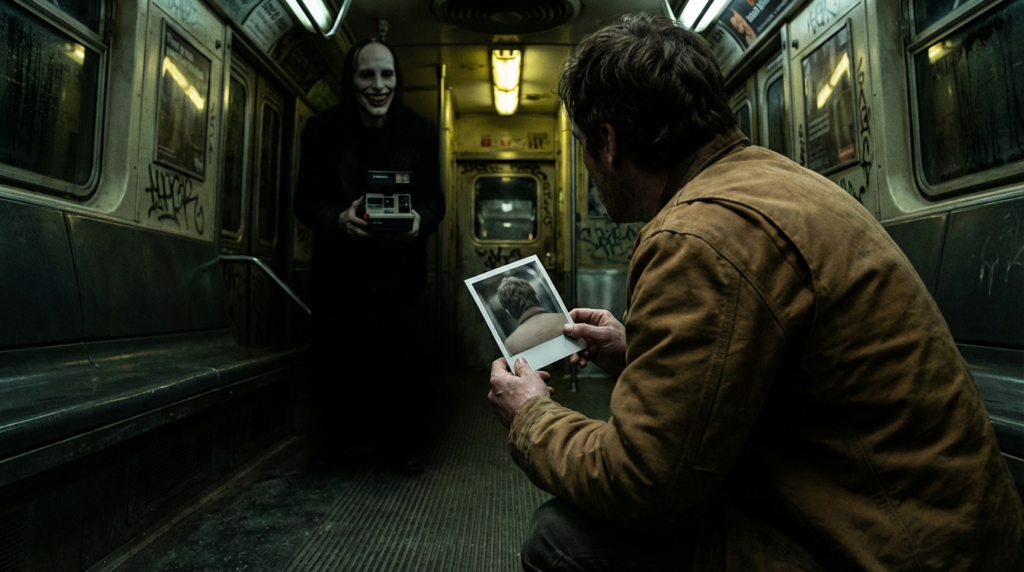
It was the back of a man’s head. The man was wearing a heavy canvas work jacket. A yellow rubber glove was visible near the bottom of the frame, holding something square.
Marcus was looking at a photograph of the back of his own head.
He was looking at a photograph of himself, kneeling on the floor of Car Six, holding a photograph.
The perspective of the shot was looking slightly downward.
The photographer was standing directly behind him. Right now.
Every nerve in Marcus’s body screamed. The hairs on the back of his neck stood on end. He felt a sudden, freezing drop in temperature in the air directly behind his spine. He could smell it now—beneath the chemical tang of the Polaroid film was the foul, stagnant stench of something old and dead.
He heard a sound.
It was a slow, wet inhalation, like air being drawn through a crushed windpipe.
Marcus couldn’t move. He was locked in a state of absolute, petrifying terror. His brain demanded he turn around, demanded he fight, but his muscles were utterly unresponsive.
Right beside his left ear, so close he could feel the unnatural cold of its breath, a voice whispered. It didn’t sound human. It sounded like the grinding of dry bones and the tearing of wet meat.
“Smile.”
A deafening, high-pitched whine filled the air—the sound of a camera flash capacitor charging to full capacity.
Marcus closed his eyes.
Whir-click.
The blinding white light of the flash exploded in the dark car, illuminating the glass window directly in front of him like a mirror.
For a fraction of a second before the darkness swallowed him completely, the flash burned an image into his retinas.
He saw his own terrified face in the glass.
And directly behind him, looming over his shoulder, he saw the pale, hairless face from the photograph, its jaw unhinged, revealing rows of needle-like teeth, its pale, multi-jointed fingers holding a vintage Polaroid camera right next to his head.
The flash faded.
The darkness returned.
And Marcus was no longer alone in the dark.
Further Reading & External Resources
Ultimately, Polaroids – Horror Story remains compelling because the documented evidence answers some questions while leaving others open to careful investigation.