Violet Hour – Horror Story is the focus of this in-depth HorrorStuck guide. We examine the known facts, evidence, leading explanations, and the details that still remain uncertain.
Violet Hour – Horror Story: Key Facts and Context
The digital clock on the microwave read 3:14 AM. Its glowing green numbers were the sharpest things in the otherwise muted, shadowy expanse of Clara’s kitchen.
Clara stood barefoot on the cold linoleum, the ceramic mug of chamomile tea warming the palms of her hands, though the heat did little to thaw the deep, persistent chill in her chest. She had lived in the sprawling, manicured subdivision of Whispering Pines for exactly three weeks. She had moved here to escape the suffocating pity of her family in the city, to outrun the memories of the car accident, and to find a place where the nights were quiet.
She had found the quiet. But she had also found that silence in the suburbs was not a peaceful thing; it was a vacuum, waiting to be filled.
Sleep was a luxury she hadn’t afforded herself since the crash. Every time she closed her eyes, she heard the crunch of metal, smelled the acrid bite of deployed airbags, and saw her sister’s vacant stare in the passenger seat. So, Clara stayed awake. She paced the pristine, empty rooms of her new, heavily mortgaged house. She listened to the settling of the foundation, the hum of the refrigerator, and the rhythmic, metronomic tick-tick-tick of the grandfather clock in the hallway.
She took a sip of her tea. It was lukewarm, tasting faintly of dust and dried flowers.
She walked out of the kitchen, her bare feet sinking into the thick, plush carpet of the living room. The room was dominated by a large, brick fireplace that she had never used, its dark hearth looking like a square, open mouth set into the wall. Beyond the living room was the large bay window that looked out onto Elm Street.
Clara approached the window, pulling the heavy curtain back just a fraction of an inch to peer outside.
Whispering Pines was a community of identical two-story colonial homes, each boasting perfectly manicured lawns, sensible sedans in the driveways, and tall, imposing streetlights that bathed the neighborhood in a warm, sodium-orange glow. It was a sterile, safe environment. A place where nothing bad was supposed to happen.
Clara checked her watch. 3:24 AM.
Her heart began its nightly acceleration, a slow, heavy thudding against her ribs. Her mouth grew dry, the metallic taste of anxiety coating her tongue. She didn’t want to watch, but a morbid, paralyzed fascination kept her rooted to the spot by the window.
She had noticed the phenomenon on her fourth night in the house. She had tried to convince herself it was an electrical surge, a trick of her exhausted, trauma-riddled brain. She had even called the city’s public works department, only to be met with a confused operator who assured her there were no reported issues with the grid on Elm Street.
But Clara knew what she saw. And she knew it was about to happen again.
3:29 AM.
The street was utterly deserted. Not a single car drove past. No wind rustled the leaves of the decorative maple trees. The silence was absolute, pressing against the double-paned glass of her window like water against a submarine.
3:31 AM.
Clara swallowed hard. She could feel the hairs on her arms begin to rise. A strange, localized drop in barometric pressure seemed to squeeze the air out of her living room, making it difficult to draw a full breath. The temperature in the house dropped several degrees, the cold seeping through the glass and biting at her cheeks.
3:32 AM.
Click.
It wasn’t a loud sound, but in the dead silence of the night, it sounded like a gunshot. The sound came from the streetlights. All of them, simultaneously.
3:33 AM.
The warm, orange glow of the sodium bulbs vanished, plunging the street into a split-second of pitch black. Then, they snapped back on.
But the light was wrong.
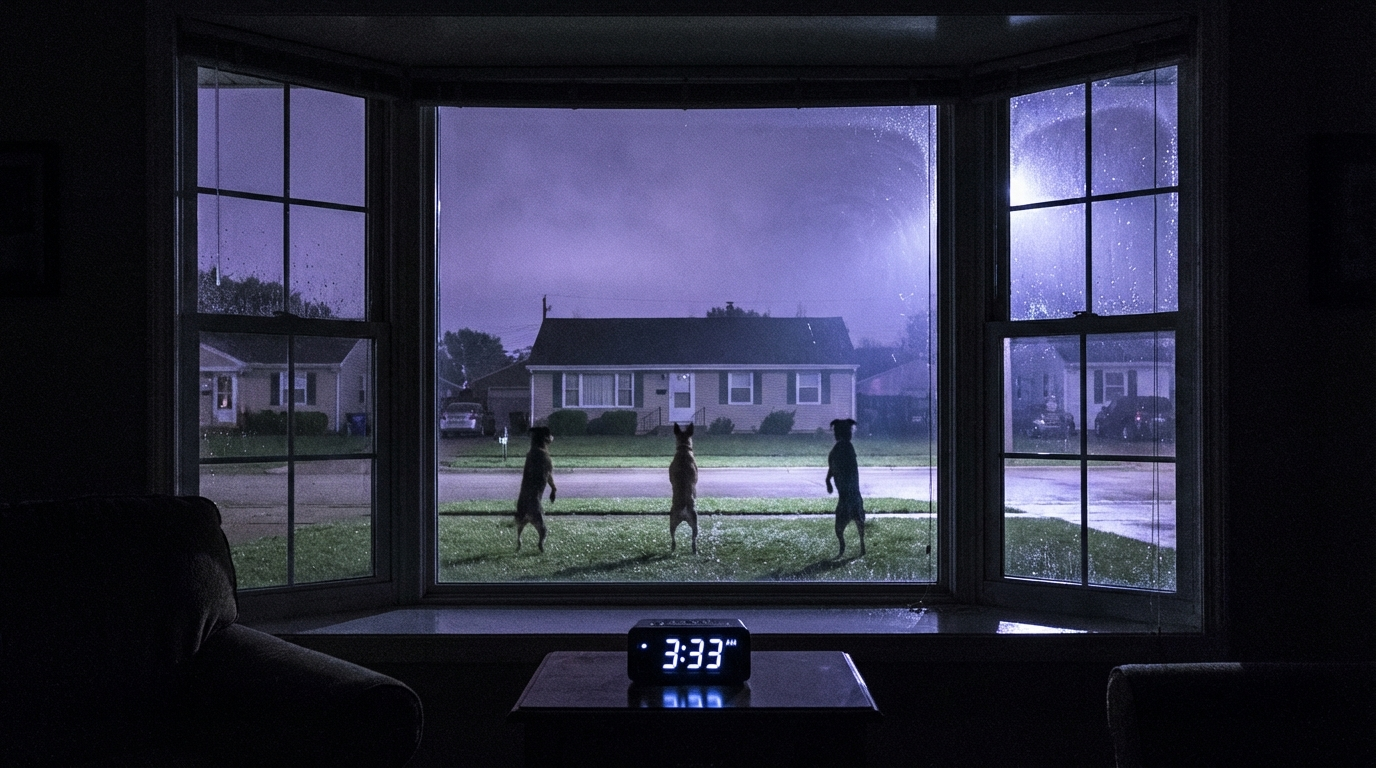
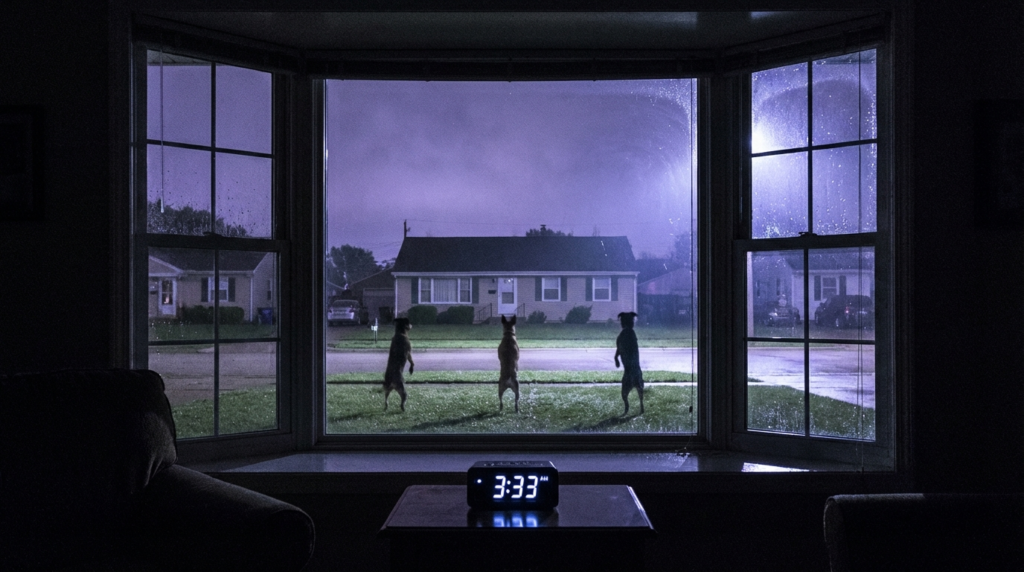
It was a sickly, bruised violet. The color of old, stagnant blood pooling beneath the skin. It wasn’t a light that illuminated; it was a light that stained. It washed over the manicured lawns, turning the green grass into a dark, rotting purple. It hit the white siding of the houses across the street, making them look like rows of necrotic teeth.
The violet light bled through Clara’s window, casting long, distorted, purplish shadows across her living room carpet. It made her pale hands look corpselike. It made the room feel instantly diseased.
Clara squeezed her eyes shut, her breathing coming in short, ragged gasps. It’s just a power issue. It’s just a bulb defect. You are safe. You are inside. The doors are locked.
She opened her eyes.
The neighborhood dogs had arrived.
This was the part that broke her mind a little more every night. Clara watched as Mrs. Gable’s golden retriever, a usually dopey, affectionate animal, walked out from the side yard of the house directly across the street. The dog moved stiffly, its head completely rigid.
It walked to the center of the violet-stained lawn and stopped.
Slowly, unnaturally, the dog hoisted itself up onto its hind legs. Its front paws dangled limply against its chest. Its spine straightened with a sickening pop that Clara could hear even through the insulated glass.
Down the street, two more dogs—a beagle and a large German shepherd—emerged from their respective yards. They, too, walked to the center of their lawns, stood up on their hind legs, and became perfectly still.
None of them barked. None of them growled. The silence was maddening.
They were all staring at Clara’s house.
No, Clara realized, her stomach dropping into a bottomless pit of cold terror. They weren’t staring at her house. They were staring up. They were staring at the roof.
Clara pressed her forehead against the cold glass, trying to look up at her own roofline, but the angle was impossible. The dogs, bathed in the sickly violet light, looked like grotesque, furry men in cheap costumes. Their eyes caught the purple glow, reflecting it back as flat, dead discs.
For three weeks, this had been the routine. The lights would change, the dogs would stand, stare at her roof for exactly one hour, and then, at 4:33 AM, the orange lights would snap back, the dogs would drop to all fours and trot home, and the world would resume its mundane rotation.
But tonight, the air in the living room felt heavier. The violet light filtering through the window seemed thicker, almost viscous.
Then, Clara heard it.
THUD.
The sound came from directly above her head. It was a heavy, substantial impact, shaking the plaster of the ceiling. A small shower of white dust drifted down from the ceiling fan, sparkling in the purple light.
Clara froze, the mug of tea slipping from her numb fingers. It hit the carpet with a dull thud, the lukewarm liquid soaking quickly into the fibers.
It’s a branch, her mind screamed desperately, scrambling for any logical handhold. A heavy branch broke off the pine tree in the backyard.
But there was no wind. And the sound hadn’t been the sharp crack of timber. It had been dense, fleshy, and heavy. Like a sack of wet cement being dropped from a great height.
Clara backed away from the window, her eyes fixed on the ceiling. She held her breath, the silence of the house roaring in her ears.
Scraaaape. Squelch.
The thing on the roof moved.
It wasn’t walking. There were no distinct footsteps. It was a continuous, heavy, dragging sound, accompanied by a wet, suctioning noise, like thick mud being pulled apart. The shingles groaned under its immense weight.
It was moving toward the center of the house. Toward the chimney.
Panic, absolute and unfiltered, seized Clara’s chest in a vice grip. She spun around and ran to the kitchen. She grabbed her smartphone from the counter. The screen lit up—no service. The bars in the top corner were completely empty. She rushed to the wall-mounted landline, snatching the receiver from the cradle and pressing it to her ear.
There was no dial tone. Instead, a low, rhythmic static whispered from the earpiece. It sounded like the wet, ragged breathing of someone with a crushed throat.
Clara slammed the phone back onto the wall, tears of sheer terror welling in her eyes. She was cut off. She was isolated in a house bathed in bruised light, surrounded by bipedal dogs standing like silent sentinels, while something impossibly heavy dragged itself across her roof.
She needed to leave. She needed to get to her car.
She ran to the front door, her hands shaking so violently she could barely grasp the deadbolt. She turned it, the metal clicking loudly. She grabbed the handle and yanked.
The door didn’t budge.
It wasn’t locked. It felt fused. She pulled harder, planting her feet, whimpering with exertion. The wood groaned, but the door remained entirely solid, as if the frame itself had sealed shut.
Scraaaape. Squelch.
The sound was directly over the living room now. Right above the fireplace.
Clara backed away from the front door, retreating into the hallway. The grandfather clock ticked on, oblivious to the nightmare unfolding. Tick. Tick. Tick. Above her, the dragging sound stopped.
A moment of agonizing, breathless silence stretched out. Clara stood in the hallway, looking into the living room, staring at the dark, open mouth of the fireplace.
From the roof, a new sound emerged. A grating, metallic screech. The heavy iron cap on top of the chimney was being pried off.
The screech ended with a heavy, muffled clang as the iron cap was tossed onto the roof shingles.
Clara backed up until her spine hit the hallway wall. She slid down to the floor, pulling her knees to her chest, pressing her hands over her mouth to muffle the sound of her own hyperventilation.
From inside the chimney wall, the descent began.
It was not a fast fall. Whatever had entered the flue was far too large for the narrow brick shaft. It was forcing itself down.
Slidddde. Scrap.
Clara could hear the wet, fleshy mass of the thing compressing against the rough bricks. The sound was visceral, echoing loudly in the quiet house. It sounded like a massive piece of raw meat being shoved through a meat grinder.
Squish. Scrap.
With every downward movement, a shower of black soot and decades-old ash cascaded down the flue, hitting the hearth with a soft, hissing sound.
The smell hit her next.
It seeped out from the fireplace, rolling across the carpet like an invisible fog. It was a complex, horrific odor. It smelled like stagnant swamp water, ozone, oxidized copper, and underneath it all, the sweet, cloying stench of rot. It was the smell of things that had been dead for a very, very long time, dredged up from the bottom of a cold lake.
Clara gagged, the smell burning her nostrils and coating the back of her throat with a foul taste. She squeezed her eyes shut, rocking back and forth on the floor.
Please, she prayed to a god she hadn’t spoken to since the car crash. Please, let it be an animal. Let it be a raccoon. Let me wake up.
Scrap. Tear.
The sound was lower now. It was past the second-floor bedrooms. It was in the main shaft behind the living room wall.
The entity paused.
Through the thick drywall, Clara could hear it breathing. It was a wet, laboring sound, the air bubbling through whatever mucus and fluid coated its form.
“Sarah,” Clara whispered, the name of her dead sister escaping her lips like a curse. Guilt, heavy and suffocating, mixed with the terror. Is this it? Is this my punishment? Did the universe finally send something to collect the debt?
Inside the chimney, the thing began to move again. Faster now.
Scrap-squish-scrap-squish.
The brickwork of the fireplace groaned under the internal pressure. A fine spiderweb crack appeared in the mortar between the bricks above the mantle.
A massive clump of wet, black soot plummeted down the chimney, exploding into a dark cloud on the hearth.
Clara could see the fireplace from where she sat in the hallway. The violet light from the window illuminated the hearth in a bruised, dim glow.
The sound reached the damper just above the firebox. The heavy cast-iron flap, rusted shut for years, screamed as immense pressure was applied from above.
BANG.
The damper gave way, the metal snapping with the sound of a fractured bone. A torrent of ash, dead leaves, and mummified bird bones poured into the fireplace, spilling out onto the carpet.
Clara clamped her hands over her ears, burying her face in her knees, trembling so violently her teeth rattled together. She couldn’t look. She refused to look.
The heavy, wet sound transitioned from the vertical shaft to the horizontal firebox.
Slop.
Something massive and formless dropped onto the brick hearth.
The room went dead silent. Even the grandfather clock seemed to pause its ticking. The dogs outside remained perfectly still in the violet light.
The smell in the house was now overpowering, a physical weight that made Clara’s eyes water and her stomach heave.
She waited. She waited for the thing to charge her, to tear her apart, to exact whatever vengeance it had come for.
But it didn’t move.
Minutes ticked by in absolute, agonizing stillness. The only sound was the wet, bubbling respiration of the thing in the fireplace, and the frantic hammering of Clara’s own heart.
Slowly, driven by a primal need to know her doom, Clara lowered her hands from her ears. She lifted her head from her knees. She opened her eyes and looked down the hallway, into the living room.
The violet light from the window cast the entity in deep, purple shadows.
It was sitting on the hearth, spilling over the brick edge onto her carpet. It had no definitive shape. It was a massive, wet mound of dark, glistening matter. It looked like a pile of discarded, rotting kelp, mixed with dark mud and something that looked sickeningly like matted hair. It pulsed slowly, rhythmically, with its bubbling breaths.
As Clara watched, paralyzed by a terror so profound it bordered on awe, the mass began to shift.
It wasn’t attacking. It was rearranging itself.
The top of the mass began to rise, elongating, pulling itself upward with a wet tearing sound. The dark, muddy substance shifted and molded, sculpting itself with horrifying precision.
It formed a torso. Then shoulders. Then a neck.
Finally, a head emerged from the top of the mass. It was still coated in the black, shining soot and slime, featureless at first. But as Clara stared, unable to blink, unable to breathe, the material began to indent and protrude, forming a face.
It formed the bridge of a nose. The hollows of eye sockets. The curve of a cheekbone.
It formed the face of her sister, Sarah.
The face was closed, serene, exactly how it had looked in the casket before the lid was shut forever. The soot-blackened eyelids slowly, mechanically, opened.
There were no eyes beneath the lids. Just deep, empty black holes that seemed to draw the violet light into them.
The mouth, an open gash in the wet mud, moved.
When it spoke, it didn’t use sound. The voice manifested directly inside Clara’s mind, echoing in the hollow spaces of her skull. It was a chorus of a thousand drowning voices, overlapping, echoing, but at the center of the cacophony was Sarah’s voice.
You drove so fast, Clara. You were always so impatient.
Clara let out a whimpering, broken sob. “I’m sorry. I’m so sorry. Please.”
The soot-entity didn’t move toward her. It simply sat on the hearth, its empty, black eye sockets locked onto her terrified form in the hallway.
It’s cold here, the voice echoed in her mind. But the quiet is nice. We will share the quiet now. You and I.
The entity began to slough off its wet, dark mass, the form melting and dripping onto the carpet, leaving only the perfectly sculpted upper torso and head of her dead sister, anchored to a puddle of rotting black slime.
It was settling in.
Clara realized then, with a crushing wave of existential despair, that the thing hadn’t come to kill her. Death would be an escape. It had come to live with her. It had smelled the rotting guilt in her soul and found a comfortable home.
She looked past the living room, through the bay window.
The digital clock on the microwave in the kitchen shifted to 4:33 AM.
Click.
The sickly violet light vanished, instantly replaced by the warm, sodium-orange glow of the streetlights. The suffocating pressure in the room lifted.
Outside, Mrs. Gable’s golden retriever dropped down from its hind legs. It shook its fur out, as if waking from a nap, sniffed the grass, and trotted back into the shadows of its yard. The other dogs followed suit. The neighborhood returned to normal.
They had done their job. They had watched the delivery.
Clara remained on the floor of the hallway. The sun would be up soon. The neighbors would water their lawns and wave to each other. The mail would be delivered.
And Clara would stay inside. She would stay inside her beautiful, expensive suburban home, sitting in the hallway, listening to the grandfather clock tick, and smelling the rotting, coppery stench of the thing sitting in her fireplace.
The thing that wore her sister’s face. The thing that was currently smiling at her in the orange light of the streetlamp, waiting for her to come into the living room and sit down.
Further Reading & External Resources
Ultimately, Violet Hour – Horror Story remains compelling because the documented evidence answers some questions while leaving others open to careful investigation.