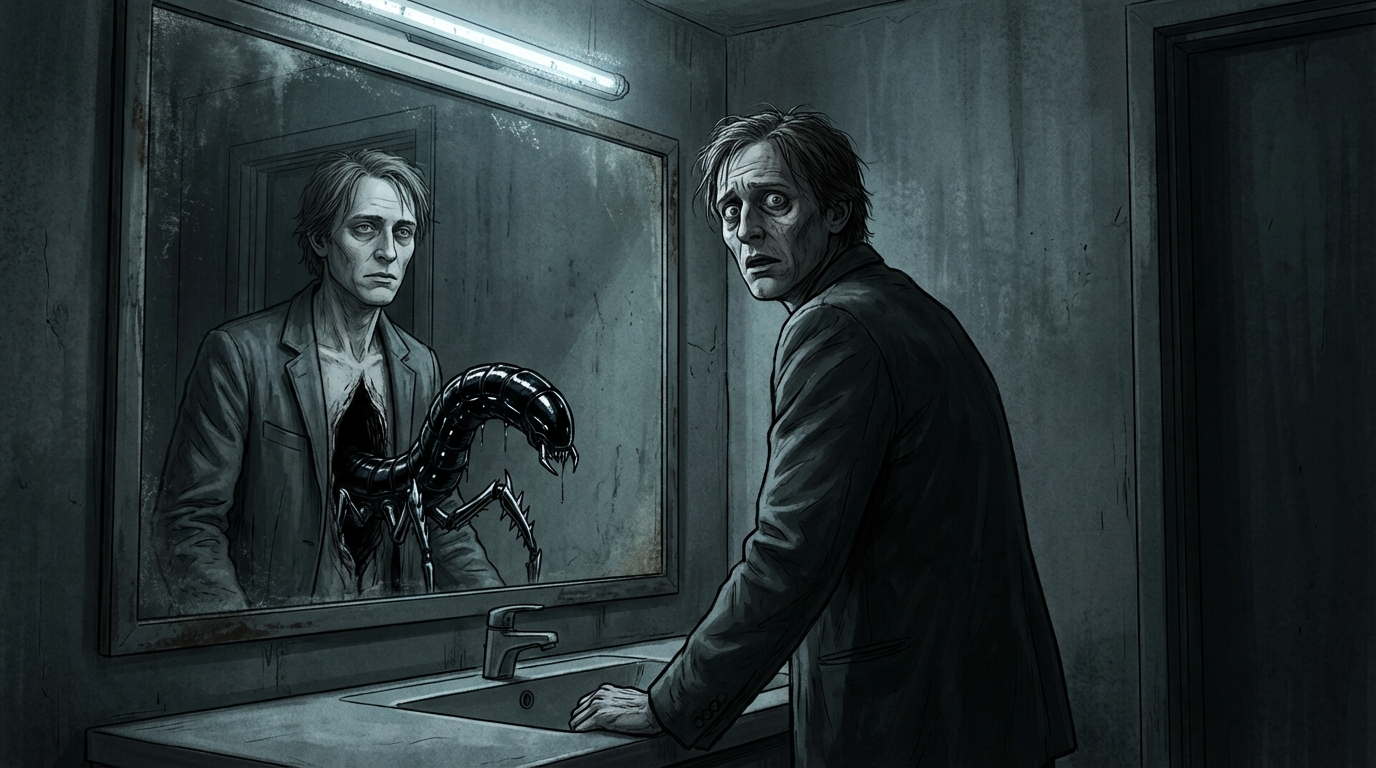
Delay – Horror Story is the focus of this in-depth HorrorStuck guide. We examine the known facts, evidence, leading explanations, and the details that still remain uncertain.
Delay – Horror Story: Key Facts and Context
The cab ride back to his apartment was a masterclass in agonizing, hyper-focused endurance. Arthur Pendelton sat rigidly in the back seat, his hands resting lightly on his thighs, his posture unnaturally straight. Every pothole, every sudden brake from the driver, sent a jarring, white-hot flare of pain radiating outward from the center of his sternum.
He had just been discharged from the Vanguard Clinic after a “routine” bio-synthetic mitral valve replacement. Dr. Silas Vance, a man whose reputation was built on pioneering, proprietary cardiac tech, had assured Arthur it was a marvel of modern medicine. “Minimal invasion, maximum integration,” Vance had said, his smile perfectly symmetrical, his hands smelling faintly of lavender soap.
Arthur’s apartment, an impeccably clean, minimalist loft on the fourteenth floor, offered the first true exhalation he had managed in three days. The air here smelled of expensive cedarwood diffusers and lemon polish, a sharp, welcoming contrast to the cloying, antiseptic stench of the clinic that still seemed to cling to the fine hairs of his arms.
He locked the heavy deadbolt behind him, the satisfying thunk of the metal a testament to his obsession with security and control. Arthur was a man who lived his life by spreadsheets, schedules, and precise routines. His body’s failure—the congenital heart defect that had sneaked up on him in his late thirties—had been the ultimate betrayal of that control. The surgery was supposed to be the fix. The restoration of order.
He moved with painstaking slowness toward the bathroom. His chest felt heavy, as if Dr. Vance had left a solid lead weight nestled between his lungs. Beneath the thick, square gauze pad taped to the center of his chest, a dull, throbbing ache pulsed in time with his heartbeat.
Lub-dub. Lub-dub.
It sounded normal. Stronger than before, even.
Arthur reached the bathroom. It was a sterile sanctuary of white marble, brushed nickel, and a massive, seamless sheet of mirrored glass that spanned the entire length of the double vanity. He turned on the cold water, cupped his hands, and splashed his face. The shock of the chill was grounding. It washed away the lingering fog of the general anesthesia.
He reached for a plush white towel, patted his face dry, and finally looked up at himself in the mirror.
He looked pale. The dark circles under his eyes were prominent, standing out against his sallow skin. His dark hair was slightly unkempt. But it was him.
Arthur sighed, a ragged breath that pulled uncomfortably at his stitches.
He blinked.
A fraction of a second later, his reflection blinked back.
Arthur froze, the towel still held loosely in his left hand. The bathroom was perfectly silent, save for the faint, high-pitched hiss of the water pressure in the pipes.
He stared into his own dark eyes. He took a slow, deliberate breath. In the mirror, his chest rose and fell in perfect synchronization. Nothing. He was just exhausted. The anesthesia drugs were notorious for lingering in the lipid tissues, playing havoc with the central nervous system, creating microscopic lags in cognitive processing.
He raised his right hand to touch the gauze pad on his chest.
He watched his reflection’s hand rise.
It was slight. Microscopic, almost. But to a man like Arthur, who noticed when a picture frame was a millimeter out of alignment, it was glaring. As his physical fingertips brushed the rough texture of the medical tape, the fingertips in the mirror were still traveling through the air, making contact a tenth of a second later.
A cold prickle of unease washed over his scalp.
“Stop it,” Arthur muttered out loud. His voice sounded thin, raspy from the intubation tube.
In the mirror, his mouth formed the words, but the visual movement lagged just slightly behind the audio in his own ears, like a poorly dubbed foreign film.
He squeezed his eyes tightly shut, pinching the bridge of his nose until it hurt. “Post-operative delirium,” he whispered. “Sensory desynchronization. Dr. Vance mentioned this. It’s normal.”
When he opened his eyes, he didn’t look at the mirror. He kept his gaze focused downward on the marble countertop. He turned off the light, walked into his pristine bedroom, and collapsed onto the bed, letting the heavy darkness of the apartment pull him into a restless, chemical sleep.
The next morning, the delay was worse.
Arthur knew it the moment he walked into the kitchen to pour a glass of water. He stood before the stainless steel refrigerator, catching his distorted reflection in the polished surface. He raised the glass to his lips and drank. The cold water slid down his throat. Half a second later, the warped reflection in the steel raised its glass.
Arthur dropped the glass.
It shattered against the hardwood floor, a sharp, violent explosion of noise.
In the refrigerator door, the reflection dropped its glass.
He backed away, his heart kicking into a sudden, frantic overdrive. Lub-dub. Lub-dub. Lub-dub. Wait.
Arthur pressed his hand flat against the center of his chest, right over the gauze. He closed his eyes, isolating his hearing, focusing entirely on the internal acoustics of his own body.
The familiar, fleshy thump of his heart was gone. It had been replaced.
Click-whir. Click-whir. Click-whir.
It was a wet, mechanical sound. It sounded like the chitinous clicking of a large insect’s mandibles, followed by a soft, unspooling whir of something tightening and releasing. It was rhythmic, steady, and utterly alien.
Panic, cold and sharp as a scalpel, sliced through Arthur’s meticulously constructed composure. He rushed to the kitchen island, his bare feet crunching over the broken glass, ignoring the sharp sting as a shard bit into his heel. He grabbed his phone and dialed the Vanguard Clinic.
“Vanguard Clinic, patient intake,” a smooth, automated voice answered.
“I need to speak to Dr. Vance,” Arthur demanded, his voice trembling. “It’s Arthur Pendelton. I had the mitral valve replacement yesterday.”
“Please hold for the on-call nursing staff.”
Smooth, looping elevator jazz filled his ear. Arthur paced the kitchen, his eyes darting around the room, actively avoiding the dark, reflective surface of the television screen, the microwave door, the large windows looking out over the city.
“Mr. Pendelton, this is Nurse Hayes. How are you feeling today?”
“I’m not,” Arthur stammered, gripping the phone so tightly his knuckles ached. “Something is wrong. My vision… my reflections. They’re delayed. And my chest. The valve doesn’t sound like a valve. It sounds… mechanical. It sounds like something is moving in there.”
There was a long, clinical pause on the other end. Arthur could hear the quiet clack-clack of a keyboard.
“Mr. Pendelton, sensory distortions, including visual lag and auditory hallucinations, are a known, albeit rare, side effect of the proprietary neuro-blocker we use in conjunction with the anesthesia. Your brain is simply recalibrating its sensory input.”
“It’s not a hallucination!” Arthur yelled, the sudden exertion sending a sharp, tearing pain through his incision. “I am watching it happen!”
“I assure you, it is neurological,” Nurse Hayes said, her tone hardening into a wall of professional dismissal. “As for the auditory feedback, the bio-synthetic valve requires a period of tissue integration. The mechanical sounds will muffle as your heart muscle scars over the synthetic housing. Take the prescribed sedatives, rest, and we will evaluate you at your follow-up next week. If you experience shortness of breath or bleeding, go to an emergency room. Goodbye, Mr. Pendelton.”
The line went dead.
Arthur stood in the center of the kitchen, the dial tone blaring against his ear. He slowly lowered the phone.
Tissue integration.
He walked toward the dark, powered-off television screen mounted on the wall. He stood three feet away from it. The black glass threw back a dark, ghostly image of his living room.
Arthur raised his hand and waved.
One full second passed.
Then, the dark figure in the television waved back.
It wasn’t a hallucination. It was a fracture in physics. It was as if the light bouncing off his body was encountering an invisible resistance before hitting the mirror, slowing down to a crawl. But that was impossible. Light doesn’t lag.
Therefore, the problem wasn’t the light. The problem was the reflection itself.
Over the next twelve hours, Arthur’s apartment descended from a sanctuary of control into a paranoid, heavily quarantined bunker.
He stripped the sheets from his guest bed and systematically covered every reflective surface in the loft. He draped a heavy quilt over the television. He taped newspaper over the microwave door and the glass front of the oven. He closed all the heavy blackout curtains, plunging the apartment into a deep, artificial twilight.
He finally stood before the massive bathroom mirror, holding a large, king-sized fitted sheet.
He didn’t want to look. He kept his eyes locked on the white marble of the sink as he fumbled with the corners of the sheet, hooking them over the edges of the heavy mirror frame. Only when the glass was completely obscured by the pale blue cotton did he allow himself to breathe.
He spent the rest of the evening sitting on the edge of his bathtub, in the dark, listening to his chest.
Click-whir. Click-whir. Click-whir.
It was getting louder. The sound was no longer just auditory; it was physical. He could feel a strange, syncopated vibration against the inside of his ribs. It felt like something with many small, hard legs was scrabbling against the bone, testing the boundaries of its cage.
He took the sedatives. Two small, blue pills that tasted like chalk. They did nothing but make his limbs feel heavy and uncoordinated, while his mind raced with horrifying, spiraling logic.
If the reflection was lagging, it meant the reflection was separating. It was no longer a real-time bounce of light. It was becoming a recording. A mimic.
And if it was mimicking him, what happens when it decides to stop?
At 3:14 AM, the pain hit him.
It wasn’t the dull throb of a healing incision. It was a sharp, agonizing, tearing sensation deep within his left ventricle. It felt as though a serrated hook had been driven into the muscle of his heart and was being violently twisted.
Arthur screamed, falling off the edge of the bathtub onto the cold tile floor. He clutched his chest, his fingers digging into the edges of the medical gauze.
He was having a heart attack. The valve had failed. He was going to die on his bathroom floor.
He needed to see the incision. He needed to know if he was bleeding out.
Gasping for air, the click-whir in his chest accelerating into a frantic, wet buzzing, Arthur dragged himself up the side of the vanity. His trembling hand reached out and grabbed the edge of the blue fitted sheet covering the mirror.
With a desperate, agonizing yank, he pulled it down.
The sheet fell to the floor, pooling around his ankles.
Arthur leaned heavily over the sink, staring into the glass, panting. He looked terrible. His skin was the color of old ash, shining with a thick layer of cold sweat. His eyes were bloodshot, wide with terror.
He waited.
One second. Two seconds. Three seconds.
The reflection didn’t move. It was frozen in the exact position Arthur had been in three seconds ago—pulling the sheet down.
Then, the reflection caught up. The image in the glass leaned over the sink, panting, eyes wide.
Arthur let out a shuddering sob of relief. It was still just a lag.
He reached up with both hands, gripping the edges of the thick white gauze taped to his chest. He braced himself, gritted his teeth, and ripped the adhesive away from his skin.
He looked down at his chest.
The incision was brutal. A six-inch vertical slash down his sternum, held together by thick, black surgical staples. The skin around it was angry, bruised purple and yellow. But there was no massive hemorrhaging. The wound was closed.
He looked back up at the mirror to check the reflection.
The reflection had not ripped off the bandage.
Arthur froze. The air in his lungs turned to ice.
In the mirror, the reflection of Arthur Pendelton was standing perfectly straight. Its face was completely devoid of the terror and agony currently warping Arthur’s real features. The reflection’s expression was flat. Dead. Clinical.
Arthur tried to step back, to run from the bathroom, but his legs refused to obey. He was paralyzed by a hypnotic, mind-shattering dread.
The reflection raised its hands. It didn’t reach for the bandage. Instead, it raised its hands like a surgeon prepping for an operation.
“What are you?” Arthur breathed, his voice a terrified, broken rasp.
The reflection did not answer. It slowly lowered its hands to its own chest. In the mirror, the bandage was already gone. The incision was bare.
But the incision in the mirror wasn’t stapled shut.
It was open.
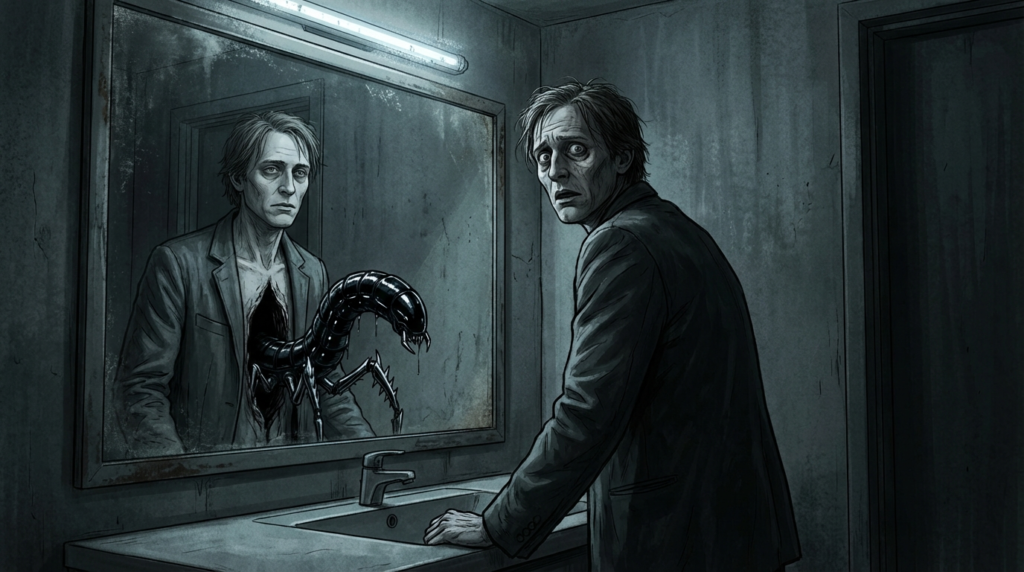
Arthur watched in absolute, visceral horror as the reflection inserted its thumbs into the open wound on its sternum. The reflection’s face remained utterly impassive as it gripped the edges of its own flesh and, with a slow, sickeningly fluid motion, pulled its ribcage apart.
There was no blood in the mirror. Just a dark, yawning cavity.
Arthur felt a phantom echo of the movement in his own body. A massive, horrific pressure built against the inside of his ribs, pushing outward, making it impossible to draw breath.
The reflection leaned closer to the glass, offering Arthur a perfect, brightly lit view of what lay inside its open chest.
Where the human heart should have been—a muscular, pulsing organ of red tissue—there was something else.
It was biological, but it was not human. It was a massive, segmented parasite, the size of a grapefruit. Its carapace was a glistening, wet obsidian black. It had dozens of long, barbed legs that were deeply embedded into the surrounding pulmonary tissue, anchoring it in place. Thick, pulsating veins ran from the creature’s segmented body directly into the severed ends of Arthur’s aorta and vena cava.
The creature was breathing. Its segmented back expanded and contracted.
Click-whir. Click-whir.
The sound from Arthur’s own chest synchronized perfectly with the movements of the horror in the mirror.
“No,” Arthur wept, tears streaming down his face, his real chest heaving rapidly. “No, Vance. What did you do to me? What did you put inside me?”
The reflection did not answer. Instead, the entity inside the reflection’s chest moved.
One of the long, barbed legs unhooked itself from the lung tissue. The creature shifted, its dark, glistening body rotating slightly within the chest cavity. Slowly, from the top of the mass, a cluster of thin, pale tendrils unspooled.
They looked like the delicate roots of a diseased plant, or the raw nerve endings of a spinal cord.
In the mirror, the tendrils reached upward, snaking out of the chest cavity, wrapping around the reflection’s collarbone, and driving themselves deep into the sides of the reflection’s neck, plunging straight upward into the brainstem.
The moment the tendrils connected in the mirror, Arthur felt it in reality.
A sharp, electric shock lanced up the back of his neck, followed immediately by the sensation of hot, liquid lead being injected directly into his spinal fluid. His vision flared white. A high-pitched squeal obliterated all sound in the room.
He fell backward against the bathroom door, sliding to the floor, convulsing. He clutched his head, feeling the impossible, squirming pressure beneath his scalp. It was taking root. It was tapping into his motor cortex, his visual centers, his amygdala.
He was being integrated.
“Get it out,” Arthur screamed, his voice no longer sounding entirely human. It was layered with a strange, clicking undertone. “Get it out of me!”
He needed a knife. He needed to cut it out.
Arthur crawled across the bathroom floor, his body shaking violently. He reached the bottom drawer of the vanity. He yanked it open, sending bottles of cologne and shaving cream spilling across the tile. His fingers scrambled through the mess until they closed around the cold, heavy steel of his grooming scissors. They were long, incredibly sharp.
He pushed himself up, leaning heavily against the sink. He gripped the scissors in his right hand, pointing the sharp steel tips directly at the center of his own chest, hovering millimeters above the angry, stapled incision.
He would plunge them in. He would dig it out, even if it meant tearing his own heart to shreds. Death was a million times preferable to whatever hostile takeover was currently rewriting his nervous system.
He took a massive, ragged breath, preparing to thrust the blades inward.
He looked up at the mirror one last time.
The reflection was no longer pantomiming the horrific surgery. The chest in the mirror was closed, sealed by the thick black staples, exactly as it was in reality.
The reflection was standing perfectly straight.
Arthur paused, the scissors trembling in his hand. He stared at his own face.
The reflection smiled.
It was a slow, stretching smile that utilized the facial muscles with clinical precision, but lacked any warmth or human emotion. It was the smile of a pilot settling into the cockpit of a newly acquired machine.
Arthur tried to push the scissors forward. He tried to drive the steel into his chest.
His arm didn’t move.
The command originated in his brain—thrust, kill, destroy the parasite—but the signal never reached his bicep. The pathway had been severed. Rerouted.
Arthur watched in the mirror as his right arm, entirely against his conscious will, slowly lowered the scissors to the marble countertop. He felt his fingers unclasp, the metal clattering softly against the stone.
His breathing slowed. The frantic, terrified hammering in his chest subsided, settling back into a rhythmic, steady cadence.
Click-whir. Click-whir. Click-whir.
It didn’t hurt anymore. The tearing pain in his ventricle was gone, replaced by a strange, numb warmth. The terror, the absolute panic that had consumed him for two days, was simply shut off, like a switch being flipped at a breaker box.
Arthur Pendelton looked into the mirror.
His reflection looked back. There was no delay. Not even a fraction of a millisecond. The synchronization was absolute, flawless, and perfect.
He raised his hand and smoothed his unkempt hair. The reflection matched him perfectly.
“Minimal invasion,” Arthur’s mouth said, though Arthur did not choose to speak the words. His voice was smooth, calm, and layered with that faint, clicking resonance. “Maximum integration.”
Arthur was still there, trapped somewhere deep behind his own eyes, a screaming, horrified passenger in a body that no longer belonged to him. But the body felt fine. The body turned off the bathroom light, walked back into the pristine bedroom, and lay down to get some much-needed rest.
Tomorrow, there was a lot of work to do.
Further Reading & External Resources
Ultimately, Delay – Horror Story remains compelling because the documented evidence answers some questions while leaving others open to careful investigation.