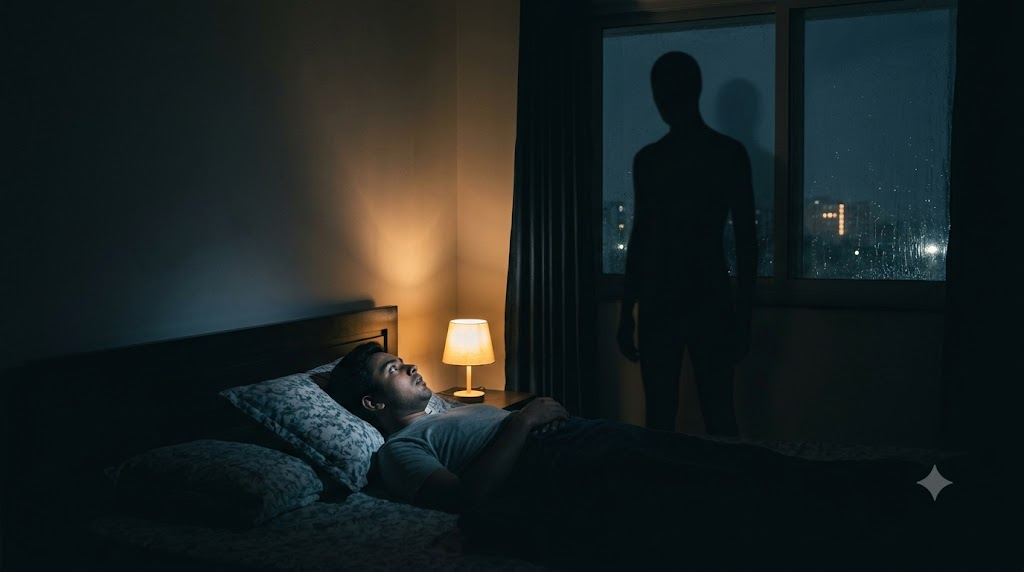
You wake up in the dead of night. The room is silent, bathed in the faint, silvery glow of moonlight filtering through the blinds. You feel a sudden, inexplicable drop in the ambient temperature and a primal, suffocating sense of dread. Your eyes adjust to the gloom, scanning the familiar geometry of your bedroom. Then, you see it.
Shadow People: Key Facts and Context
Standing in the corner, darker than the shadows surrounding it, is a silhouette. It has no face, no eyes, and no discernible clothing, yet it is undeniably humanoid. It does not reflect light; it seems to absorb it. You try to scream, but your voice is paralyzed. You try to run, but your limbs refuse to move. The figure steps closer, radiating an aura of pure malevolence.
This terrifying scenario is not an isolated nightmare. Every single night, across different cultures, languages, and continents, thousands of people report identical encounters with entities known as “Shadow People.”
Are these figures the product of a glitching human brain, an evolutionary leftover from when we were hunted in the dark by apex predators? Or are they something else entirely—interdimensional travelers, demonic entities, or the restless dead? To answer the question of whether Shadow People are myth or reality, we must dissect the phenomenon from every conceivable angle: medical science, neurology, historical folklore, and parapsychology.
The Phenomenology of the Shadow Person
To understand what Shadow People are, we must first establish what they are not. In the realm of the paranormal, a Shadow Person is distinctly different from a traditional ghost or apparition.
Traditional ghosts are usually described as retaining their human appearance. They might appear translucent, wearing period-specific clothing, or carrying the emotional weight of their former lives (sadness, confusion, or anger). They are often tied to specific locations or historical tragedies.
Shadow People, by contrast, possess none of these humanizing traits. Witnesses consistently report the same terrifying characteristics:
- Absolute Darkness: They are not simply dark spots in a room; they are described as a concentrated void. Witnesses often state they are “darker than the dark,” possessing a 3D mass that blocks out background light.
- Lack of Features: They rarely have faces. There are no eyes, noses, or mouths. They lack distinct appendages like fingers or toes.
- Kinetic Movement: Unlike ghosts that glide or float, Shadow People are often described as moving with jarring, unnatural speed. They dart around corners, sink into floors, or dissipate rapidly when observed directly.
- The Feeling of Dread: The hallmark of a Shadow Person encounter is the overwhelming, almost physical sensation of fear. This is not just the surprise of seeing something anomalous; it is a profound, instinctual terror, often accompanied by the feeling that the entity is feeding on that fear.
A Taxonomy of Shadows
While the basic description remains consistent, decades of reports have allowed researchers to categorize these entities into distinct archetypes.
| Archetype | Visual Description | Typical Behavior |
| The Lurker | A shapeless, human-sized mass. | Seen primarily in peripheral vision. Darts out of sight when the observer turns their head. |
| The Predator | A dense, humanoid silhouette. | Approaches the bed during sleep. Radiates intense malice and often leans over the victim. |
| The Hooded Figure | A silhouette wearing what appears to be a monk’s cowl. | Stands at the foot of the bed or in doorways. Radiates ancient, heavy, and oppressive energy. |
| The Hat Man | A tall silhouette wearing a wide-brimmed hat and often a trench coat. | Stands completely still, simply observing. Feels authoritative rather than overtly aggressive. |
| The Red-Eyed Shadow | A standard shadow figure but with two glowing red eyes. | Highly aggressive. Often associated with negative poltergeist activity or demonic hauntings. |
Among these, The Hat Man is arguably the most famous and baffling. People from entirely different cultural backgrounds, with no prior knowledge of the urban legend, have described waking up to see a tall man in a fedora or gaucho hat standing at the foot of their bed. Why would a hallucination or an interdimensional being wear a mid-20th-century hat? This question remains one of the greatest mysteries of the phenomenon.
The Medical Reality: Sleep Paralysis and the Brain on Fire
If you ask a neurologist or a sleep specialist if Shadow People are real, their answer will be a definitive “yes”—but not in the way paranormal enthusiasts hope. The medical community recognizes these encounters as deeply traumatic, hyper-realistic experiences rooted entirely in the mechanics of the human brain.
The primary culprit behind the vast majority of Shadow Person encounters is Sleep Paralysis.
The Mechanics of REM Atonia
To understand sleep paralysis, we must look at how we sleep. When the human body enters Rapid Eye Movement (REM) sleep, which is the cycle where our most vivid dreams occur, the brain triggers a mechanism called REM atonia. This is a biological safeguard that essentially paralyzes the voluntary muscles of the body. It prevents us from physically acting out our dreams, ensuring we don’t jump out of bed or injure ourselves while chasing a dream-world threat.
Sleep paralysis occurs when the transition in or out of REM sleep is interrupted. The brain wakes up and becomes fully conscious of its surroundings, but the body’s motor functions remain switched off. The person is awake, but entirely paralyzed.
The “Intruder Hallucination”
When a person wakes up paralyzed, the brain panics. The amygdala—the brain’s fear and threat-detection center—goes into overdrive. It registers that the body is vulnerable and paralyzed, which, in evolutionary terms, means an apex predator is nearby.
Because the brain is still hovering on the border of REM sleep, it is perfectly capable of projecting dream-imagery into the waking world. These are known as hypnagogic (occurring while falling asleep) or hypnopompic (occurring while waking up) hallucinations.
The terrified amygdala essentially says to the visual cortex: “We are paralyzed and in danger. Generate a threat to justify this fear.”
Because the room is dark, the brain projects the most primal, archetypal representation of a threat possible: a dark, featureless, humanoid shape. The Shadow Person. The crushing sensation on the chest, often reported during these encounters, is the result of the sleeper trying to take deep, panicked breaths while the chest muscles are still paralyzed in shallow REM breathing.
The Role of Cultural Priming
If Sleep Paralysis explains the entity, how do we explain the specific recurrence of figures like The Hat Man? Psychologists point to cultural priming. Even if a person does not consciously research paranormal lore, they absorb archetypes from movies, books, and collective consciousness. The sinister figure in a trench coat and fedora has been a cinematic shorthand for “stranger danger,” spies, and villains since the noir films of the 1940s. When the brain reaches for a threatening avatar during sleep paralysis, it naturally pulls from this culturally ingrained catalog of fear.
Environmental and Neurological Triggers
Beyond sleep paralysis, people often see Shadow People while wide awake, walking down hallways, or working late at night. Science offers several fascinating explanations for these waking encounters.
Pareidolia and the Survival Instinct
The human brain is fundamentally a pattern-recognition machine. We are biologically hardwired to find human faces and figures in our environment. This evolutionary trait kept our ancestors alive; it is much safer to mistake a shadow in the bushes for a stalking tiger than to mistake a stalking tiger for a shadow.
This hyper-active facial recognition software is called pareidolia. When we are in low-light environments, our visual cortex struggles to interpret ambiguous visual data. A coat hanging on a door, a stack of boxes, or a trick of the moonlight can be instantly interpreted by the brain as a lurking figure. By the time your rational mind catches up and realizes it’s just a coat, your heart is already racing, and the memory of the “shadow person” is cemented.
Electromagnetic Fields (EMF)
Paranormal investigators frequently use EMF meters to search for ghosts, theorizing that spirits emit electromagnetic radiation. However, neuroscience suggests that EMF is indeed responsible for hauntings—just not in the way ghost hunters think.
In the 1980s, cognitive neuroscientist Dr. Michael Persinger conducted a series of famous experiments using a device dubbed the “God Helmet.” He discovered that exposing the human brain’s temporal lobes to specific, fluctuating electromagnetic fields could induce profound hallucinations. Subjects reported feeling an “invisible presence” in the room, sensations of being watched, and outright dread.
Many older homes, or houses situated near high-tension power lines, have areas with naturally occurring, chaotic electromagnetic fields due to faulty wiring. A person sitting in one of these “fear cages” may experience induced paranoia, optical illusions in their peripheral vision, and the distinct feeling of a dark entity looming just out of sight.
Carbon Monoxide and Toxicology
There is a long, documented history of “haunted houses” being cured by plumbers and HVAC technicians. Carbon monoxide (CO) is an odorless, colorless gas produced by faulty furnaces or water heaters. Prolonged exposure to low levels of CO causes hypoxia (lack of oxygen to the brain). The symptoms include profound dread, paranoia, auditory hallucinations (footsteps, whispering), and visual hallucinations—most notably, dark figures darting through the home.
Similarly, severe sleep deprivation, high stress, and the use of certain medications or illicit substances (particularly stimulants like methamphetamine, which lead to “shadow people” hallucinations during binges) can cause the visual cortex to misfire, resulting in the appearance of dark, fleeting figures.
The Paranormal and Metaphysical Theories
While the scientific explanations are robust and solve the vast majority of cases, they do not satisfy everyone. Many witnesses report encounters that simply do not fit the medical mold. What if multiple people in the same room see the same Shadow Person at the same time? What if the entity physically interacts with the environment, knocking over objects or leaving physical marks?
For these anomalies, we must explore the theories posited by parapsychology and metaphysics.
The Interdimensional Hypothesis
One of the most popular modern theories abandons the idea of “ghosts” entirely and looks toward theoretical physics. String theory and quantum mechanics suggest the possibility of multiple dimensions existing parallel to our own. We exist in three spatial dimensions and one temporal dimension.
The interdimensional hypothesis suggests that Shadow People are not spirits of the dead, but beings from a parallel dimension or a different frequency of reality. Just as a three-dimensional object (like a human) casts a two-dimensional, featureless shadow on a wall, a theoretical four-dimensional entity intersecting with our three-dimensional world might appear to us as a featureless, 3D shadow.
This would explain their bizarre movements. If a 4D being steps “out” of our dimension, it would appear to us to vanish instantly or shrink into nothingness. If they vibrate at a different frequency, they would appear dark and void-like because our eyes cannot process their composition. They are travelers, bleeding into our reality for brief, terrifying moments.
Demonic Entities and “Loosh”
In demonology and extreme paranormal circles, Shadow People—particularly the Hooded Figures and Red-Eyed Shadows—are considered demonic. Unlike human ghosts, which are bound by earthly emotions, demonic entities are thought to be ancient, inhuman spirits that feed on negative energy.
In esoteric philosophy, this negative energy is sometimes referred to as “loosh.” According to this theory, Shadow People are parasitic. They manifest in bedrooms at night because that is when humans are most vulnerable. By presenting themselves as terrifying, faceless voids, they elicit a massive spike of pure terror from the victim. They do not attack physically because they do not need to; they are simply harvesting the emotional energy generated by the victim’s fear.
Thought-Forms and Tulpas
A fascinating bridge between psychology and the paranormal is the concept of the Tulpa, an idea originating in Tibetan Buddhism. A Tulpa is a thought-form: an entity created entirely by the sheer force of human belief and concentration.
The theory suggests that if enough people believe in a specific monster—like The Hat Man—and pour enough fear, anxiety, and collective energy into that archetype, the entity can begin to manifest in reality. It is a psychological contagion that takes on a life of its own. The shadow does not have its own consciousness; it is a mirror reflecting the collective anxiety of humanity, brought to life by the very people who fear it.
Echoes from the Past: Shadow Beings in History
While the term “Shadow People” was popularized on the internet in the late 1990s and early 2000s, the phenomenon is ancient. A look at historical folklore reveals that humanity has been dealing with these dark figures since the dawn of recorded history.
The Jinn of Islamic Theology
In Islamic theology, the universe is shared by humans, angels, and Jinn. While angels are made of light and humans of clay, the Jinn are made of “smokeless fire.” They are invisible to the human eye, but they exist parallel to us. They can be good, evil, or neutral. When evil or mischievous Jinn manifest to humans, they are often described as appearing in the form of dense, black shadows or smoke, lurking in the corners of homes and causing feelings of intense dread or illness.
Ancient Egypt and the Khaibit
The ancient Egyptians had a deeply complex view of the human soul, dividing it into several distinct parts. One of these parts was the khaibit, or the shadow. The Egyptians believed that a person’s shadow was a distinct, living entity that carried parts of their essence. They believed that after death, a person’s shadow could detach from the body and wander the earth independently. To protect the dead, spells in the Egyptian Book of the Dead specifically instruct the deceased on how to command and control their wandering shadow.
Native American Folklore
Many Native American tribes have legends of shadow-like entities. The Choctaw people speak of the Nalusa Chito, literally translating to the “Big Black Thing” or the Impalpable. It is described as an ancient, dark spirit that lurks in the deep shadows of the forest. It does not possess a physical body, but it can paralyze those who look upon it, feeding on their negative thoughts and pushing depressed individuals toward despair.
Similarly, the Cherokee have legends of the Raven Mockers, evil spirits that rob the dying of their life force, often appearing as dark, shadowy figures that dart around the sickbed.
The Digital Age: Creepypasta and the Shadow Epidemic
It is impossible to ignore the role the internet has played in the modern Shadow Person phenomenon. Before the late 1990s, people who experienced sleep paralysis or saw a shadow in their hallway usually kept it to themselves, fearing they were losing their minds.
When the internet connected the world, message boards and paranormal forums became safe havens for people to share their experiences. In 1997, the paranormal radio show Coast to Coast AM hosted by Art Bell opened its phone lines to callers asking about “Shadow People.” The switchboards were overwhelmed. Thousands of people realized they were not alone.
However, the internet is a double-edged sword. While it provided validation, it also provided a breeding ground for modern myth-making. The rise of Creepypasta (internet horror stories) and viral folklore like Slender Man blurred the lines between genuine anomalous experiences and collaborative fiction. Today, searching for “Shadow People” yields a mix of terrifying, genuine sleep paralysis accounts and highly embellished, fictionalized horror stories. The internet has taken the biological reality of sleep paralysis and weaponized it into a global urban legend.
Conclusion: The Darkness Reflects the Light
So, are Shadow People a myth, or are they a reality?
The answer depends entirely on how one defines reality. If you require physical proof—ectoplasm, a captured entity, or a scientifically verified portal to another dimension—then Shadow People remain a myth. They are a ghost story told in the dark, a misfiring of a tired brain, a trick of the light, and a biological remnant of our ancestral fear of the night.
But if reality is defined by human experience, then Shadow People are undeniably real. The sheer volume of accounts, the astonishing consistency of the descriptions, and the profound, life-altering terror experienced by the witnesses cannot be simply brushed aside. The trauma they inflict is real. The racing heartbeats and the cold sweats are real.
Perhaps the terrifying truth of the Shadow Person is not that it is a monster hiding in your closet, but that it is a monster hiding in your own mind. It is a manifestation of our deepest, most primal anxieties, given shape by a brain that is desperate to put a face to the fear of the unknown.
Whether they are visitors from a fourth dimension, parasitic demons feeding on our fear, or a brilliant, horrifying illusion created by a glitching amygdala, the Shadow Person achieves the same goal. It reminds us that no matter how much we illuminate our world with science, technology, and reason, we will always be fundamentally afraid of the dark.