sleep paralysis vs paranormal encounters,sleep paralysis demon,REM atonia hallucinations,incubus hallucination,alien abduction symptoms is the focus of this in-depth HorrorStuck guide. We examine the known facts, evidence, leading explanations, and the details that still remain uncertain.
sleep paralysis vs paranormal encounters,sleep paralysis demon,REM atonia hallucinations,incubus hallucination,alien abduction symptoms: Key Facts and Context
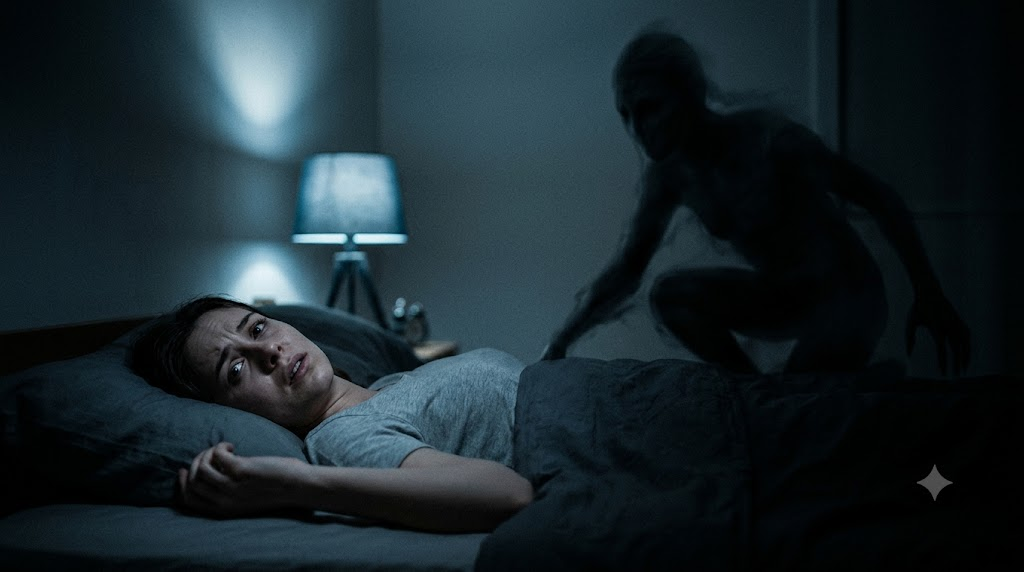
You open your eyes. The room is dark, illuminated only by the faint bleed of moonlight filtering through the blinds. You try to roll over, but your body refuses to respond. A sudden, cold realization sets in: you are completely paralyzed. Your breathing feels shallow, restricted by an invisible, crushing weight pressing down on your chest. Then, from the darkest corner of the room, a shadow detaches itself from the wall. It has no face, yet you know with terrifying certainty that it is watching you. It moves closer.
For centuries, this horrifying scenario has been the source of our darkest folklore. Across different eras and continents, humanity has attributed this terrifying phenomenon to demons, witches, ghosts, and extraterrestrials. Today, medical science has a much more clinical term for it: sleep paralysis.
Yet, even with a firm neurobiological explanation, the debate between sleep paralysis and paranormal encounters remains a fascinating intersection of human biology, psychology, and cultural mythology. What happens when the waking mind is trapped inside a sleeping body? And why does the human brain universally default to the supernatural when trying to make sense of it?
The Anatomy of a Nightmare: The Scientific Reality
To understand why sleep paralysis feels so profoundly supernatural, we must first understand the architecture of human sleep.
When you drift off, your brain cycles through multiple stages of sleep, eventually landing in Rapid Eye Movement (REM) sleep. This is the stage where your brain is highly active, processing memories and generating the vivid, bizarre narratives we call dreams.
Because the brain is firing on all cylinders during REM, it creates a potential physical danger: if you were to act out the movements in your vivid dreams, you could seriously injure yourself. To prevent this, the brain employs an evolutionary defense mechanism known as REM atonia. Through the release of inhibitory neurotransmitters—specifically γ-Aminobutyric acid (GABA) and glycine—the brain temporarily paralyzes the voluntary motor neurons in the spinal cord. Your eyes can dart around, and your involuntary systems (like breathing and heartbeat) continue, but your arms, legs, and vocal cords are effectively locked down.
The Glitch in the Matrix
Sleep paralysis occurs when there is a dysfunctional overlap between the REM sleep stage and wakefulness. Essentially, your conscious mind wakes up, but the neurochemical switch that controls REM atonia has not yet flipped off. You are mentally awake, but your physical body is still paralyzed.
If the experience ended at mere paralysis, it would be frightening but not necessarily supernatural. However, because the brain is still partially submerged in the REM state, the dream world begins to bleed into reality. The result is a highly immersive, multi-sensory hallucination layered over the physical environment of your bedroom.
The brain, suddenly aware that it is awake but unable to move or defend itself, panics. The amygdala—the brain’s fear and threat-processing center—goes into hyper-drive. This hyper-activation triggers an intense state of vigilance. The mind desperately searches the environment for a reason for this paralysis and fear. Finding none, the dreaming mind creates one.
The Nightmare by Swiss artist Henry Fuseli is perhaps the most famous visual representation of sleep paralysis, capturing the crushing weight of the “Incubus” and the terrifying presence of the “Night Mare” looking through the curtain.
Monsters of the Mind: The Three Hallucinations
When studying the phenomenon, researchers have categorized the terrifying visions associated with sleep paralysis into three distinct types of hallucinations. These categories perfectly mirror the historical accounts of paranormal and demonic encounters.
1. The Intruder Hallucination
This involves the profound, unshakable sensation of a menacing, evil presence in the room. Sufferers often report seeing dark, faceless silhouettes—commonly referred to as “Shadow People”—lurking in doorways, standing at the foot of the bed, or slowly creeping across the floor. Even if nothing is visually seen, the feeling of being watched by something malevolent is overwhelming. This is a direct result of the amygdala’s threat-activated vigilance system misfiring, projecting an external predator to justify the internal state of absolute terror.
2. The Incubus Hallucination
The word “incubus” is Latin, stemming from the verb incubare, which means “to lie down upon”. This hallucination is characterized by a crushing pressure on the chest, often accompanied by the sensation of being strangled or suffocated.
The scientific explanation for this terrifying sensation lies in the mechanics of breathing. During REM sleep, our breathing is naturally shallower, and we lose voluntary control over our respiratory muscles. When a person wakes up in a state of paralysis, they instinctively try to take a deep, panicked breath. When the paralyzed chest muscles fail to respond to this command, the brain perceives a massive physical resistance. The dreaming mind then rationalizes this resistance by hallucinating a physical entity—a demon, a witch, or a monster—sitting directly on the sleeper’s chest.
3. Vestibular-Motor Disorientation
Also known as unusual bodily experiences, this hallucination involves sensations of floating, flying, falling, or hovering over one’s own body. Neurologically, this is believed to occur when the cerebellum—the part of the brain that coordinates movement and spatial awareness—experiences a sudden spike in activity, completely misinterpreting the body’s position in space. It is this specific hallucination that forms the basis for many accounts of out-of-body experiences (OBEs), astral projection, and reports of being levitated from bed during alien abductions.
The Paranormal Lens: A Cultural History of the Night Terror
Because the neurophysiology of the human brain is identical regardless of geography, the biological experience of sleep paralysis is a human universal. However, how the waking mind interprets those terrifying hallucinations is entirely dependent on the cultural and religious framework of the sufferer.
For thousands of years, before polysomnography and neuroscience could explain REM atonia, our ancestors experienced these exact same terrifying nights. To make sense of the horror, they created myths. The “Sleep Paralysis Demon” is one of the most pervasive, cross-cultural archetypes in human history.
| Culture / Region | Entity Name | Translation / Meaning | Characteristics |
| Ancient Mesopotamia | Lilitu (Lilith) | She-Demon | A female night spirit who preyed on sleepers, believed to be the ancestor of the succubus myth. |
| Old England / Europe | The Mære | Harm / Crushing Spirit | A malicious female spirit that rides the chest of sleepers; the origin of the word “nightmare.” |
| Japan | Kanashibari | Bound in Metal | Rooted in medieval spells; involves invisible spirits or yokai physically binding the sleeper. |
| Newfoundland | The Old Hag | Night Hag | A withered crone who perches on the chest, often attributed to a curse or stagnant blood. |
| Middle East / Egypt | Ja-thoom / Jinn | What sits heavily | Shape-shifting spirits or Ifrit made of smokeless fire that choke the sleeper. |
| Nigeria (Yoruba) | Ogun Oru | Nocturnal Warfare | A spiritual battle, often involving an otherworldly spouse attacking the sleeper. |
| Zanzibar | Popobawa | Bat-wing | A shadowy, shapeshifting entity that emerged during political unrest to attack sleepers. |
| Mexico | Se me subió el muerto | A dead body climbed on me | The belief that the spirits of the deceased are physically pinning the sleeper to the bed. |
The Evolution of the “Night-Mare”
The very word we use today to describe a bad dream has its roots entirely in sleep paralysis. In Old English, the word mære (derived from a Proto-Indo-European root meaning “to harm”) referred to a demonic spirit that would suffocate sleepers by sitting on them. A “night-mare” was not a story your brain told you while you slept; it was a literal, physical assault by a supernatural entity. This linguistic root spread across Europe, evolving into the German Nachtmahr and the French cauchemar (from caucher, meaning to trample, and mare, meaning spirit).
In Germany, the phenomenon was also called Hexendrücken, which translates to “witch’s pressing.”. During the dark eras of European history, including the Salem Witch Trials, sufferers of sleep paralysis genuinely believed they were being physically cursed and crushed by local witches, leading to tragic, real-world consequences and executions based on these nocturnal hallucinations.
Bound by Spirits and Ancestors
In Japan, the phenomenon is known as Kanashibari, which chillingly translates to being “bound in metal”. Originally stemming from medieval Buddhist magic used by priests to immobilize spirits, the term was adapted to describe the sensation of being paralyzed by yokai (supernatural tricksters or ghosts).
In the subarctic regions of Canada, the Inuit people refer to the experience as uqumangirniq. Deeply tied to their shamanistic beliefs, it involves the presence of a faceless, shapeless being and is often attributed to spells cast by rival shamans.
Meanwhile, in Southeast Asia, particularly among the Hmong culture, sleep paralysis is attributed to the dab tsog, a pressing nightmare spirit. The belief in the dab tsog is so profoundly ingrained that it has been linked to Sudden Unexplained Nocturnal Death Syndrome (SUNDS), where healthy individuals mysteriously die in their sleep, potentially triggered by the extreme cardiovascular stress of a culturally reinforced terror.
When the Lines Blur: Modern Paranormal Interpretations
As society modernized and belief in witches, goblins, and hags waned, the hallucinations of sleep paralysis did not disappear; they simply updated their wardrobe. The brain utilizes the cultural lexicon available to it to dress its fears.
In the mid-to-late 20th century, a massive surge in reported alien abductions swept the Western world. When analyzing the core components of these reports, sleep researchers found a near-perfect overlap with the symptoms of sleep paralysis.
- Paralysis in bed: The inability to move or cry out.
- The Intruder: Grey aliens or strange figures standing around the bed.
- Vestibular-motor hallucinations: The sensation of levitating out of bed or floating toward a light.
- The Incubus: The feeling of physical pressure, often reinterpreted as extraterrestrial medical examinations.
Rather than being attacked by an Old Hag, the modern sleeper’s brain, steeped in science fiction and pop culture, rationalizes the terrifying biological glitch as an extraterrestrial encounter.
Similarly, the modern internet era has given rise to the lore of “Shadow People” and the “Hat Man.” Countless forums and communities exist where individuals share their encounters with a tall, shadowy silhouette wearing a wide-brimmed hat. Paranormal enthusiasts argue that because so many unconnected people see the exact same entity, it must be a real, interdimensional being.
However, neuroscientists offer a different explanation. The human brain is hardwired for facial recognition and pattern detection. When the visual cortex is starved of light in a dark bedroom and flooded with the fear-inducing chemicals of an interrupted REM cycle, it defaults to the most basic, universally terrifying archetype: a dark, looming human silhouette. The shared details are not evidence of a shared ghost, but rather evidence of our shared neuroanatomy.
Why Science Doesn’t Always Provide Comfort
One of the most fascinating aspects of sleep paralysis is its psychological persistence. Even when an individual is fully educated on the neurobiology of REM atonia, GABA neurotransmitters, and amygdala hyper-activation, the experience of an episode remains utterly terrifying.
During an episode, the logical, rational parts of the brain (the prefrontal cortex) are essentially overpowered by the primal, emotional centers. You can tell yourself, “This is just sleep paralysis; it’s just a chemical glitch,” but the hallucination feels hyper-real. The pressure on your chest is physical. The shadow in the corner commands absolute, primal terror.
This hyper-reality is why the debate between science and the supernatural persists. For the person experiencing it, the event does not feel like a dream; it feels like an assault. The visceral intensity of the phenomenon leaves a profound psychological imprint, blurring the line between the subjective experience of the mind and the objective reality of the physical world.
Reclaiming the Night: Risk Factors and Management
While an estimated 11% of the general population will experience sleep paralysis at least once in their lifetime, certain groups are far more susceptible.
The primary trigger for sleep paralysis is sleep deprivation and the disruption of the regular circadian rhythm. Shift workers, students, and those suffering from jet lag are highly prone to episodes because their fragmented sleep schedules cause the brain to drop into REM sleep too quickly or abruptly.
Furthermore, there is a deep connection between trauma and parasomnias. Individuals suffering from PTSD, severe anxiety, and panic disorders experience sleep paralysis at significantly higher rates. In these cases, the brain’s threat-detection systems are already sensitized during waking hours, making the transition into sleep highly volatile. It is also highly prevalent in individuals with narcolepsy, a neurological disorder that inherently blurs the boundaries between wakefulness and sleep.
How to Break the Paralysis
If you find yourself trapped in the grip of the Old Hag, understanding the mechanics of the event can help you escape it.
- Acknowledge and De-escalate: The feedback loop of fear exacerbates the hallucinations. The harder you fight the chest pressure, the more the brain interprets it as a threat. Mentally recognizing the event as a biological glitch can lessen the amygdala’s panic.
- Focus on the Extremities: Because the paralysis affects the major voluntary muscles, attempting to thrash or sit up will fail. Instead, focus all your mental energy on wiggling a single toe, clenching a fist, or twitching your facial muscles. Breaking the atonia in a small extremity often cascades, breaking the paralysis across the whole body.
- Regulate Breathing: Instead of trying to take deep, gasping breaths (which the paralyzed chest muscles will resist, worsening the incubus hallucination), focus on slow, shallow, rhythmic breathing until the body catches up with the mind.
The Enduring Mystery
The phenomenon of sleep paralysis offers a profound mirror into the human condition. It reveals a brain that is incredibly powerful, yet vulnerable to its own chemical transitions.
When we look at the historical timeline of the night terror—from the ancient Sumerian Lilitu, to the medieval Incubus, to the Japanese Yokai, to the modern Grey Alien—we are not looking at a history of monsters. We are looking at a history of ourselves. We are watching the human mind continually strive to make sense of the darkness.
Science has successfully mapped the neurotransmitters, identified the REM cycles, and illuminated the pathways of the amygdala. We know exactly how the demon gets into the room. Yet, when the lights go out, the paralysis sets in, and the shadow detaches itself from the wall, the clinical explanations fade away. In that terrifying space between waking and dreaming, the paranormal remains as real, and as terrifying, as it was a thousand years ago.
Explore the link to Alien Abductions
The overlap between modern reports of alien abductions and the clinical symptoms of sleep paralysis is so profound that many sleep researchers and psychologists consider them to be descriptions of the exact same biological event, simply filtered through different cultural lenses.
When you break down the classic “alien abduction” narrative, almost every core element maps perfectly to a known hallucination type triggered by the brain during a sleep paralysis episode.
Mapping the Symptoms
Psychologists and sleep specialists point to a near 1-to-1 correlation between the structure of an abduction story and the neurochemical misfires of REM atonia (the mechanism that paralyzes you while dreaming).
| Abduction Narrative | Sleep Paralysis Equivalent | Neurological Cause |
| Waking up paralyzed in bed | REM Atonia | Brain fails to “switch off” the paralysis of REM sleep upon waking. |
| Sensing a presence / Seeing Greys | Intruder Hallucination | The amygdala (fear center) panics at the paralysis and projects a predator into the room. |
| Floating out of bed / Beamed onto a ship | Vestibular-Motor Disorientation | The cerebellum misinterprets the body’s position in space, creating sensations of levitation or falling. |
| Medical probes / Crushing pressure | Incubus Hallucination | The sleeper tries to take a deep breath, but paralyzed chest muscles resist. The brain interprets this resistance as external pressure or “probing.” |
| Bright flashing lights / Buzzing sounds | Hypnopompic Hallucinations | Sensory neurons firing erratically as the brain transitions from REM sleep to wakefulness. |
Explore how these symptoms overlap directly:
What Psychologists Say
Psychologists do not believe that people reporting alien abductions are lying. In fact, physiological tests (like measuring heart rate and sweat responses when recounting the event) show that abductees exhibit the same trauma responses as combat veterans. The terror they experienced was 100% real to their brains.
The difference lies in how the brain interprets that terror after the fact. Psychologists attribute the alien abduction phenomenon to three main factors:
1. The Cultural Lexicon
In the Middle Ages, a terrifying sleep paralysis episode was interpreted as a demon or an incubus because that was the dominant cultural fear. Following the Space Race, the Roswell incident, and the heavy influx of sci-fi media in the mid-20th century (especially the 1968 publication of Betty and Barney Hill’s abduction story), the “Grey Alien” replaced the demon as the default archetype for the unknown intruder. The brain simply uses the most relevant cultural imagery available to dress up its primal fears.
2. False Memory Syndrome and Hypnosis
Many abduction narratives are “recovered” weeks or years later through regressive hypnosis. Psychologists strongly warn against this. The human memory is highly malleable, and hypnosis places the subject in a highly suggestible state. If a hypnotist asks leading questions (“Were there lights?”, “Did you see small beings?”), the subject’s brain will unknowingly fabricate memories to fill in the gaps of a confusing, terrifying sleep paralysis episode, cementing the “abduction” as a real memory.
3. The Need for Meaning
Sleep paralysis is inherently chaotic and meaningless—it’s just a chemical glitch. For many, accepting that their brain tortured them for no reason is psychologically unsatisfying. Framing the terrifying event as an alien abduction provides a narrative, a community of fellow “experiencers,” and a sense of profound, cosmic importance.
Ultimately, psychology views modern alien abduction reports as a fascinating testament to the power of the human brain: it can paralyze itself, terrify itself with vivid hallucinations, and then write a compelling science-fiction narrative to explain it all away.
Further Reading & External Resources
Ultimately, sleep paralysis vs paranormal encounters,sleep paralysis demon,REM atonia hallucinations,incubus hallucination,alien abduction symptoms remains compelling because the documented evidence answers some questions while leaving others open to careful investigation.
[…] Sleep Paralysis vs Paranormal Encounters […]
[…] Sleep Paralysis vs Paranormal Encounters […]
[…] Sleep Paralysis vs Paranormal Encounters […]