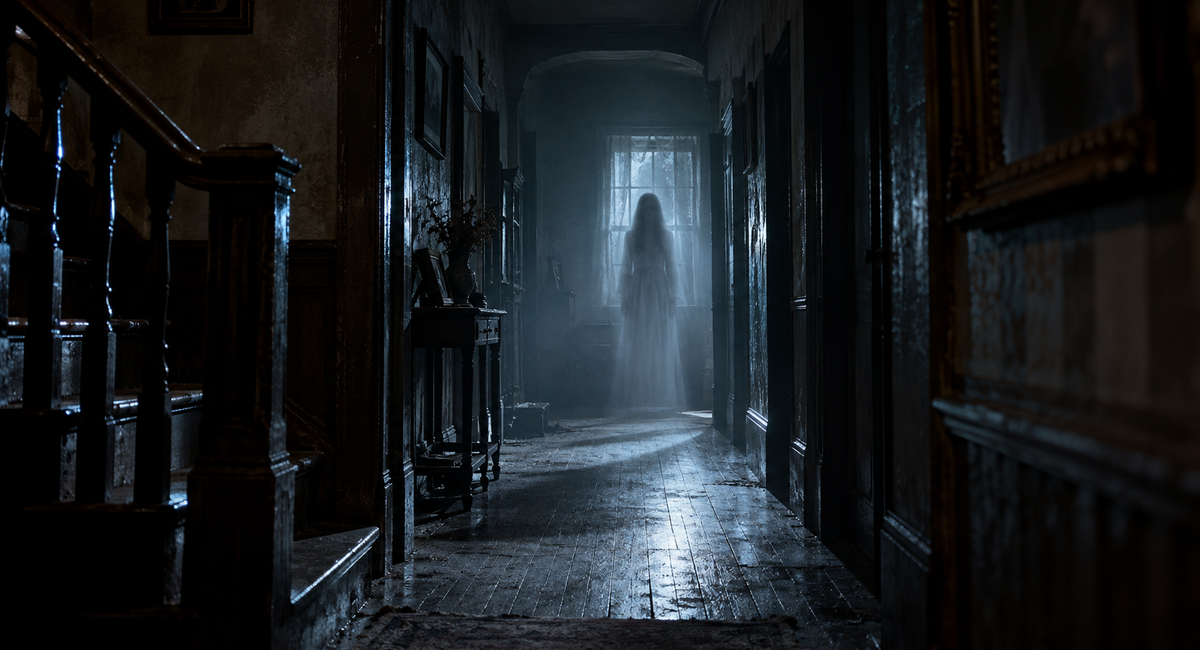
What Are Ghosts is the focus of this in-depth HorrorStuck guide. We examine the known facts, evidence, leading explanations, and the details that still remain uncertain.
What Are Ghosts: Key Facts and Context
Table of Contents
You wake up in the middle of the night.
The house is completely silent.
Then you hear footsteps in the hallway.
Slow.
Heavy.
Coming closer.
You know nobody else is supposed to be home.
For a moment, you remain perfectly still.
Then the footsteps stop outside your bedroom door.
Nothing happens.
When you finally gather enough courage to look outside, the hallway is empty.
Was it the house settling?
A dream?
A hallucination?
Or was somebody—or something—really there?
Stories like this have existed for thousands of years. People from very different cultures have described seeing dead relatives, hearing unexplained voices, feeling invisible presences, watching human-shaped figures disappear, and witnessing objects move apparently without explanation.
We commonly call such entities ghosts.
But what exactly is a ghost?
Do ghosts really exist?
And after centuries of stories, investigations, photographs, recordings and alleged encounters, is there any convincing evidence?
The answer depends heavily on whether we approach the question through folklore, spirituality, psychology or science.
And that is where things become fascinating.
What Is a Ghost?
In the simplest sense, a ghost is traditionally understood as the spirit, soul or apparition of a deceased person that somehow remains capable of appearing to or interacting with the living.
Descriptions vary enormously.
Some people report seeing a completely realistic person who suddenly disappears.
Others describe transparent figures.
Some never see anything at all but report:
- footsteps
- voices
- knocking
- doors moving
- cold sensations
- strange smells
- objects changing position
- shadows
- feelings of being watched
- the unmistakable sensation that another person is standing nearby
Ghost folklore exists in cultures across the world, although different societies interpret these experiences differently.
Some traditions regard ghosts as souls unable to move on after death.
Others see them as ancestors visiting relatives.
Still others describe spirits attached to locations, traumatic events or particular objects.
Science, however, does not currently recognize ghosts as established entities.
That creates an important distinction.
People unquestionably report ghost experiences. Whether those experiences are actually caused by the spirits of dead people is a separate question.
Do Ghosts Exist?
There is currently no reproducible scientific evidence establishing that deceased human consciousness survives death and subsequently appears as ghosts.
That does not mean every person reporting a paranormal encounter is lying.
In fact, many researchers studying anomalous experiences emphasize exactly the opposite: people can have extremely vivid, emotionally powerful experiences while being completely sincere about what they perceived.
Psychologist Chris French, who has researched anomalous experiences, has discussed how genuine experiences involving sleep paralysis, hallucinations and perceptual effects can later be interpreted according to a person’s existing supernatural beliefs.
The mystery therefore involves two different questions:
Question 1: Did the person genuinely experience something unusual?
Very possibly.
Question 2: Was the cause a deceased human spirit?
That is much harder to demonstrate.
Why Have Humans Believed in Ghosts for So Long?
Belief in some form of continued existence after death is extremely old.
Funeral rituals, ancestor traditions and beliefs concerning spirits appear throughout human history.
Ghost stories often perform an important psychological and cultural role.
They allow humans to confront one of life’s most difficult questions:
What happens after we die?
For someone who believes consciousness survives physical death, a ghost may represent evidence that life continues.
For someone grieving a loved one, sensing their presence may feel comforting rather than frightening.
For others, ghosts represent something darker—a dead person trapped between worlds, unable or unwilling to leave.
Different religions and spiritual traditions have developed very different concepts of the soul, afterlife and communication with the dead. There is therefore no single universal “spiritual explanation” for ghosts.
Instead, several broad ideas repeatedly appear.
Spiritual Explanations for Ghosts
1. The Human Soul Survives Death
Perhaps the most familiar spiritual explanation is that consciousness—or some nonphysical component of a person—continues after the physical body dies.
Under this interpretation, a ghost is essentially a surviving personality.
It may retain:
- memories
- emotions
- awareness
- attachment to people
- attachment to places
- unfinished intentions
Believers sometimes describe these as intelligent spirits because the apparition appears capable of reacting to living people.
Reports might include a voice answering a question, an apparition appearing deliberately, or unexplained activity apparently responding to investigators.
None of these behaviors has scientifically established the existence of surviving spirits, but they form an important part of paranormal belief.
2. Spirits With Unfinished Business
One of the oldest ideas in ghost folklore is that certain people cannot peacefully move on after death.
The supposed reasons include:
- sudden death
- murder
- unresolved relationships
- revenge
- guilt
- protecting loved ones
- unfinished responsibilities
- attachment to a particular location
This explains why so many traditional ghost stories involve people who died violently or unexpectedly.
From a scientific perspective, however, there is no established mechanism demonstrating that emotional trauma can cause consciousness to remain at a physical location after death.
It remains a spiritual and folkloric explanation rather than a demonstrated phenomenon.
3. Residual Hauntings
Not every paranormal theory considers a ghost to be conscious.
Some paranormal investigators describe something called a residual haunting.
The idea is that an intensely emotional event somehow leaves an imprint on a location.
Rather than encountering an intelligent spirit, witnesses supposedly observe something resembling a recording repeatedly playing.
For example, people might report hearing the same footsteps along the same staircase every night without the footsteps ever responding to anyone.
The controversial Stone Tape theory proposes that buildings or materials might somehow retain emotional events.
No accepted scientific evidence currently demonstrates that physical materials can record traumatic human consciousness in this manner.
Nevertheless, residual haunting remains a popular idea in paranormal investigation.
4. Ancestors or Loved Ones Visiting
Not every ghost encounter is frightening.
Many people report experiences involving deceased spouses, parents, friends or relatives.
These can include:
- hearing the person’s voice
- smelling a familiar perfume
- seeing them briefly
- dreaming vividly about them
- feeling them sitting beside the bed
- experiencing an overwhelming sense that they are nearby
Interestingly, experiences involving deceased loved ones are sufficiently common that psychologists and bereavement researchers study them.
An interdisciplinary review published in Schizophrenia Bulletin found that sensory and quasi-sensory experiences of deceased people occur frequently during bereavement and are usually benign rather than automatically indicating psychological illness.
This does not establish that deceased people are actually communicating.
But it demonstrates that the experience of someone’s continued presence can be profoundly real to the person experiencing it.
What Does Science Say About Ghost Sightings?
Science approaches ghost encounters differently.
Instead of beginning with:
“Was this a ghost?”
researchers are more likely to ask:
“What mechanisms could produce this experience?”
Several possibilities can explain at least some alleged paranormal encounters.
1. Sleep Paralysis
One of the strongest scientific explanations for certain frightening ghost encounters is sleep paralysis.
During normal REM sleep, the brain temporarily prevents most voluntary muscles from moving. This helps stop us from physically acting out our dreams.
Occasionally, consciousness returns before this paralysis completely disappears.
The person wakes up but temporarily cannot move.
What makes the experience terrifying is that dream-like hallucinations can continue while the person feels awake.
People have reported:
- dark figures
- people standing beside the bed
- whispering
- footsteps
- pressure on the chest
- frightening faces
- invisible presences
- creatures entering the bedroom
Scientific reviews describe an “intruder” form of sleep-paralysis hallucination involving intense fear, sensed presence and visual or auditory experiences.
Someone unfamiliar with sleep paralysis could understandably interpret the experience as a ghost or supernatural attack.
Internal link: Sleep Paralysis vs Paranormal Encounters
2. Hypnagogic and Hypnopompic Hallucinations
Human perception does not instantly switch between “dreaming” and “awake.”
When falling asleep, people can experience hypnagogic hallucinations.
When awakening, similar experiences are called hypnopompic hallucinations.
These experiences can feel astonishingly real.
A person might hear someone calling their name.
They may see a human figure standing nearby.
They might feel someone touching them.
Because the individual may feel partially awake, the experience can easily be interpreted as something physically present in the room.
This could explain some encounters traditionally described as bedroom ghosts, demons or mysterious shadow figures.
3. Shadow People and Peripheral Vision
Another frequently reported paranormal phenomenon involves dark human-shaped figures commonly called shadow people.
Witnesses often report seeing them:
- beside doorways
- walking through halls
- standing in corners
- watching from across a room
- appearing briefly in peripheral vision
Human vision is extremely good at detecting possible people, faces and threats.
But our peripheral vision contains considerably less detail than our central vision.
In darkness or ambiguous lighting, the brain must interpret incomplete information.
Sometimes that interpretation may create something that looks unmistakably human.
Studies have also investigated illusory agency detection—the tendency to perceive intentional agents where none are actually present. Research has found associations between paranormal belief and increased tendency to report agency under ambiguous conditions.
That doesn’t prove every shadow-person report has the same explanation.
But it demonstrates how easily human perception can create meaningful figures from uncertain information.
Internal link: Shadow People: Myth or Reality?
4. Pareidolia
Have you ever seen a face in a cloud?
Or looked at the front of a car and thought the headlights resembled eyes?
That is pareidolia.
Our brains are extraordinarily sensitive to recognizable patterns—especially faces.
Evolutionarily, detecting another human or potential threat quickly can be extremely useful.
But that pattern-detection system sometimes produces false positives.
A curtain becomes a woman.
A coat hanging beside a door becomes a person.
Reflections in a window become a face.
Three random shapes in a photograph become ghostly eyes and a mouth.
In darkness, where visual information is incomplete, pareidolia becomes especially relevant to alleged paranormal encounters.
5. The Feeling That Someone Is There
Perhaps one of the strangest paranormal experiences requires no visible ghost at all.
You simply feel someone standing behind you.
Researchers sometimes refer to this as a felt presence or sensed presence.
It can occur in several circumstances, including sleep-related states, extreme physical environments and bereavement.
This sensation can be exceptionally convincing.
Nothing appears visually.
No voice speaks.
Yet the brain produces an almost undeniable impression that another conscious entity occupies the room.
For someone already inside a supposedly haunted building, such a sensation could easily become interpreted as paranormal activity.
6. Bereavement Experiences
Seeing or sensing someone who recently died is not necessarily evidence of mental illness.
Research literature has repeatedly documented experiences involving deceased loved ones among otherwise healthy grieving people.
People may:
- hear a familiar voice
- momentarily see the deceased
- smell their perfume or tobacco
- sense them nearby
- experience vivid dreams
- feel an apparent touch
Reviews emphasize that such experiences are often meaningful and comforting and should not automatically be pathologized.
Science can study when these experiences happen and how people interpret them.
What it cannot currently demonstrate is that the deceased person objectively caused the experience.
7. Expectation and Suggestion
Imagine walking into an ordinary old hotel.
You hear pipes knocking behind a wall.
You probably think:
“Old plumbing.”
Now imagine someone tells you before entering:
“A woman was murdered in Room 213, and guests hear her knocking inside the walls.”
Suddenly the same sound feels very different.
Expectation changes attention.
People begin actively searching for unusual noises, shadows and sensations.
Modern psychological research shows that prior beliefs can influence what people notice and how ambiguous sensory information is interpreted.
This does not mean people deliberately invent experiences.
Rather, the brain is constantly interpreting incomplete information using expectations and previous knowledge.
8. Memory Is Not a Perfect Recording
Eyewitness testimony feels powerful because the witness often seems completely certain.
But human memory does not operate like video footage.
Every time we remember an event, the brain reconstructs it.
Details can change.
Information learned later can influence how the original experience is remembered.
Imagine someone sees a vague white shape moving across an old house.
Initially they describe:
“Something white moved past the doorway.”
Later they learn that a woman supposedly died there wearing a white nightdress.
Months later, the memory may feel more specific:
“I saw a woman in a white dress.”
The witness may be perfectly sincere.
The memory itself has simply evolved.
What About Photographs of Ghosts?
Ghost photography has existed almost as long as photography itself.
Thousands of alleged paranormal images circulate online.
Common examples include:
- translucent people
- faces in windows
- unexplained shadows
- glowing orbs
- figures behind people
- strange mist
- blurred human shapes
Unfortunately, photographs have several ordinary ways of producing ghost-like effects.
These include:
- long exposure
- motion blur
- reflections
- lens flare
- dust
- insects
- moisture
- camera straps
- image compression
- double exposure
- editing
- deliberate fabrication
Photography has also historically been used to manufacture supposed spirit images.
During the nineteenth-century rise of Spiritualism, techniques involving optics, staged effects and photography created apparently supernatural figures. Smithsonian’s historical coverage of Spectropia and Spiritualist demonstrations shows how convincing ghostly imagery could be produced using ordinary perceptual and optical effects.
A strange photograph can therefore be interesting evidence of something unusual in the photograph, but identifying that something as a dead person’s spirit requires much stronger evidence.
What Are Ghost Orbs?
Perhaps the most common paranormal photographs contain small circular lights known as orbs.
Some paranormal enthusiasts interpret them as spiritual energy.
Photographers usually have a simpler explanation.
Dust, moisture, insects or other tiny objects close to the camera can reflect flash light while being out of focus.
The resulting circle can look surprisingly mysterious.
This became particularly common with compact digital cameras whose flash was positioned close to the lens.
An orb by itself therefore provides weak evidence for paranormal activity.
Can Ghosts Be Recorded on Audio?
Another popular form of paranormal evidence is Electronic Voice Phenomena, or EVP.
Investigators leave audio recorders running in supposedly haunted locations and later listen for voices that were not noticed during the recording.
Sometimes faint sounds appear to resemble words or sentences.
Believers suggest these may be spirits communicating electronically.
Skeptics point to several alternative explanations:
- distant voices
- radio interference
- background noise
- audio compression
- accidental sounds
- auditory pareidolia
Auditory pareidolia happens when the brain finds meaningful words inside ambiguous noise.
If someone tells you:
“The ghost says ‘Get out,'”
you may suddenly hear exactly that phrase.
Without the suggestion, the recording may simply sound like static.
Do EMF Meters Detect Ghosts?
Watch almost any modern ghost-hunting program and somebody eventually produces an EMF meter.
EMF means electromagnetic field.
These devices can detect electromagnetic activity associated with ordinary sources such as:
- electrical wiring
- appliances
- mobile devices
- transformers
- electronic equipment
Some paranormal investigators interpret unexplained EMF fluctuations as evidence of spirits.
The problem is that science has never established that ghosts produce electromagnetic fields.
Therefore an EMF spike demonstrates the presence of an electromagnetic field—not necessarily a ghost.
Without first identifying and eliminating ordinary sources, the measurement tells investigators very little about paranormal activity.
What About Cold Spots?
Another classic haunted-house phenomenon is the mysterious cold spot.
Witnesses enter a room and suddenly notice one area feels dramatically colder.
Paranormal folklore sometimes associates this with spirits drawing energy from their surroundings.
Possible ordinary explanations include:
- drafts
- open vents
- poor insulation
- air pressure differences
- windows
- chimneys
- convection currents
- heating-system variations
A properly investigated temperature anomaly can certainly be interesting.
But detecting a cold area does not automatically establish a supernatural cause.
What Are Poltergeists?
Poltergeists deserve separate attention because these cases frequently involve physical activity rather than simple apparitions.
Reports can include:
- objects moving
- knocking
- furniture shifting
- doors opening
- objects falling
- unexplained impacts
Historically, some paranormal researchers have proposed spirits as the cause.
Others proposed unconscious psychokinetic activity originating from living individuals.
Conventional explanations include misinterpretation, structural sounds, human interference and fraud.
Scientific investigation has not established poltergeists as a verified supernatural phenomenon.
Internal link: What Is a Poltergeist?
The Problem With Ghost Hunting
Investigating ghosts scientifically is difficult because scientific evidence requires more than something unusual happening once.
Researchers generally look for phenomena that can be:
Observed
Measured
Tested
Controlled
Repeated
Independently verified
Ghost experiences rarely satisfy all of these requirements.
A door moving unexpectedly is interesting.
But was there airflow?
Was the floor uneven?
Could somebody have moved it?
Was the event recorded continuously?
Can the effect happen again?
The more alternative explanations investigators eliminate, the more interesting an event becomes.
But unexplained does not automatically mean supernatural.
This distinction is crucial.
Why Isn’t Eyewitness Testimony Enough?
Millions of people throughout history have reported paranormal experiences.
Surely they cannot all be wrong?
This is one of the strongest intuitive arguments made by believers.
And it deserves serious consideration.
The problem is that eyewitness testimony demonstrates that people experience something.
It does not necessarily identify the cause.
Two people can witness the same unexplained event and interpret it differently.
One thinks:
“Ghost.”
Another thinks:
“Optical illusion.”
A third thinks:
“Someone was actually standing there.”
Experiences deserve investigation without automatically assuming either a paranormal or non-paranormal explanation.
Can Multiple People See the Same Ghost?
Shared experiences are particularly intriguing.
If one person sees something, hallucination or misperception might seem plausible.
But what if several people report it?
Multiple witnesses certainly make a case more interesting, but they still do not automatically prove a supernatural cause.
Several people can experience the same:
- environmental stimulus
- unusual sound
- reflection
- lighting effect
- vibration
- mistaken identity
Social influence can also affect interpretation.
If one frightened person suddenly says:
“Did you see that woman?”
others may begin interpreting an ambiguous shape as a woman too.
However, independently documented reports containing similar details—especially when witnesses were unaware of previous accounts—can be more difficult to explain and are among the cases paranormal researchers find particularly interesting.
They still require careful investigation.
Famous Attempts to Scientifically Investigate Ghosts
Interest in investigating spirits scientifically is not new.
During the nineteenth century, Spiritualism became extremely popular in Europe and the United States.
Mediums claimed they could communicate with dead people through:
- séances
- table movements
- automatic writing
- mysterious knocking
- spirit photography
- materialized apparitions
Some scientists became interested.
Others attempted to expose fraudulent mediums.
The Fox sisters helped popularize modern Spiritualism after claiming mysterious rapping sounds represented communication with spirits. Their performances became enormously influential, although Maggie Fox later publicly described how the knocking effects had been produced.
Magician Harry Houdini later became famous for investigating and exposing fraudulent mediums, using his knowledge of stage magic to recognize techniques that appeared supernatural to ordinary observers.
The history illustrates an important lesson:
Something can appear completely impossible until its mechanism is understood.
Has Science Proved Ghosts Don’t Exist?
No.
Science generally cannot prove that no ghost exists anywhere under any possible circumstances.
Instead, science asks whether there is sufficient reliable evidence supporting the claim that ghosts exist.
At present, that threshold has not been reached.
Parapsychology has attempted to scientifically study alleged paranormal phenomena for decades. The American Psychological Association’s dictionary notes that even some of the strongest positive claims in the field have faced difficulties with independent replication, contributing to mainstream scientific skepticism.
Therefore the scientific position is better summarized as:
There is currently no reproducible evidence demonstrating that ghost experiences are caused by surviving spirits of dead people.
That is different from declaring every paranormal experience fake.
Many experiences remain personally mysterious even when several possible explanations exist.
Could Consciousness Survive Death?
This is ultimately the deeper question behind ghosts.
If human consciousness depends entirely on brain activity, then the destruction of the functioning brain would presumably end individual consciousness.
If consciousness can somehow exist independently of the brain, survival after death might at least become conceptually possible.
Science currently has no accepted evidence demonstrating that a person’s memories, identity and conscious awareness continue functioning independently after irreversible death.
Yet questions about consciousness remain among the most profound areas of philosophy and neuroscience.
Ghost claims therefore sit at the intersection of several enormous questions:
What creates consciousness?
What exactly is personal identity?
Does consciousness require a functioning brain?
And what, if anything, happens to subjective experience at death?
Until those questions are completely understood, humans are unlikely to stop wondering about ghosts.
Why Do Ghost Stories Feel So Convincing?
Because ghost experiences often involve the things our brains consider most important:
People.
Faces.
Voices.
Threats.
Loved ones.
Death.
Darkness.
When an unexplained sound occurs during daylight, we investigate.
When the same sound happens at 2:17 a.m. inside a dark house, our emotional system responds before careful reasoning begins.
Evolution has rewarded organisms that react quickly to possible threats.
If a shadow in the forest might be a predator, assuming danger first could be safer than waiting for perfect evidence.
Our brains therefore constantly attempt to transform incomplete information into meaningful patterns.
Usually this works extremely well.
Occasionally it may also create ghosts.
But What About Cases That Remain Unexplained?
This is where the subject becomes genuinely interesting.
Not every reported paranormal experience has been conclusively explained.
Some cases contain unusual combinations of:
- independent witnesses
- repeated phenomena
- historical reports
- recordings
- physical observations
- unexpected coincidences
However, there is an important scientific principle to remember:
Unexplained does not mean unexplainable.
And unexplained does not automatically mean ghost.
A case may remain unresolved simply because investigators lack enough information.
Perhaps the correct explanation disappeared with the event itself.
That can be frustrating.
But intellectually, “we don’t know” is sometimes the most accurate answer available.
Are Ghosts Real? The Most Balanced Answer
So, after centuries of ghost stories, what can we actually conclude?
What we know:
People around the world report ghost-like experiences.
These experiences can feel extraordinarily real.
Bereaved people sometimes see, hear or sense deceased loved ones, and such experiences do not automatically indicate mental illness.
Sleep paralysis can produce terrifying apparitions, voices and sensed presences.
Perception can create human figures and intentional agents from ambiguous information.
Memory, expectation and cultural beliefs can influence how unusual events are interpreted.
Photographs, recordings and electronic devices can produce strange results without supernatural causes.
What we don’t know:
Whether every reported paranormal encounter can ultimately be explained conventionally.
Whether human consciousness can survive physical death.
Whether some currently unexplained experiences represent phenomena science has not yet understood.
What has not been demonstrated:
That ghosts are objectively existing spirits of deceased humans capable of interacting with the physical world.
Final Thoughts: Ghosts May Tell Us Something Important Either Way
Perhaps the most fascinating thing about ghosts is that they remain interesting regardless of which explanation is ultimately correct.
If ghosts genuinely exist, their existence would transform our understanding of consciousness, death and perhaps reality itself.
But if ghosts do not exist as supernatural entities, ghost experiences still reveal something extraordinary about the human mind.
Our brains can generate sensations so convincing that we hear voices nobody else hears.
We can sense people who aren’t visibly present.
We can transform shadows into human figures.
We can feel the presence of loved ones years after they are gone.
We can walk into an empty room and suddenly become certain that we are not alone.
Science can explain some of these experiences.
Spiritual traditions offer different interpretations.
Other cases remain unresolved.
And perhaps that uncertainty explains why ghost stories have survived for thousands of years.
Because somewhere, at some point, almost everyone has experienced that uncomfortable moment.
A strange noise downstairs.
A shadow where no shadow should be.
Footsteps inside an empty room.
And the quiet thought that immediately follows:
What if I’m not alone?
Frequently Asked Questions About Ghosts
Are ghosts scientifically proven?
No. There is currently no reproducible scientific evidence establishing that ghosts are the surviving spirits of deceased people. However, scientists do study many experiences associated with alleged ghost encounters, including hallucinations, sensed presence, sleep paralysis and bereavement experiences.
Are ghost sightings always hallucinations?
No. A ghost sighting could potentially involve misidentification, reflections, lighting, dreams, sleep paralysis, memory errors, ordinary people, environmental effects, deliberate hoaxes or other causes. Calling every unexplained sighting a hallucination would be just as premature as calling every sighting a ghost.
Why do people see ghosts at night?
Low lighting provides less visual information, making ambiguous objects easier to misinterpret. Fatigue, sleep-related hallucinations and heightened fear can also contribute to unusual nighttime experiences.
Why do people see deceased relatives?
Sensory and sensed-presence experiences involving deceased loved ones are documented in bereavement research and can occur in otherwise healthy individuals. Their psychological mechanisms are still studied, while spiritual traditions may interpret them as genuine visits from the deceased.
Can sleep paralysis make you see ghosts?
Yes. Sleep paralysis can involve vivid visual, auditory and tactile hallucinations as well as the powerful sensation that an intruder is nearby.
What is the difference between a ghost and a spirit?
In popular usage, a ghost usually refers specifically to the supposed apparition or presence of a deceased being. “Spirit” is a broader term that may refer to a nonphysical being, soul or supernatural entity depending on the religious or cultural tradition.
Can EMF meters detect ghosts?
EMF meters detect electromagnetic fields. There is currently no established scientific evidence demonstrating that spirits produce electromagnetic fields, so an EMF reading cannot by itself prove paranormal activity.
What are shadow people?
Shadow people are dark, human-like figures reported during some paranormal encounters and sleep-related experiences. They may appear briefly in peripheral vision or during sleep paralysis. Their interpretation remains disputed between paranormal explanations and perceptual or neurological explanations.
Internal link: Shadow People: Myth or Reality?
Can a house really be haunted?
People certainly report repeated unexplained experiences in particular locations. However, no scientific method currently confirms that a building contains spirits. Individual cases require investigation of structural, electrical, environmental, psychological and potentially fraudulent explanations before supernatural causes are considered.
Is there real evidence of ghosts?
There are thousands of eyewitness accounts, photographs, videos, audio recordings and paranormal investigation reports. The problem is not the absence of claimed evidence but its scientific reliability. None has yet produced reproducible proof accepted by mainstream science that deceased human spirits cause ghost phenomena
Further Reading & External Resources
Ultimately, What Are Ghosts remains compelling because the documented evidence answers some questions while leaving others open to careful investigation.
[…] What Are Ghosts? Science, Spiritual Beliefs and the Evidence […]