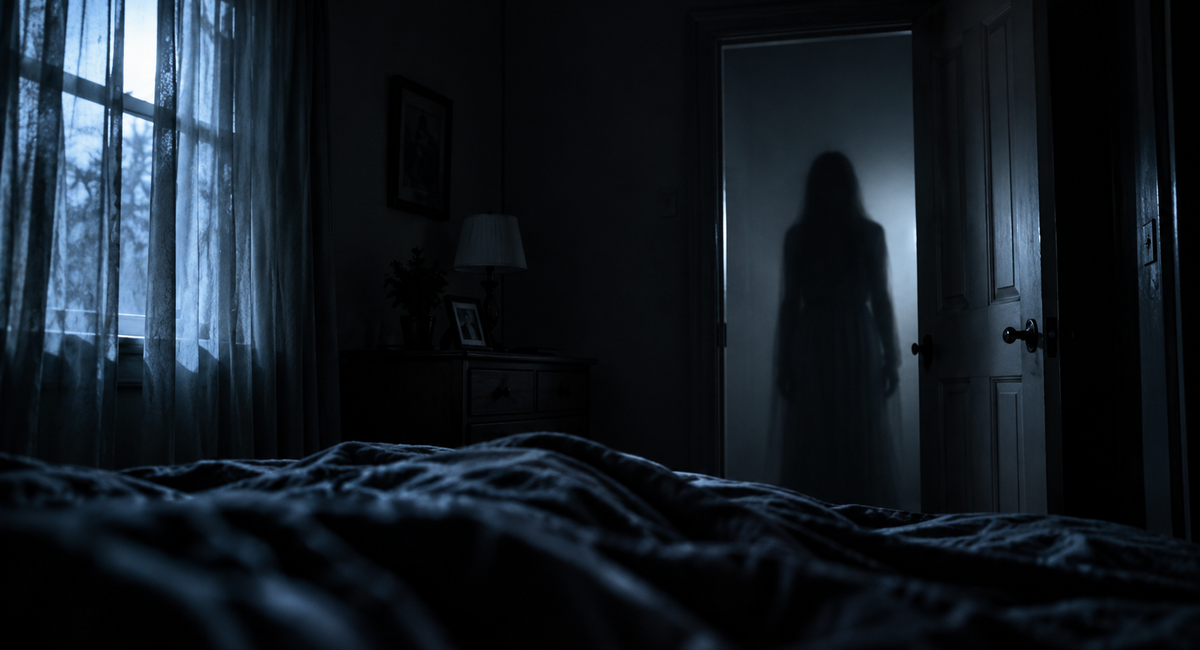
Why Do People See Ghosts? Science is the focus of this in-depth HorrorStuck guide. We examine the known facts, evidence, leading explanations, and the details that still remain uncertain.
Why Do People See Ghosts? Science: Key Facts and Context
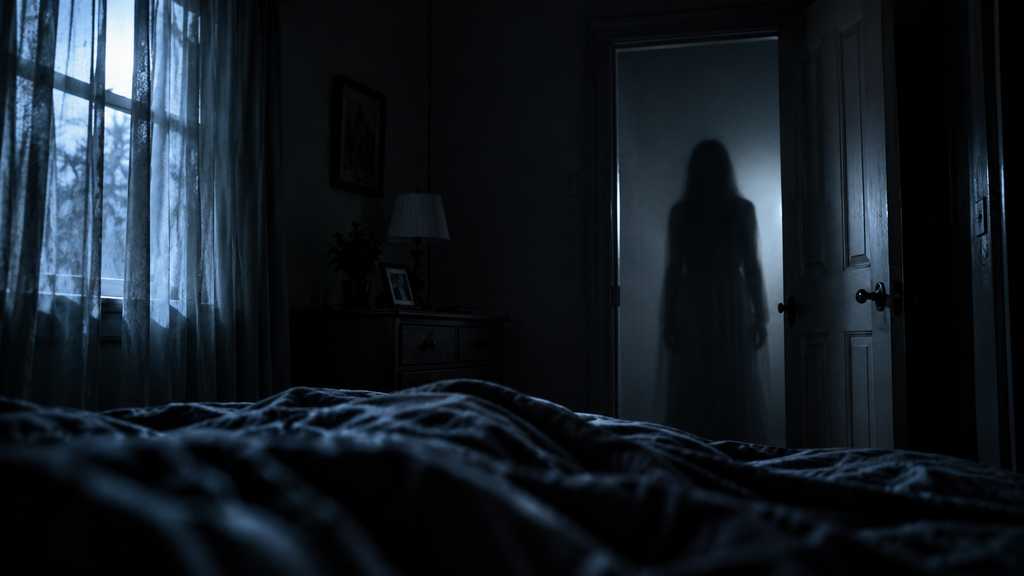
You wake in the middle of the night.
The room is dark, but not completely dark. A little light enters through the curtains.
And then you see someone standing near the bedroom door.
For a few seconds, there is no doubt in your mind. It looks like a person. Maybe even someone you recognize.
You blink.
The figure disappears.
Was it a ghost?
Was your brain still partly dreaming?
Or did you genuinely see something that science cannot yet explain?
Stories of people seeing ghosts exist across cultures and centuries. Some witnesses describe transparent figures. Others report perfectly normal-looking people who vanish suddenly. Some see deceased relatives, shadowy figures, children, soldiers, strangers or human shapes standing silently at the edge of a room.
But why do people see ghosts?
Science offers several fascinating explanations involving sleep, perception, memory, grief, expectation and the human brain.
Paranormal researchers, however, argue that not every reported apparition fits comfortably into those explanations.
So what is actually happening?
Let’s examine both sides.
Quick Answer: Why Do People See Ghosts?
People may report seeing ghosts for many different reasons.
Scientific explanations include:
- Sleep paralysis and dream-related hallucinations
- Pareidolia and visual misinterpretation
- Low light and peripheral vision
- Grief-related sensory experiences
- Expectation and suggestion
- Stress, exhaustion and sleep deprivation
- Certain neurological or medical conditions
- The brain’s tendency to recognize human faces and figures
- Memory reconstruction after unusual events
Paranormal explanations propose possibilities such as:
- Spirits of deceased people
- Apparitions
- Crisis apparitions
- Intelligent hauntings
- Residual hauntings
- Psychic perception
- Consciousness surviving physical death
At present, science has not established that ghosts exist as spirits of the dead. At the same time, the experiences reported by witnesses can be extremely vivid and psychologically real.
And that distinction is important.
Seeing something unexplained does not necessarily mean someone is lying—or that a ghost has been proven.
What Does It Actually Mean to “See a Ghost”?
When someone says:
“I saw a ghost.”
they may be describing very different experiences.
One person might see a pale human figure for several seconds.
Another might see a dark silhouette move across a hallway.
Someone else might wake to find a deceased relative apparently sitting beside their bed.
Others report briefly seeing a person in a location, only to discover that nobody was actually there.
There are also experiences where people don’t visibly see anything but strongly feel that someone else is in the room.
Scientists often discuss some of these events using terms such as:
- visual hallucination
- illusion
- sensed presence
- hypnagogic hallucination
- hypnopompic hallucination
- bereavement-related sensory experience
- perceptual misinterpretation
Paranormal researchers may instead use terms such as:
- apparition
- ghost
- spirit
- haunting
- after-death communication
The same experience can therefore receive completely different interpretations depending on who is examining it.
The Scientific Explanation: How the Brain Can Create a Ghost
One of the most surprising things about human perception is that we do not experience reality like a camera recording everything around us.
Our brain constantly interprets incomplete information.
It predicts.
It fills gaps.
It searches for patterns.
And sometimes it gets those patterns wrong.
Under the right conditions, the result can feel astonishingly real.
1. Pareidolia: The Brain Is Constantly Looking for Faces
Have you ever seen a face in:
- clouds
- curtains
- trees
- wallpaper
- rocks
- shadows
- car headlights
- windows
That phenomenon is called pareidolia.
Pareidolia occurs when the brain detects a meaningful pattern—especially a face—in ambiguous visual information.
The human brain is remarkably sensitive to faces. Research using brain imaging has shown that face-like objects can rapidly activate parts of the visual system involved in processing real faces.
This ability makes evolutionary sense.
For our ancestors, quickly noticing another human—or a potential threat—could have been more important than carefully checking whether every shape was actually a person.
Imagine entering a dark room.
A coat hangs from a chair.
There is just enough light to reveal:
- something resembling shoulders
- a dark area where a head should be
- two lighter spots resembling eyes
Your brain may identify:
Person.
Only after you turn on the light do you realize:
Coat.
In a frightening location, however, that moment of misidentification may become remembered as something far stranger.
2. Darkness Makes Your Brain Guess
Ghost sightings frequently happen in places with poor visibility:
- bedrooms at night
- hallways
- abandoned buildings
- basements
- forests
- old houses
- cemeteries
- dim staircases
This matters.
When visual information is incomplete, the brain has to interpret uncertain shapes.
A shadow becomes a person.
A curtain movement becomes a hand.
A reflection becomes a face.
A tree outside a window becomes someone watching.
The less information the eyes receive, the more room there is for expectation and previous experience to influence perception.
This could explain why many supposed apparitions disappear when:
- lights are switched on
- the witness moves closer
- the viewing angle changes
- the person looks directly at the object
But not every report behaves this way.
Some witnesses claim to have seen apparitions clearly, sometimes for several seconds or longer.
Those reports form part of the paranormal debate.
3. Your Peripheral Vision Can Play Tricks on You
One of the most common paranormal experiences sounds like this:
“I saw someone standing there from the corner of my eye. When I looked directly at them, nobody was there.”
Peripheral vision is excellent at detecting movement.
But it is much worse than central vision at seeing fine detail.
That means your brain may detect:
something moved
without receiving enough information to determine exactly what moved.
The brain then makes its best guess.
In a normal environment, you may think:
“That was probably a curtain.”
Inside an allegedly haunted house, your interpretation may become:
“Something walked past me.”
Expectation changes how ambiguous information is understood.
This may also play a role in reports of shadow people—dark human-like figures frequently reported in bedrooms, hallways and peripheral vision.
If you want to explore that phenomenon further, read Shadow People: Myth or Reality? on HorrorStuck.
4. Sleep Paralysis Can Produce Terrifying “Ghosts”
Perhaps one of the strongest scientific explanations for bedroom ghost encounters is sleep paralysis.
During REM sleep—the stage strongly associated with vivid dreaming—the brain normally prevents much of the body from moving.
Sometimes consciousness returns before that paralysis has completely ended.
You are awake.
You can see your room.
But you cannot move.
And occasionally, elements of dreaming seem to intrude into waking awareness.
People may experience:
- a shadowy figure
- someone standing beside the bed
- a person sitting on their chest
- whispering
- footsteps
- breathing
- strange faces
- pressure on the chest
- the sensation that someone is watching them
Research on sleep paralysis has repeatedly documented the experience of a threatening “sensed presence.”
Cleveland Clinic also notes that sleep paralysis can include perceptions of threatening presences sometimes popularly described as “sleep demons.”
The experience can be so realistic that telling someone afterward that it was “just a dream” may seem ridiculous to them.
They were awake.
They saw their bedroom.
And they saw something else inside it.
For a deeper explanation, read Sleep Paralysis vs Paranormal Encounters on HorrorStuck.
5. Hypnagogic and Hypnopompic Hallucinations
You don’t necessarily have to experience complete sleep paralysis to see something strange around sleep.
Two important phenomena are:
Hypnagogic hallucinations
These occur while you are falling asleep.
Hypnopompic hallucinations
These happen while you are waking up.
A person may briefly:
- hear someone calling their name
- see a face
- see someone standing beside the bed
- hear footsteps
- feel someone touching them
- see insects or animals
- perceive a figure moving through the room
Because you may feel awake during part of the experience, distinguishing dream imagery from external reality can become extremely difficult.
This is probably responsible for at least some traditional accounts of nighttime spirits, demons and supernatural visitors.
But ghost sightings don’t happen only near sleep.
And that is where the subject becomes more complicated.
6. Grief Can Make People See or Feel the Dead
One particularly interesting category of ghost experience occurs after someone loses a loved one.
Bereaved people sometimes report:
- hearing the deceased person’s voice
- seeing them briefly
- smelling their perfume
- feeling them sit on a bed
- sensing them nearby
- feeling their touch
These experiences are more common than many people realize.
Scientific reviews have found sensory or presence-like experiences of deceased loved ones across bereaved populations, and researchers emphasize that such experiences should not automatically be interpreted as evidence of mental illness.
For some people, the experience is frightening.
For others, it is comforting.
Consider this example.
A woman loses her husband after decades of marriage.
Weeks later, she enters the kitchen and, for a brief instant, sees him sitting in his usual chair.
What happened?
Scientific interpretation
Her brain has spent decades expecting him to occupy that space. Memory, grief, attention and perception may briefly combine to create an intensely realistic experience.
Paranormal interpretation
Her husband may genuinely have appeared to her after death.
Science has evidence that bereavement-related perceptions occur.
What science cannot currently demonstrate is that the perceived person was objectively present as a surviving spirit.
7. Expectation Can Influence What We Experience
Imagine two groups entering the same old building.
Group A is told:
“This building is historically interesting.”
Group B is told:
“This is one of the most haunted buildings in the area.”
Which group is more likely to interpret:
- a floorboard creaking
- a sudden cold sensation
- an unexplained shadow
- an odd smell
- a distant sound
as paranormal?
Expectation matters.
One fascinating experiment attempted to create an artificial “haunted” room using environmental manipulations including electromagnetic fields and infrasound.
Participants reported unusual sensations—but the number of experiences was not reliably tied to whether those environmental factors were actually present. The researchers argued that suggestibility provided the most economical explanation for the results.
In other words:
Tell someone strange things may happen, put them in an eerie environment, and ordinary sensations can suddenly acquire extraordinary meanings.
8. Fear Makes the Brain Look for Threats
Imagine walking alone through a dark abandoned building.
You hear something behind you.
Your brain doesn’t calmly say:
“Let’s calculate the statistical probability of structural expansion in aging timber.”
It says:
“WHAT WAS THAT?”
Fear increases vigilance.
Your attention begins searching for threats.
Tiny sounds become important.
Movement becomes suspicious.
Ambiguous shapes become possible people.
This survival system normally protects us.
But in an already frightening environment, it can also make harmless information seem threatening.
That’s why exploring an old building at 2:00 AM after hearing its ghost stories produces a very different psychological state from visiting the same building at noon with fifty tourists around you.
9. Memory Is Not a Perfect Recording
There is another problem with ghost stories.
Human memory changes.
After an unusual event, we reconstruct what happened rather than replaying a perfect video stored in the brain.
Imagine seeing a strange shape for two seconds.
At first you remember:
“I saw something near the stairs.”
After discussing it repeatedly:
“It looked like a person.”
Weeks later:
“It looked like a woman.”
Months later:
“I clearly saw a woman wearing an old-fashioned white dress.”
This does not necessarily mean someone is deliberately lying.
Memory can become more detailed—or simply different—as events are repeatedly recalled and interpreted.
That is why investigators place greater weight on testimony recorded immediately after an event than stories reconstructed many years later.
10. Some Medical Conditions Can Cause Visual Hallucinations
Seeing something that isn’t externally present can sometimes have medical causes.
Visual hallucinations can occur in association with various neurological, ophthalmological, psychiatric and medical conditions. Modern researchers emphasize that visual hallucinations themselves are complex and probably arise through several interacting brain mechanisms rather than one simple process.
They can also be associated with:
- certain medications
- substance use
- severe sleep deprivation
- neurological disorders
- some forms of dementia
- problems affecting vision
- fever or delirium
- migraines in some individuals
This does not mean that anyone who reports seeing a ghost has a psychiatric disorder.
That would be an enormous oversimplification.
But persistent or disturbing visual or auditory experiences—particularly when they occur frequently while fully awake or alongside other symptoms—are worth discussing with a qualified medical professional.
So Has Science Explained Every Ghost Sighting?
No.
And this is where discussions about ghosts often become unnecessarily polarized.
Science can identify mechanisms capable of producing convincing ghost-like experiences.
That does not mean researchers can retrospectively prove exactly what happened during every reported encounter.
Consider an account from 80 years ago:
A witness claims they saw a deceased relative standing at the bottom of the stairs for ten seconds.
Science could propose:
- misperception
- hallucination
- grief
- memory distortion
- sleep-related imagery
But without examining the witness at the exact moment, there may be no way to establish which explanation—if any—applied.
“Unexplained” therefore does not automatically mean paranormal.
But it also means the exact cause remains unknown.
The Paranormal Explanation: Could Some Apparitions Be Real?
People have reported ghosts for thousands of years.
Paranormal researchers argue that certain cases appear difficult to reduce to simple visual mistakes.
The Society for Psychical Research, founded in Britain in 1882, was among the earliest organizations to systematically collect and examine reports of apparitions and other claimed psychic phenomena.
Researchers interested in apparitions have described several categories.
1. Apparitions of the Dead
These are the classic ghosts.
A person reports seeing someone who has died.
Interestingly, many reported apparitions are not described as transparent monsters or glowing figures.
They may look completely ordinary.
The witness may initially believe they have encountered a living person—until something unusual happens.
For paranormal investigators, these cases raise the possibility that some aspect of consciousness may survive bodily death.
Mainstream science has not established this as fact.
2. Crisis Apparitions
Perhaps one of the most intriguing claims in psychical research involves crisis apparitions.
The pattern usually goes like this:
Someone unexpectedly sees or senses a distant friend or relative.
Later, they discover that the person died or experienced a major crisis around that same time.
Historic psychical researchers collected many such reports and investigated whether the apparent coincidences occurred more frequently than chance might predict.
Paranormal interpretations include:
- telepathic communication
- consciousness separating from the body
- a final communication before death
Skeptical explanations include:
- coincidence
- selective memory
- inaccurate timing
- retrospective reconstruction
- reporting bias
These cases remain controversial because extraordinary interpretations require stronger evidence than anecdotal testimony alone.
3. Intelligent Hauntings
In paranormal terminology, an intelligent haunting describes supposed activity that appears aware of living people.
Witnesses might report:
- responses to questions
- footsteps approaching when called
- objects apparently moving deliberately
- apparitions making eye contact
- voices answering investigators
If such behavior could be objectively demonstrated under controlled conditions, it would be extraordinarily significant.
The difficulty is that reliable, repeatable scientific evidence has not yet established that spirits cause these events.
4. Residual Hauntings
Another paranormal theory proposes that some hauntings are not conscious spirits at all.
Instead, an event somehow becomes “recorded” in a location and occasionally replays.
For example:
A ghost reportedly:
- walks along the same hallway
- follows the same route
- never acknowledges witnesses
- appears wearing the same clothing
- repeats the same behavior
This is sometimes called a residual haunting.
The related “Stone Tape” idea proposes that environments may somehow store impressions of emotionally intense events.
It is an intriguing paranormal concept, but there is currently no established scientific mechanism demonstrating that buildings can record and replay human consciousness in this way.
The Most Difficult Ghost Reports to Explain
Many ghost encounters have straightforward possible explanations.
But paranormal believers point to certain characteristics they consider more interesting.
Multiple Witnesses
What if two people see the same figure at the same time?
Independent witnesses would potentially reduce some explanations involving an individual’s hallucination.
However, investigators must still consider:
- whether witnesses influenced each other
- whether both saw the same ambiguous stimulus
- whether their descriptions matched before discussion
- how quickly testimony was recorded
Reports of collectively perceived apparitions exist in psychical-research literature, although interpreting them remains controversial.
Apparitions Containing Unknown Information
Another unusual category involves someone reporting details they supposedly could not have known.
For example:
A witness sees an unfamiliar person in an old house.
Later, they are shown a historical photograph and claim the person resembles the apparition.
Such stories can sound impressive.
But investigators need to rule out:
- prior exposure
- suggestive questioning
- coincidence
- flexible interpretation
- information leakage
- altered memory
Good paranormal investigation is less about asking:
“Could this be a ghost?”
and more about asking:
“What normal explanations can we eliminate first?”
Why Ghosts Often Look Human
Whether ghosts are paranormal or neurological, there is an interesting pattern:
Most apparitions look human.
That makes sense from the scientific perspective.
The human brain is exceptionally specialized for detecting:
- faces
- bodies
- eyes
- biological movement
Research into face pareidolia shows just how easily ambiguous information can activate mechanisms normally used for real face perception.
From the paranormal perspective, the explanation is simpler:
If ghosts are surviving human consciousness, naturally they would appear human.
The same observation therefore supports completely different narratives depending on your starting assumptions.
Why Are Ghosts Usually Seen at Night?
Ghosts appear overwhelmingly associated with darkness in popular culture.
There are several obvious scientific reasons.
At night:
- visibility decreases
- peripheral perception becomes more important
- shadows become ambiguous
- people are tired
- dream states are closer
- sleep paralysis becomes possible
- unusual household sounds become noticeable
- anxiety increases when we are alone
A house that feels perfectly ordinary at noon can seem entirely different at 3:00 AM.
But paranormal traditions offer another explanation: nighttime, particularly certain hours, is sometimes believed to make communication between the living and dead easier.
There is no established scientific evidence that a specific hour makes paranormal activity more likely.
Why Do Ghosts Sometimes Disappear When You Look Directly at Them?
This is particularly common in reports of shadow figures.
Someone notices a human shape in peripheral vision.
They immediately turn.
Nothing is there.
This fits very well with the limitations of peripheral vision and the brain’s tendency to interpret incomplete shapes.
But paranormal believers sometimes argue that apparitions may only manifest briefly.
Without objective evidence, distinguishing those possibilities in an individual case is extremely difficult.
Why Do Some People See Ghosts While Others Never Do?
There may not be a single reason.
Differences could involve:
- sleep patterns
- personality
- expectation
- culture
- religious beliefs
- attention
- susceptibility to unusual perceptual experiences
- exposure to frightening environments
- grief
- stress
- imagination
- neurological differences
Cultural interpretation is especially important.
Imagine that three people experience exactly the same nighttime sensed presence.
One may call it:
sleep paralysis.
Another:
a ghost.
Another:
a demon.
The sensory experience may be similar.
The explanation comes partly from culture and belief.
Are People Who See Ghosts Mentally Ill?
Not necessarily.
This is one of the biggest misconceptions surrounding paranormal experiences.
Unusual perceptions can occur in otherwise healthy people.
They are especially associated with circumstances such as:
- falling asleep
- waking up
- bereavement
- exhaustion
- extreme stress
- sensory ambiguity
Research into bereavement-related experiences specifically warns against automatically treating sensed or perceived contact with a deceased loved one as evidence of pathology.
Context matters enormously.
Ghosts vs Hallucinations: What’s the Difference?
A hallucination is generally a sensory experience occurring without the corresponding external stimulus.
Someone may genuinely see, hear or feel something even though researchers cannot identify an external source producing that perception.
Calling an experience a hallucination does not mean:
“The person is lying.”
The experience can feel completely real.
A paranormal investigator may use the word apparition instead when the perceived figure is interpreted as something anomalous, potentially involving another consciousness.
The fundamental disagreement is therefore not always over whether the witness had an experience.
Often everyone agrees:
They experienced something.
The disagreement concerns:
What caused it?
What Should You Do If You Think You Saw a Ghost?
If something strange happens, don’t immediately decide what it was.
Investigate.
Ask yourself:
Were you falling asleep or waking up?
Sleep-related hallucinations are a strong possibility.
Was the room dark?
Check the area under normal lighting.
Was there a mirror, window or reflective surface nearby?
Reflections can produce remarkably convincing human shapes.
Were curtains or objects moving?
Air movement can transform ordinary objects into apparent figures.
Were you extremely tired or stressed?
Both can influence perception.
Did another person see it independently?
Ask them to describe what they saw before telling them your own description.
Can the event be repeated?
Return under similar conditions.
Was there a physical source?
Investigate lighting, sound, plumbing, heating systems, animals and structural movement.
The best investigation begins by trying to prove yourself wrong.
If conventional explanations fail, you are left with something much more interesting:
an unexplained experience.
Not automatically a ghost.
But unexplained.
Science vs the Paranormal: Who Is Right?
Science currently has the stronger evidence for explaining how humans can experience ghost-like perceptions without an actual ghost being present.
We know that:
- brains misinterpret ambiguous visual information
- people experience pareidolia
- sleep paralysis can produce frightening figures
- hallucinations can occur around sleep
- bereaved people can perceive deceased loved ones
- expectation affects interpretation
- memory is reconstructive
- unusual perceptions can occur without psychiatric illness
These phenomena have been observed and studied.
What science has not demonstrated is that spirits of deceased human beings objectively appear to living witnesses.
Paranormal researchers nevertheless argue that some apparition cases contain unusual characteristics—particularly apparently shared experiences or information allegedly unknown to witnesses—that deserve investigation rather than automatic dismissal.
So the scientifically responsible answer is neither:
“Every ghost is real.”
nor:
“Anyone who sees a ghost is imagining things.”
A better answer is:
People genuinely have experiences they interpret as ghosts. Many have plausible scientific explanations. Some historical or anecdotal cases remain unresolved, but unresolved evidence is not the same as proof of the paranormal.
Perhaps the Real Mystery Is the Human Mind
There is something almost as fascinating as ghosts hidden inside this question.
The brain.
Inside a dark bedroom, your brain can apparently create a figure convincing enough to make you believe another being is standing only a few feet away.
It can make you hear footsteps.
Feel watched.
Recognize a dead relative.
See a face inside meaningless shadows.
And occasionally, people report encounters containing details that leave them convinced they experienced something beyond psychology.
Maybe every ghost eventually belongs to neuroscience.
Maybe some don’t.
For now, the boundary between what we perceive and what is actually there remains one of the strangest places in the human experience.
And perhaps that is why ghost stories refuse to die.
Frequently Asked Questions
Why do people see ghosts?
People may see what they interpret as ghosts because of sleep paralysis, sleep-related hallucinations, pareidolia, poor lighting, peripheral vision, grief, expectation, stress or various perceptual and neurological processes. Paranormal believers alternatively interpret some experiences as genuine apparitions.
Can a normal person see a ghost or hallucination?
Yes. Unusual sensory experiences do not automatically indicate mental illness. They can occur during sleep transitions, bereavement, exhaustion and other circumstances in otherwise healthy people.
Why do people see ghosts when waking up?
One explanation is a hypnopompic hallucination, which occurs as the brain transitions from sleep to wakefulness. Sleep paralysis can also produce vivid human or shadow-like figures.
Why do I see shadows from the corner of my eye?
Peripheral vision detects movement well but provides less visual detail than central vision. The brain may therefore interpret ambiguous movement or shadows as human figures.
What is pareidolia?
Pareidolia is the tendency to perceive meaningful patterns—particularly faces—in ambiguous visual information. It can make shadows, objects and random patterns appear human.
Can grief make you see someone who died?
Bereaved people sometimes report seeing, hearing, smelling or sensing deceased loved ones. Research indicates these experiences are relatively common and should not automatically be regarded as signs of mental illness.
Is seeing a ghost proof of the paranormal?
No. A personal experience alone cannot establish that spirits exist because several psychological, neurological, environmental and sleep-related explanations may produce similar experiences.
Has science proven ghosts don’t exist?
No. Science has not demonstrated the existence of ghosts, but it also cannot prove the absolute nonexistence of every conceivable supernatural phenomenon. Scientific conclusions are based on testable evidence, and currently there is no generally accepted reproducible evidence demonstrating that apparitions are spirits of deceased people.
Can two people see the same ghost?
There are historical reports of multiple witnesses apparently seeing the same apparition. Such cases are interesting, but investigators must rule out shared environmental stimuli, suggestion, communication between witnesses and memory effects before considering paranormal explanations.
Why do ghosts appear at night?
Low visibility, fatigue, sleep-related experiences, heightened fear and ambiguous shadows make nighttime particularly suitable for ghost-like perceptions. Paranormal traditions sometimes offer supernatural explanations, but no specific “ghost hour” has been scientifically demonstrated.
Final Verdict
So, why do people see ghosts?
In many cases, the answer may lie inside the human brain.
Sleep paralysis, pareidolia, grief, expectation, memory and the limitations of human vision can create experiences powerful enough to feel unquestionably supernatural.
But ghost reports have existed for centuries, including unusual apparition cases that continue to fascinate paranormal researchers.
Science asks us not to mistake an unexplained event for proof of a spirit.
The paranormal asks us not to assume every unexplained experience has already been solved.
Somewhere between those two positions lies the mystery.
And until we understand human consciousness completely, perhaps the question will remain:
When someone sees a figure standing in an empty room… what exactly are they seeing?
Further Reading & External Resources
Ultimately, Why Do People See Ghosts? Science remains compelling because the documented evidence answers some questions while leaving others open to careful investigation.
[…] Why Do People See Ghosts? Science vs the Paranormal […]
[…] Why Do People See Ghosts? Science vs the Paranormal […]