what is a poltergeist is the focus of this in-depth HorrorStuck guide. We examine the known facts, evidence, leading explanations, and the details that still remain uncertain.
what is a poltergeist: Key Facts and Context
Few supernatural phenomena captivate the human imagination—and challenge conventional scientific paradigms—quite like the poltergeist. While traditional ghosts are typically depicted as passive, ethereal apparitions tethered to tragedy or historical memory, the poltergeist is defined by kinetic violence, acoustic chaos, and deliberate disruption. It does not merely linger in the shadows; it rattles the architecture, hurls everyday objects across rooms, manipulates electrical circuitry, and demands the immediate, terrified attention of the living.
To understand what a poltergeist truly represents, one must examine the intersection of folklore, historical parapsychology, environmental physics, and human psychology. Whether interpreted as autonomous supernatural entities or externalized manifestations of profound psychological distress, poltergeists remain one of the most thoroughly documented and fiercely debated enigmas in anomalous research.
1. Etymology and Definition: The “Noisy Ghost”
The term poltergeist originates from the German language, combining poltern (meaning to rumble, crash, knock, or make a loud noise) and Geist (meaning ghost, spirit, or mind). Literally translated, it is a “noisy ghost” or “raucous spirit.”
Unlike classic hauntings, which often appear static, repetitive, or tied indefinitely to a specific geographical location (known as residual hauntings), poltergeist activity is overwhelmingly agent-centered. It almost invariably clusters around a specific living individual within a household—historically referred to as the “focus” or “agent”—rather than the physical structure itself. If the focal person vacates the dwelling, the terrifying manifestations frequently move with them.
Traditional Haunting (Place-Memory)          Poltergeist Outbreak (Agent-Centered)
┌─────────────────────────────────────┐      ┌─────────────────────────────────────┐
│  • Tied to a building or site       │      │  • Tied to a living human agent     │
│  • Static, repetitive apparitions   │      │  • Dynamic, escalating kinetic chaos│
│  • Permanent or long-term duration  │      │  • Acute, episodic (weeks to months)│
│  • Passive environmental echoes     │      │  • Interactive and reactive physics │
└─────────────────────────────────────┘      └─────────────────────────────────────┘
Furthermore, poltergeist outbreaks possess a distinct temporal lifecycle. Where conventional hauntings may persist across centuries, a typical poltergeist infestation is acute and short-lived. Most reported cases follow a bell-curve trajectory: igniting suddenly, escalating to violent peaks over a period of weeks or months, and then dissipating just as abruptly as they began.
2. The Hallmarks of a Poltergeist Manifestation
Parapsychologists and field investigators categorize poltergeist activity into four distinct classifications of physical and environmental disruption. An authentic outbreak rarely exhibits just one; rather, it presents as an escalating matrix of interconnected anomalies.
Acoustic Anomalies (Percussive Manifestations)
The earliest phase of an outbreak is almost universally auditory. Witnesses report deep, resonant knocking, rapping, or scratching sounds originating from within solid load-bearing walls, beneath floorboards, or inside sealed attics. These acoustic phenomena often exhibit a crude form of intelligence. When investigators or residents tap a rhythm against a wall, the unseen source frequently mimics the cadence or responds to mathematical queries with corresponding raps. Other common auditory disturbances include disembodied footsteps, dragging sounds, subterranean groans, and the spontaneous ringing of disconnected mechanical or electrical bells.
Telekinesis and Object Displacement
The signature characteristic of the poltergeist is the displacement of physical objects without visible cause. This ranges from micro-movements—such as utensils stacking themselves in locked cupboards or paintings tilting systematically on walls—to macro-kinetic events. In severe cases, heavy furniture, including wardrobes, dining tables, and beds containing sleeping occupants, is shoved across rooms or levitated.
A specialized subset of displacement is the apport: an object that seems to materialize out of thin air or penetrate solid barriers, dropping onto the floor from the center of a ceiling. Curiously, items hurled during poltergeist events often exhibit bizarre trajectory physics. Witnesses frequently report that heavy projectiles travel in slow, floating, curvilinear arcs rather than straight ballistic paths, and frequently strike human targets with surprisingly gentle impact, causing no physical injury despite their mass and apparent velocity.
Electrical and Atmospheric Disruptions
In the post-industrial era, poltergeists have demonstrated a remarkable affinity for modern electrical infrastructure. Outbreaks are routinely characterized by light switches rapidly toggling, incandescent bulbs shattering simultaneously, televisions and radios igniting at maximum volume, and telephone systems dialing emergency services independently.
Accompanying these electrical surges are localized atmospheric disturbances. Investigators frequently record localized thermal drops—pockets of extreme cold within otherwise climate-controlled rooms—alongside sudden, intense olfactory hallucinations resembling sulfur, ozone, rotting vegetation, or electrical fires.
Physical Interactions and Biological Infringement
When an outbreak reaches peak intensity, manifestations can cross the physical boundary into direct human contact. Victims report the sensation of invisible hands pulling their hair, tugging at clothing, or pressing down upon their chests with crushing weight during rest. In extreme historical cases, subjects have manifested unexplained biological phenomena: sudden skin erythema, symmetrical bite marks, deep claw-like abrasions, and welts that appear spontaneously before astonished witnesses.
3. Historical Evolution of the Phenomenon
While the term poltergeist gained wide English currency during the mid-19th century due to the rise of the Spiritualist movement, historical chronicles reveal that kinetic, agent-centered disturbances have plagued human habitations for millennia.
Ancient and Medieval Accounts
The earliest recorded investigation of a poltergeist-like disturbance appears in the letters of the Roman statesman Pliny the Younger (circa 100 CE), who documented a house in Athens abandoned due to terrifying nocturnal clanking of iron chains and violent spatial disruptions.
During the European Middle Ages, such events were universally viewed through the lens of theological dualism. Demonic forces, mischievous imps, or unquiet purgatorial souls were blamed for hurling stones at rural cottages and destroying livestock. A famous early English outbreak occurred in 1661: The Drummer of Tedworth, where the household of magistrate John Mompesson was tormented for two years by rhythmic military drumming, levitating beds, and sulfurous odors following the confiscation of a vagrant drummer’s instrument.
The Epworth Rectory Outbreak (1716)
One of the best-documented pre-Victorian cases occurred within the household of the Rev. Samuel Wesley—father of John and Charles Wesley, founders of Methodism. For over two months, the Epworth Rectory in Lincolnshire was besieged by an entity the family nicknamed “Old Jeffrey.”
The manifestations included deafening knocks that interrupted family prayers, the sound of shattering glass where no glass was broken, invisible entities brushing past family members in narrow corridors, and latches lifting spontaneously before locked doors burst open. John Wesley meticulously collected written depositions from his family members, establishing one of the earliest systematic records of a localized kinetic outbreak.
4. Landmark Cases in Parapsychological History
As the 19th and 20th centuries progressed, the investigation of poltergeists transitioned from theological exorcism to empirical inquiry. The foundation of the Society for Psychical Research (SPR) in London in 1882 ushered in an era where scientists, physicists, and psychologists attempted to capture anomalous physical phenomena using laboratory instrumentation.
| Case Name | Year(s) | Location | Primary Focus / Agent | Key Anomalies Recorded |
| Borley Rectory | 1929–1939 | Essex, England | Marianne Foyster / Site | Acoustic raps, spontaneous wall writings, apports, stone-throwing |
| Rosenheim Poltergeist | 1967–1968 | Bavaria, Germany | Anne Marie Schaberl (19) | Severe electrical surges, rotating light fixtures, exploded fuses |
| Enfield Poltergeist | 1977–1979 | London, England | Janet Hodgson (11) | Levitations, furniture displacement, guttural direct-voice phenomena |
The Borley Rectory Haunting
Often sensationalized by paranormal researcher Harry Price as “the most haunted house in England,” Borley Rectory exhibited classic poltergeist hallmarks throughout the 1930s. During the tenancy of Rev. Lionel Foyster and his wife Marianne, the rectory experienced over 2,000 distinct anomalous events.
Pebbles and heavy bricks were thrown across courtyard gardens; wine bottles shattered inside locked cellars; and mysterious, desperate messages—such as “Marianne please help get”—were found scrawled upon wallpaper in apparent pencil. While later investigators suggested Marianne Foyster consciously or unconsciously produced many of the phenomena due to severe marital unhappiness, Price’s extensive field notes remains a cornerstone of early poltergeist literature.
The Rosenheim Poltergeist
In 1967, the law offices of Sigmund Adam in Rosenheim, Germany, became the epicenter of an extraordinary electrical poltergeist. Fluorescent ceiling tubes unscrewed themselves and fell to the floor; telephones dialed the local time clock service hundreds of times per day without human intervention; and heavy filing cabinets shifted across carpeted floors.
Parapsychologist Hans Bender and physicists from the Max Planck Institute installed industrial voltage recorders throughout the building. Their instruments captured massive, unexplainable surges of electric current that coincided precisely with the physical distortion of picture frames and exploding light bulbs. The phenomena ceased entirely the exact day a 19-year-old legal secretary named Anne Marie Schaberl—who was experiencing immense emotional frustration and workplace stress—resigned from her position.
The Enfield Poltergeist
Perhaps the most thoroughly documented and publicized outbreak of the 20th century unfolded inside a modest municipal council house at 284 Green Street in Enfield, North London. Between 1977 and 1979, single mother Peggy Hodgson and her four children—most notably 11-year-old Janet Hodgson—were subjected to relentless kinetic torment.
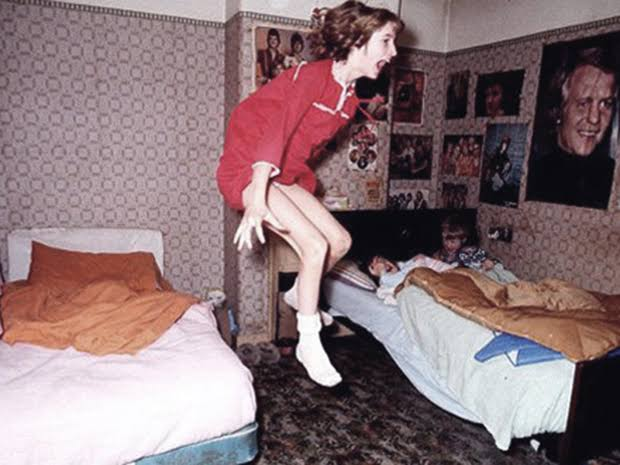
Investigated over 14 months by Maurice Grosse and Guy Lyon Playfair of the SPR, the case yielded over 200 hours of audio recordings and thousands of field observations. Phenomena included heavy metal fireplaces ripped from brick walls, pools of standing water appearing on dry floors, toys flying across bedrooms at high velocity, and Janet herself being thrown violently from her bed.
Most unsettling was the manifestation of a low-frequency, rasping male voice projecting from Janet’s vocal cords, claiming to be the spirit of a former occupant named Bill Wilkins who had died of a brain hemorrhage in the room years prior. While skeptics captured instances of the children playing pranks to test investigators, visiting police officers, press photographers, and structural engineers confirmed witnessing severe physical displacements that defied conventional mechanical explanation.
5. The Three Competing Theories of Causation
The question of what fuels a poltergeist remains fiercely contested. Modern discourse divides into three primary explanatory models: the parapsychological human-agent theory, the traditional spiritual hypothesis, and the skeptical environmental/psychological framework.
                  THE POLTERGEIST CAUSATION SPECTRUM

  INTERNAL AGENT              EXTERNAL SPIRIT              PHYSICAL/SKEPTICAL
┌──────────────────────┐   ┌──────────────────────┐   ┌──────────────────────┐
│         RSPK         │   │  Discarnate Entity   │   │  Infrasound / Strain │
│ Recurrent Spontaneous│   │ Autonomous spirits,  │   │ Misinterpretation,   │
│    Psychokinesis     │   │ demons, or residual  │   │ neurological stress, │
│  (William G. Roll)   │   │ human consciousness  │   │ or deliberate fraud  │
└──────────────────────┘   └──────────────────────┘   └──────────────────────┘
Theory 1: Recurrent Spontaneous Psychokinesis (RSPK)
First formalized by researcher William G. Roll in the 1960s, the RSPK hypothesis is the prevailing model within academic parapsychology. Roll analyzed hundreds of historical cases and identified a startling correlation: over 80% of verified poltergeist outbreaks cluster around a living human focal agent who is undergoing acute psychological, emotional, or physiological turmoil.
Most frequently, this focal agent is an adolescent undergoing puberty, a repressed individual trapped in an abusive domestic environment, or a person suffering from severe neurological instability such as temporal lobe epilepsy. According to the RSPK model, the focal agent unconsciously externalizes their repressed emotional energy—rage, anxiety, grief, or frustration—converting psychological distress into raw kinetic force.
The individual acts as a subconscious battery, broadcasting psycho-kinetic energy into their immediate environment. When the emotional crisis resolves, or the individual matures and develops healthy psychological coping mechanisms, the RSPK activity abruptly ceases.
Theory 2: The Discarnate Entity Hypothesis
Spiritualists, demonologists, and traditional paranormal researchers reject the purely internal RSPK model, arguing that certain outbreaks exhibit a degree of external intelligence, strategic planning, and historical memory that cannot be generated by a living human subconscious.
Under this hypothesis, poltergeists are discarnate entities—either earthbound human spirits harboring deep resentment, or non-human entities drawn to the chaotic emotional energy of the household. Proponents suggest that living humans experiencing turmoil do not create the kinetic force, but rather generate an intense emotional “beacon” or atmospheric charge that external, opportunistic spirits co-opt to interact with the physical plane.
Theory 3: The Environmental and Skeptical Consensus
Mainstream science, psychology, and skepticism dismiss both psychokinetic and supernatural explanations, proposing that poltergeist outbreaks are complex sociologies constructed from environmental anomalies, psychological distress, and physical misinterpretation.
Infrasound and Tectonic Strain
Skeptical researchers point to infrasound—low-frequency acoustic waves below the threshold of human hearing (under 20 Hz)—generated by faulty HVAC systems, industrial machinery, or local geological seismic strain. Infrasound frequencies around 18.9 Hz have been laboratory-proven to resonate with the human eyeball, inducing optical visual hallucinations, peripheral shadow figures, feelings of intense dread, and vibrations that can rattle glassware and picture frames.
Electromagnetic Hypersensitivity and Neurobiology
High-voltage power lines, ungrounded household wiring, and localized geomagnetic anomalies can generate intense electromagnetic fields (EMFs). Neurological studies demonstrate that exposing the human temporal lobes to complex, fluctuating EMFs can trigger profound hallucinations, feelings of an unseen presence, and severe sensory disorientation.
Psychological Dynamics and Fraud
Many cases, when subjected to rigorous scientific scrutiny, dissolve into mundane explanations. Sleep paralysis explains reports of nocturnal suffocation and chest pressure. Furthermore, severe family dysfunction frequently breeds deliberate hoaxes; frustrated children or neglected teens often throw objects, manipulate wiring, or knock on walls when unseen to garner attention, exert control over oppressive households, or distract parents from deeper domestic crises. Once an anomalous narrative is established, confirmation bias takes hold: occupants begin attributing every creaking floorboard, misplaced house key, and burnt bulb to the “ghost.”
6. The Poltergeist Lifecycle: From Onset to Dissolution
Regardless of the underlying causal mechanism, well-documented poltergeist outbreaks adhere to an astonishingly consistent structural lifecycle. Understanding these progressive phases allows investigators to differentiate between environmental noise and escalating kinetic events.
Intensity
   ▲
   │                           ┌───────────────┐
   │                           │    Stage 3    │
   │                           │ Peak Kinetic  │
   │                           │  & Physical   │
   │          ┌───────────────┐└───────┬───────┘
   │          │    Stage 2    │        │
   │          │  Escalation   │        │          ┌───────────────┐
   │          │  & Acoustic   │        │          │    Stage 4    │
   │          └───────┬───────┘        │          │  Dissolution  │
   │   Stage 1        │                │          └───────┬───────┘
   │ Subtle Onset     │                │                  │
───┴───────┬──────────┴────────────────┴──────────────────┴──────────► Time
Stage 1: The Subtle Onset
The outbreak begins ambiguously. Household items are misplaced; doors are found slightly ajar; subtle, unexplained drafts sweep through rooms; and household pets exhibit erratic fear, barking at empty corners or refusing to enter specific chambers. These events are almost always dismissed as forgetfulness or natural settling of the foundation.
Stage 2: The Escalation Phase
Auditory manifestations become pronounced and impossible to ignore. Rhythmic raps, heavy subterranean thumps, and the sounds of heavy furniture dragging across empty rooms above wake occupants in the night. Small items—utensils, coins, pebbles, and small electronics—begin moving while occupants are looking away, or are flung across rooms with startling velocity.
Stage 3: Peak Intensity
The outbreak reaches absolute volatility. Macro-kinetic telekinesis occurs in full view of witnesses. Heavy furniture overturns, structural glass shatters without impact, electrical circuitry short-circuits, and direct physical infringement—hair-pulling, shoves, and unexplained marks upon the focal agent—manifests. Apports materialize, and the home environment feels thick with static electricity and palpable, suffocating dread.
Stage 4: Abrupt Dissolution
Without warning or clear external intervention, the energetic climax breaks. The kinetic outbursts rapidly drop in frequency and severity over days or weeks, eventually ceasing entirely. Whether resolved by psychological intervention, the departure of the focal agent, home repairs, or the natural burnout of stored energetic reserves, the dwelling returns to complete, permanent stillness.
7. Cultural Impact: The Poltergeist in Modern Narrative
The poltergeist occupies a uniquely terrifying space in modern folklore and popular culture because it violates the ultimate sanctuary: the domestic home. While classic gothic horror relied on distant, ruined castles and isolated cemeteries, the poltergeist brings absolute supernatural chaos into suburban living rooms, bedrooms, and kitchens.
This cultural shift was cemented by Tobe Hooper and Steven Spielberg’s iconic 1982 cinema classic, Poltergeist. The film transformed the phenomenon into modern mythology, replacing Victorian séances with flickering cathode-ray television sets and suburban housing tracts constructed over forgotten burial grounds. It codified the modern cinematic trope of the noisy ghost: dynamic, aggressive, and visually spectacular.
In the decades since, modern horror cinema—from The Conjuring 2 (a dramatic dramatization of the Enfield case) to the Paranormal Activity franchise—has leaned heavily into the poltergeist aesthetic. These narratives tap into a universal psychological dread: the realization that the structural walls built to protect us from the outside world offer zero defense against an intruder that can manipulate the very fabric of physical reality from within.
8. Conclusion: The Enduring Enigma
What is a poltergeist? Ultimately, the phenomenon remains a mirror reflecting the boundaries of human understanding.
To the strict materialist, the poltergeist is a fascinating case study in sociological contagion, environmental acoustics, neurobiology, and human fallibility—a testament to how easily the stressed human mind can construct terrifying patterns out of mundane noise and deception.
To the parapsychologist, it is empirical evidence of Recurrent Spontaneous Psychokinesis: a breathtaking demonstration that the human consciousness, under extraordinary emotional stress, possesses the latent capacity to alter gravitational and physical laws without mechanical intervention.
And to the spiritualist, it remains exactly what Pliny the Younger described two millennia ago: a raucous, disruptive intruder from an unseen dimension, rattling the cage of physical existence to announce its presence.
Whether born from the tectonic shifting of the earth, the tragic unspooling of a distressed adolescent mind, or entities dwelling beyond the veil, the poltergeist commands our respect. It strips away our comforting assumptions of physical stability, reminding us that inside the quietest homes, the architecture of reality is sometimes fragile enough to shatter.
Further Reading & External Resources
Ultimately, what is a poltergeist remains compelling because the documented evidence answers some questions while leaving others open to careful investigation.